
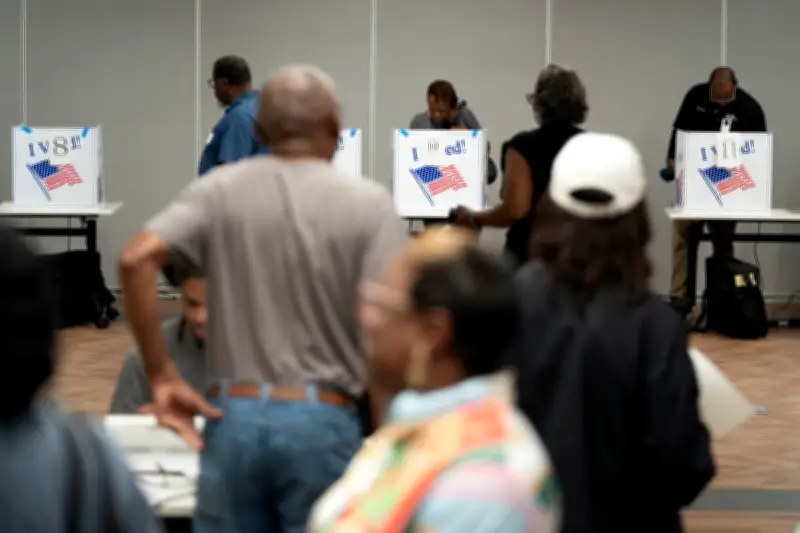
A new analysis of Black voters in the South indicates that Republican attempts to dilute their political power are driving them to the polls in larger numbers and shifting their counties further left.
Supreme Court ruling triggers redistricting
After the Supreme Court effectively gutted Section 2 of the Voting Rights Act protections in late April, Republican legislatures across the South rapidly pushed to disenfranchise Black voters by redrawing congressional maps. Louisiana, Florida, Tennessee, and Alabama all immediately worked to pass new maps, while the Mississippi governor has said he wants legislators to redraw maps before the upcoming midterm elections.
VoteHub analysis shows increased turnout
The analysis by VoteHub, a data-focused election organization, indicates that the efforts have only motivated Black voters in the 78 Black Belt counties it tracked. All but one shifted left in partisan turnout compared with 2024. Further, majority-Black counties that voted after Louisiana v. Callais, the landmark Supreme Court decision that triggered the Republican-led redistricting efforts, had a surge in voter participation.
Primaries show clear trend
The trend was clear earlier this year when Louisiana, South Carolina, Alabama, and Georgia held primaries after the Supreme Court ruling. Louisiana, from which the Callais decision stemmed, disregarded votes that had already been cast until the state was able to redraw congressional maps, while nearby Alabama quickly split its majority-Black districts. South Carolina and Georgia moved to dilute Black political power in the state by redrawing maps, though neither state ultimately did so.
Alabama sees strongest shift
Alabama produced one of the strongest shifts of all, with one of the largest positive turnout differentials and a significant partisan turnout that indicates increased Black voter mobilization in states with substantial Republican redistricting efforts. Alabama's Greene County surpassed 50% turnout in the primary election, a positive turnout differential of 27.6 percentage points. Bullock, Lowndes, Macon, and Montgomery counties, all of which are in Alabama's second congressional district that was targeted by Republican legislators, also experienced significant turnout. Bullock County, which is more than 70% Black, had the third-largest turnout in the state.
Louisiana sees Black voter surge
In nearby Louisiana, Black voters made up 35.7% of the primary electorate, despite making up only 32.1% of the population. The state experienced increased voter turnout across partisan groups and race, but 30.9% of Black voters cast ballots in the primary election – 3.2 points more than white voters.
Contrast with pre-ruling states
In contrast, Mississippi and North Carolina held their primaries before the Callais decision. In those states, turnout in majority-Black counties only outpaced statewide averages by 1.1 points on average.




