
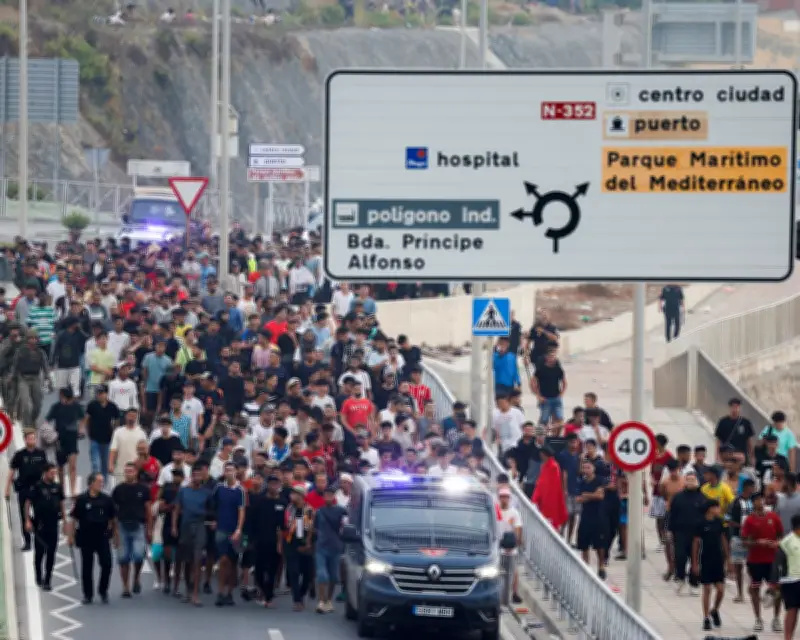
The European Union will convene an urgent meeting of interior ministers on Tuesday to address the escalating crisis in Ceuta, where more than 50,000 migrants crossed into the Spanish territory, resulting in at least 67 deaths. The decision, reached unanimously by EU member state officials and Frontex experts during a "sobering" meeting on Saturday, underscores deep divisions within the bloc over how to manage external border pressures.
Spain Confirms Deaths and Deploys Floating Barrier
Spain reported that at least 67 people perished during the attempted crossings, with some drowning and others crushed while navigating a breakwater barrier. By Saturday morning, migrant crossings had halted as Spanish police began installing a 500-metre floating barrier off the coast near the Moroccan border. The Spanish government stated that the situation in Ceuta remained calm, with containment measures, including an inflatable barrier and anchored buoys, being deployed at Tarajal beach.
The influx, which began earlier this week, has triggered a political crisis for Madrid. Spain's prime minister, Pedro Sánchez, has faced criticism from some EU partners, notably Italy and Denmark, who argue that Spain's policies encouraged the surge. Sánchez, in a pointed letter to European Commission President Ursula von der Leyen, European Council President António Costa, and Irish Prime Minister Micheál Martin, hit out at "fake news" and "disinformation," emphasizing that "virtually all" migrants had been returned to Morocco after army intervention on Friday.
EU Divisions and Schengen Suspension Threats
Italy announced on Friday evening that it would suspend its Schengen arrangements with Spain for a month, despite Ceuta and Melilla being subject to special Schengen rules that prevent onward movement. Italy's foreign minister, Antonio Tajani, blamed Sánchez's now-closed scheme to regularise over 1 million undocumented migrants, calling it "profoundly wrong" and an incentive for human trafficking.
However, France's interior minister, Laurent Nuñez, stated that France would not seek Spain's suspension from Schengen, saying, "It's absolutely not on the table. We have great cooperation with Spain." The EU's political crisis response team, convened by Ireland's presidency, met on Saturday, and Irish Prime Minister Micheál Martin announced that Tuesday's Justice and Home Affairs Council meeting would be chaired by Justice Minister Jim O'Callaghan, who has expressed solidarity with Spain's interior minister.
Spain's Defense and Accusations of Hypocrisy
Sánchez's letter also rebuked Italy, noting that Spain, according to Frontex, has "one of the least porous external borders of the European Union, with a number of irregular entries that is half that recorded, for example, in Italy in recent years (2021–26)." He argued that attacks on Spain were "contrary to European law, humanitarian law and the principles of solidarity that bind us together."
There is frustration in Spain that previous incidents of similar scale, such as migrants massing on Poland's border with Belarus, were labelled as "hybrid attacks" and met with solidarity. The EU meeting also discussed suspected Russian disinformation efforts aimed at sowing dissent within the bloc.
Ceuta's President Calls for Continued Security
Juan Jesús Vivas, president of Ceuta, said that while many had returned to Morocco, not all had left. "We're not back to normal because there are several thousand people who need to be returned, and there is still an atmosphere marked by unease and concern," he said, calling for all security measures to remain in place to guarantee safety.
By Saturday morning, many of the remaining migrants returned to Morocco under a reinforced Spanish police and military presence. Souleil Boyan, a 19-year-old from Senegal, told Agence France-Presse outside a migrant centre in Ceuta, "We hope to go to Europe to work and earn a living – that's it. We all know that in Africa there isn't much opportunity."
Historical Context and Alleged Causes
This week's crossing dwarfs the last similar event in May 2021, when Morocco loosened border controls, allowing about 10,000 people to enter over two days. That incident followed tensions over Spain's decision to allow the leader of the Western Sahara independence movement, the Polisario Front, to be treated for Covid-19 in Spain. The diplomatic crisis ended in 2022 when Madrid backed Morocco's plan for Western Sahara, causing a rift with Algeria.
Sánchez visited Algiers on 20 July, marking a thaw in relations. The Spanish government attributes the latest influx to "human-trafficking mafias" exploiting a supreme court ruling that barred summary returns of those intercepted at sea. However, migration experts express doubts. Mauricio Valiente, director general of the Spanish Refugee Aid Commission, told elDiario.es, "Unlike what happens in the Canary Islands, these aren't people who have to get into a small boat. This is a matter of being just metres from a land border, jumping into the sea and trying to get around a breakwater, which makes it much easier to do, even with all the risks." He added that there had been a steady increase in arrivals this year, and simplifying the causes to the court ruling or organised crime is "completely unfounded."




