
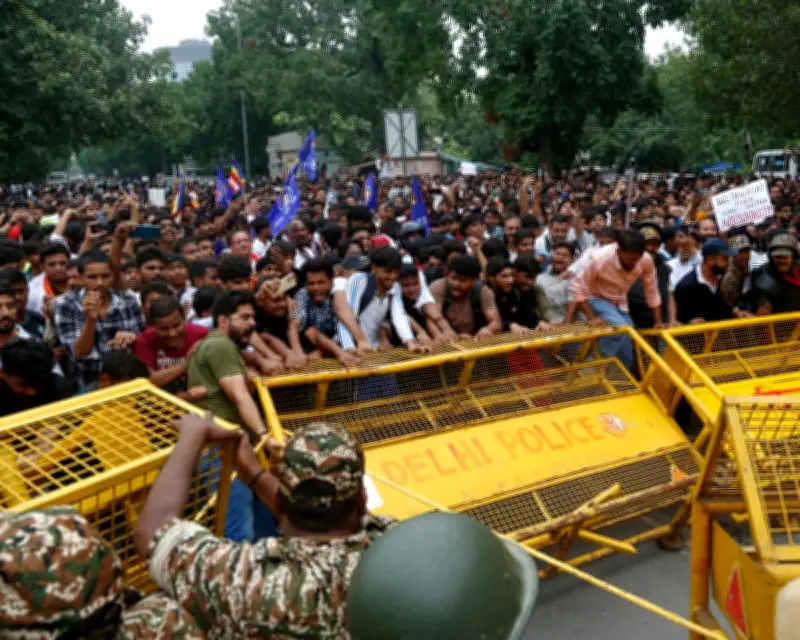
Tens of thousands of protesters defied police orders and descended on Delhi on Monday to demand the resignation of India's education minister in one of the largest anti-government demonstrations in years. The protest, led by the youth-oriented Cockroach Janta Party (CJP), saw huge crowds of students and Gen Z-ers filling the streets from early morning, shouting anti-government slogans. Hundreds had camped out overnight.
Police crackdown fails to deter protesters
Delhi police, under central government control, denied permission for the march and imposed a ban on public gatherings. Roads were barricaded and internet services were shut down in the city center. Attempts by protesters to move toward parliament were met with police brutality, including baton charges and teargas. Despite this, thousands turned out, expressing anger at Prime Minister Narendra Modi's government and the ruling Bharatiya Janata Party (BJP), accusing them of failing the country's youth.
“They are calling this protest illegal, they are calling us anti-national,” said 22-year-old protester Rhythm Katoch. “But I am standing here to fight for our education system, for the rights of the young people and for our democracy. Is it too much to ask for the government to listen to us?”
Cockroach Janta Party: From satire to serious political challenge
The CJP was inspired by remarks made in May by India's Chief Justice Surya Kant, who called some activists and unemployed youth “cockroaches.” Founded by graduate Abhijeet Dipke in May as a satirical movement, it quickly mobilized into a serious political challenge to the Modi government. The core demand is the resignation of Education Minister Dharmendra Pradhan over exam chaos, after this year's medical entrance exam—where over 2 million students compete for just 130,000 places—was leaked, forcing it to be scrapped and students to retake the grueling tests. The fiasco has been linked to more than 20 suicides. Wider frustrations over alleged failures in the education system and lack of job opportunities have also fueled support.
Protesters voice anger and determination
Rage was palpable on Delhi's streets. Harion Sharma, 18, was among those forced to retake the medical exam after the leak, which he said put “unbearable” pressure on him and fellow students. “This is a government that does not care about education, it does not care about the pressures and pain of young people. Because of those leaks, students have died. So we are here to call for accountability and for the education minister to resign. We are young but we are powerful.” Sharma described the high turnout as historic. “They might be trying to crush our futures and our democracy, but look around, how young people have come to the streets in such massive numbers. Now, finally, the government is scared of us.”
Opposition condemns police force; government invites talks
The use of police force was condemned by opposition politicians. Congress party leader Priyanka Gandhi said outside parliament: “There are massive issues… but you are firing teargas at children and beating them up? For what?” For weeks, the government had ignored CJP supporters camped near parliament. Pradhan dismissed calls for his resignation, labeling protesters “terrorists.” However, after Monday's huge turnout, the Modi government invited CJP spokespeople for talks. CJP spokesperson Saurav Das said they waited two hours and met briefly with cabinet minister JP Nadda, but no commitments were made.
Hunger strike galvanizes movement
The protest was galvanized by a hunger strike by renowned engineer and education activist Sonam Wangchuk, who has refused all food and water for 21 days in solidarity with students, demanding Pradhan's resignation. Nationwide outrage grew after Delhi police forcibly removed Wangchuk from the protest site early Sunday, with footage going viral. Wangchuk was taken to a government hospital, where he claimed he was “held hostage.” His wife, Gitanjali Angmo, condemned the heavy police presence, calling it “illegal detention.” In response, CJP organizers began a hunger strike and called for Monday's march, which Wangchuk said would be “India's second freedom movement.”
Gen Z protesters speak out
Amrita, 27, took a day off work to join, calling the government's treatment of Wangchuk “shameless.” “We have a coward government who is afraid of the young people and afraid of Sonam Wangchuk. He is a brilliant brain and he has put his life on the line for young people. How he is being treated is a shame on India. That's why the Gen Zs have come out today to speak out.”
No resignation yet; protest continues
By Monday evening, Pradhan had not responded to resignation calls. CJP organizers said they would remain at the protest site. In a handwritten note from hospital, Wangchuk said: “Seeing the brutality with which peacefully protesting youth are being dealt with, I have decided to continue my fast.”




