
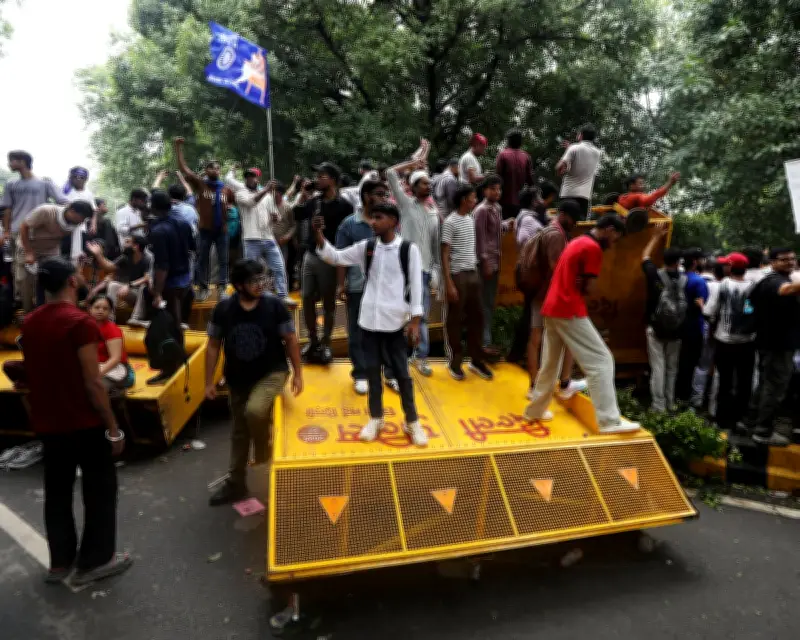
On Monday, tens of thousands of supporters of the Cockroach Janta party (CJP) attempted to march toward parliament in New Delhi, India, in one of the largest anti-government protests in recent years. The demonstration, fueled by anger over education system failures and youth unemployment, saw police respond with baton charges and tear gas, leaving protesters and officers injured.
Origins of the Cockroach Janta party
The CJP began as an online joke in May, founded by 30-year-old Abhijeet Dipke, a recent US university graduate. Outraged by comments from India's chief justice comparing unemployed youth to "parasites" and "cockroaches," Dipke posted a satirical call on social media: "What if all cockroaches came together?" The response was overwhelming. Within two weeks, the CJP's Instagram page amassed over 22 million followers, surpassing the ruling Bharatiya Janata party (BJP). The Modi government attempted to block the accounts on national security grounds but failed.
Key causes and grievances
The CJP focused on medical entrance exam leaks, which have repeatedly been sold to the highest bidder. Over 2 million students compete for just 130,000 places, driving families into debt for private coaching. A string of leaks has forced millions into retakes and been linked to dozens of suicides. The CJP demanded the resignation of Education Minister Dharmendra Pradhan, accusing the government of failing to take responsibility. Broader frustrations include an education system in crisis and a job market where nearly 40% of graduates under 25 are unemployed, according to a recent study.
Escalation of protests
The CJP's first offline protest occurred in early June in Delhi. Later that month, supporters held a second major protest, vowing to stay until Pradhan resigned. They were joined by engineer and education activist Sonam Wangchuk, who began a Gandhian hunger strike. As Wangchuk's condition worsened over 20 days, the Delhi court ordered daily health monitoring. On Sunday morning, police forcibly removed Wangchuk to a government hospital, sparking national outrage. His wife condemned it as "illegal detention." From his hospital bed, Wangchuk called for a march to parliament on Monday.
Monday's massive protest
By early Monday, thousands of protesters, mostly students and young people, gathered in central Delhi. Parents affected by exam leaks were also present in high numbers. Police denied permission to march on parliament, blockading roads and shutting down the internet. Protesters were kettled into a designated site about a mile away. Despite this, over 20,000 people gathered by early afternoon. As crowds pushed toward parliament, police used baton charges and tear gas. Dipke condemned the response as "absolutely brutal."
Government response and next steps
After weeks of ignoring the movement, the Modi government offered a meeting on Monday morning. In a brief 10-minute interaction, three CJP demands were put forward but "no commitments were made," according to a CJP spokesperson. Education Minister Pradhan made no public response. By late Monday, as police tried to clear the protest camp, Dipke emphasized that the peaceful protest would continue until Pradhan resigned.




