
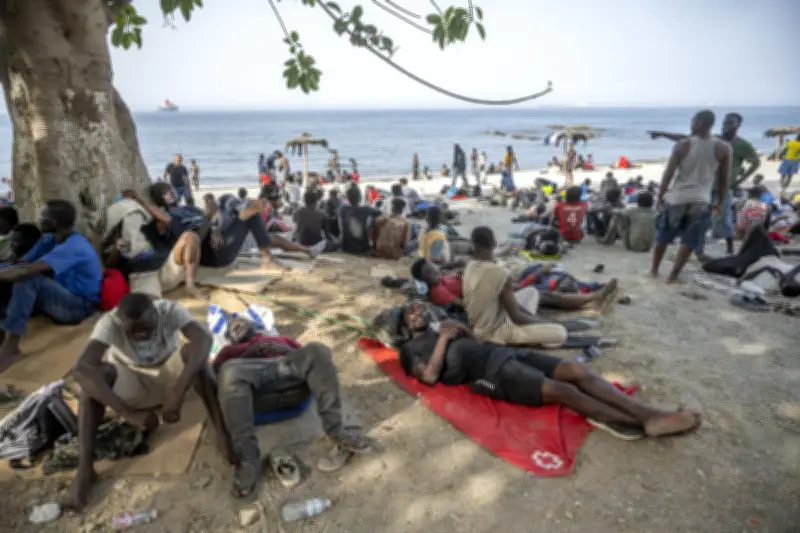
Four days after a mass border crossing that saw more than 50,000 people enter the Spanish enclave of Ceuta, the city is struggling to return to normal. While over 48,000 have already been returned to Morocco, hundreds remain, sleeping in parks, squares, and pavements, waiting for a chance to move on or simply rest. The influx, described by Spain's prime minister, Pedro Sánchez, as "a violation of Spain's territorial integrity," has left many in a state of limbo, unable to proceed to mainland Spain and unwilling to return.
One man's journey: Youssef El Abbas
Youssef El Abbas, a 44-year-old Moroccan father of four, saw an opportunity to reclaim the life he lost seven years ago. Deported from Spain in 2019 after his residency expired following job loss in Bilbao, he had been living apart from his wife and daughters, who remain in Spain. When news spread that the border was open, he took a taxi to Tétouan, where he found the city overwhelmed. "Young men were running through the streets, flooding every corner," he said. Reaching Fnideq, he found the usual blockades removed, and Moroccan police urging people to run into Spain.
El Abbas crossed at 2.45pm on Wednesday, after a short swim, but not everyone was lucky. "In just 10 minutes in the water, I saw four people floating dead in Moroccan waters," he said. At least 72 people drowned or were crushed in the attempt. His return has been bittersweet; after being helped ashore by a Guardia Civil officer, he was later beaten by a military patrol. "The same hand that helped me out of the water was the one that later hit me," he recounted.
Who is responsible? Spain blames mafias, Morocco cries foul
Madrid attributes the influx to "human-trafficking mafias" exploiting a recent Supreme Court ruling that prevents summary returns of those intercepted at sea. However, speculation suggests Morocco may have opened the border to express displeasure at Sánchez's visit to Algeria, which supports Western Sahara independence. Morocco's ambassador, Karima Benyaich Millán, said Rabat was not happy about the mass crossing, and government sources blamed "criminal organisations," insisting cooperation with Spain remained "exemplary." This echoes a similar incident in May 2021, when border controls were loosened during a diplomatic standoff, allowing 10,000 to cross in two days.
Teenagers and the unaccompanied minors crisis
Said, a 17-year-old from Casablanca, sits on a kerb with only a bottle of water and a carton of yoghurt given by a local. He was taken to a centre for unaccompanied minors but no places were available, so he ended up back on the streets. A soldier, speaking anonymously, said the current protocol is to treat unaccompanied minors as regular migrants and return them to Morocco. Said and his peers say no one will sell them food or allow them into shops because they don't speak Spanish. His goal is simple: get a place in a protection centre, learn Spanish, and find work as a barber. "All I need," he said, "is a chance."
Local solidarity and far-right exploitation
Ceuta's residents have shown solidarity, handing out water, sandwiches, blankets, and clothes. However, the arrival of far-right politicians and a neo-Nazi group threatens this. Local woman Malika, born in Ceuta, said, "They're going to exploit our feelings to claim the credit and say they defended Ceuta. We don't want them here." Fatima Hamed Hossain, a member of Ceuta's assembly, fears the crisis has deepened divisions: "Everything we've lived through has created tensions between neighbours. That's exactly what feeds the far right." The city of just over 80,000 people is under immense pressure, as Malika acknowledged: "It would have been an impossible situation for any city."
The road ahead
As the caravan of people returns over the border, Ceuta slowly recovers. Cafe terraces are filling again, and businesses are reopening. But for the remaining migrants, the future is uncertain. Leaving is not on Said's agenda, but without legal documentation, his plans may collapse before they begin. The crisis has highlighted the ongoing tensions between Spain and Morocco over border controls, migration policies, and territorial disputes, leaving many in a state of limbo.




