
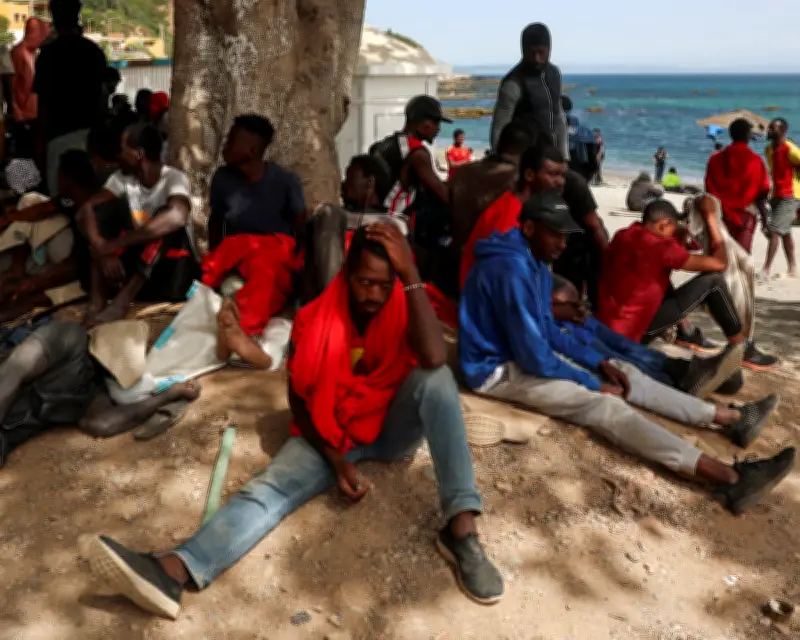
The president of the Spanish enclave of Ceuta has called on the national government to reopen the border with Morocco, arguing that the current closure is causing significant economic and social harm. The border, which has been partially closed since March 2020 due to the COVID-19 pandemic, has become a major point of contention in bilateral relations.
Economic Impact of Border Closure
The closure has severely affected local businesses, which rely heavily on cross-border trade and the thousands of Moroccan shoppers and workers who used to cross daily. According to the Ceuta Chamber of Commerce, the local economy has lost an estimated €1.5 million per day in potential revenue since the restrictions began. This has led to a surge in unemployment and business closures in the enclave.
Juan Vivas, the president of Ceuta, stated, "The reopening of the border is essential for the future of Ceuta. We cannot continue to suffer economically and socially due to a situation that has no justification in the current health context." Vivas made these remarks during a press conference in which he presented a report detailing the negative consequences of the prolonged closure.
Social and Humanitarian Concerns
Beyond the economic impact, the border closure has also created humanitarian issues. Many families are separated, with members on both sides of the border unable to visit each other. Additionally, there have been reports of increased illegal migration attempts, as the closure has pushed people to risk dangerous sea crossings or climbing the border fence.
The Spanish government has so far been cautious, citing the need to maintain security and control over migrant flows. However, recent diplomatic talks between Madrid and Rabat have raised hopes that a phased reopening could be agreed upon in the coming months. "We are open to dialogue," said a spokesperson for the Spanish Foreign Ministry, "but any decision must be based on mutual benefit and security considerations."
Historical Context and Political Tensions
The border between Ceuta and Morocco has been a source of friction for decades, with periodic crises over migration and territorial claims. The current closure has been in place for over three years, making it the longest in recent history. In 2021, a mass crossing attempt by thousands of migrants led to a temporary diplomatic crisis, with Spain accusing Morocco of not doing enough to prevent the influx.
Analysts suggest that Morocco's cooperation is crucial for Spain to manage migration effectively, and that reopening the border could be part of a broader agreement on migration and economic cooperation. "The border closure is not sustainable in the long term," said Elena Sánchez, a political analyst at the University of Madrid. "Both countries need to find a balance between security and the free movement of people and goods."
Future Prospects
Local leaders in Ceuta are pushing for a pilot scheme that would allow limited crossings for specific groups, such as workers and students, as a first step. They argue that this would help revive the local economy while still maintaining control. "We are ready to work with the central government to implement a safe and orderly reopening," Vivas added.
The issue is likely to be discussed in upcoming bilateral meetings, and the Spanish government has indicated that it is considering various options. However, no timeline has been set, and the situation remains fluid. For now, the people of Ceuta continue to wait, hoping that a solution will be found to restore the normal life and economic vitality of their city.




