
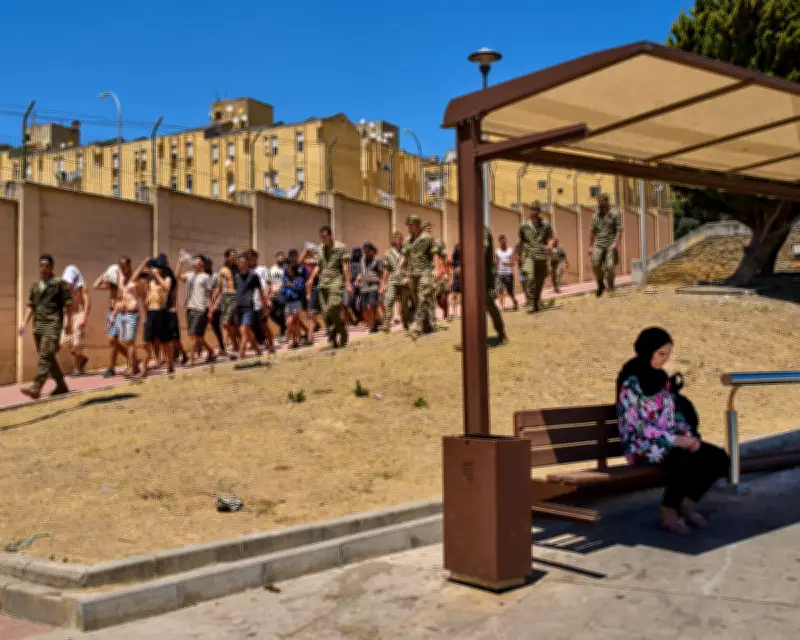
At least 72 people are believed to have died late last week, most of them drowned or crushed as they joined tens of thousands of others in attempting to swim from Moroccan waters to the Spanish exclave of Ceuta. Yet the scale of that human tragedy has barely registered, as Donald Trump has decried an “invasion” while European politicians exploit the crisis to serve their own agendas. If further evidence were needed of the way that the radical right increasingly distorts the terms of the migration debate in the EU, the last few days have furnished it.
What happened in Ceuta
The mass crossing began on Friday, with an estimated 60,000 people entering Ceuta from Morocco, according to Spanish authorities. Many swam or used makeshift rafts, while others climbed over the border fence. The Spanish government, distracted by ongoing wildfires, was utterly unprepared for the influx. The vast majority of those who crossed returned voluntarily across the border within 48 hours, but at least 72 people lost their lives, with the death toll expected to rise as search operations continue.
Misinformation on social media appears to have played a big part, following a Spanish supreme court ruling that migrants arriving by sea could not be summarily turned back. Moroccan authorities seemingly did little to prevent the chaotic exodus, which echoed previous smaller incidents and focused international attention on a territory whose sovereignty Rabat contests. If there were online indications that such an incursion was a possibility, no alarm was sounded.
Far-right exploitation
The response of leaders such as Italy’s Giorgia Meloni has been predictable but deeply dispiriting. In a performative overreaction, Ms Meloni sought to demonstrate her hard line on irregular migration by temporarily suspending Rome’s Schengen agreement with Madrid, though Ceuta has never been included in Schengen, and Italy and Spain share no border. Along with Germany’s chancellor, Friedrich Merz, she was also among 22 signatories to a letter sent to the European Commission, suggesting that the liberal migration policies of the Spanish prime minister, Pedro Sánchez – which, again, have no application in Ceuta – are undermining Europe’s security.
Such posturing is largely intended for a domestic audience. Mr Merz, for example, faces a major challenge from the far-right Alternative für Deutschland (AfD) in three imminent state elections, while Ms Meloni is dealing with the emergence of a new party that threatens her own right flank. The zeal of such forces to weaponise the immigration issue was shown by the speed with which the AfD’s leader, Alice Weidel, claimed that the “likely destination” for most of those entering Ceuta was Germany.
Impact on EU solidarity
Hyperbolic rhetoric and finger-pointing will only undermine solidarity between European nations, and hamper attempts to deal effectively with the challenges of migration. It is impossible to cross from Ceuta into mainland Spain and the Schengen zone without passing through a checkpoint. It is also worth noting that the number of irregular border crossings into Europe in fact declined by 40% in the first half of 2026 compared with last year, partly as a result of better-coordinated preventive strategies.
Instead of rounding on Mr Sánchez, mainstream European leaders should be pledging their cooperation in helping Spain to minimise the possibility of such a tragic incident ever happening again. The EU must show solidarity with its member states on the front line, rather than allowing the far right to dictate the narrative.




