
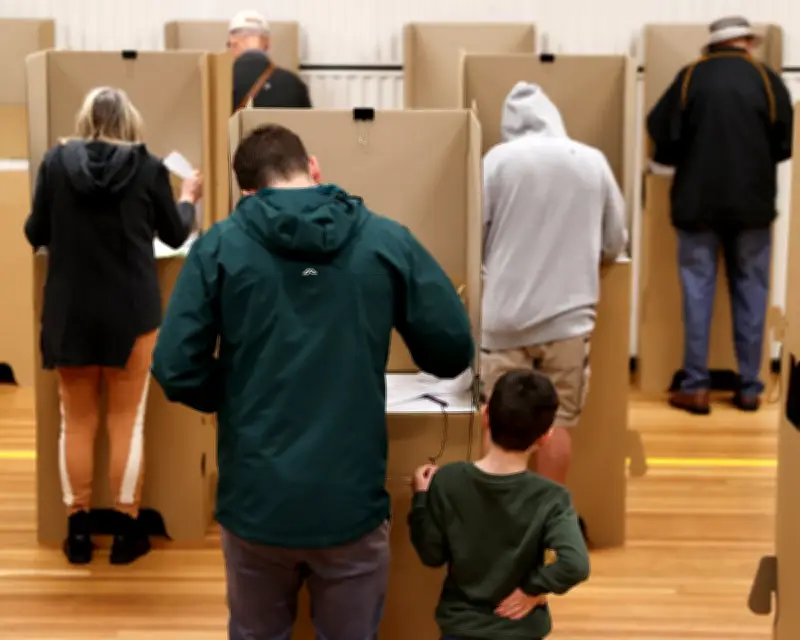
In a provocative new book extract, political commentator Bernard Keane argues that Australia's electoral system should be reformed to give younger voters more power, countering the current overrepresentation of older Australians in politics, the economy, and media. Keane, who is nearing 60, suggests that his generation has 'been very good at tilting the policy playing field in our favour,' and it's time to stack the deck in favor of young people.
A Radical Proposal: Age-Weighted Votes
Keane's preferred method is to weight votes according to age: voters under 30 would receive a more heavily weighted vote (multiplied by 1.3), voters 30 to 60 would get a moderate weighting (1.1), and those over 60 would retain their current single vote. To make counting easier, ballot papers could be color-coded: blue for under-30s, green for 30-60s, and red for seniors.
The justification is simple justice: policy decisions affect younger voters for far longer than older voters, who will be alive for a much shorter period. The classic example is the climate crisis, where younger voters will disproportionately bear the costs of climate change compared with older voters, who will die in the next 20 years and are less likely to care about it.
Addressing Objections
Some argue that younger voters, by being alive longer, will have more opportunities to change decisions than older voters. But Keane counters that older voters have had such opportunities in the past, so the 'future opportunity' argument cancels itself out. Over time, the system would ensure generational justice: today's under-30s with 1.3 votes will become the stressed parents of midcentury with 1.1 votes, and eventually seniors with one lousy vote.
Keane acknowledges that many older voters are motivated by the fate of younger people and bring valuable life experience, but argues that individual qualities are irrelevant to the central argument: exposure to outcomes should dictate the voter's role in shaping the process.
Democratic Justifications
Keane cites a 2023 paper by Danish political scientists Andreas Bengtson and Andreas Albertsen, which explores grounds for weighted voting. On the 'all-affected' principle, those affected by a decision should have the opportunity to shape it, and since younger people are affected for longer, they should have a greater opportunity. On the 'all-subjected' principle, younger voters are subject to decisions for longer, so they should have more say. Even under the 'relational egalitarian' argument, weighted voting is acceptable because people can be affected to different degrees.
Keane also notes that Australia already has a weighted voting system: the allocation of MPs and senators to states and territories has been weighted since 1901. For example, there is one senator for every 34,300 Tasmanian voters, compared with one for every 160,000 Canberrans and one for every 381,000 Victorians. This means a Victorian's Senate vote is worth less than one-tenth of a Tasmanian's, and a Canberran's about one-fifth.
An Aussie Precedent
The weighting based on where people live is traditionally justified by federalism, but Keane argues that once you accept overrepresentation on that basis, you must allow it on other rational grounds, such as age. The House of Representatives also shows disparities: it takes an average of 75,000 Tasmanians (or just 69,000 in the division of Clark in 2025) to elect each of the state's five MPs, while in New South Wales, it takes an average of 110,000 to 120,000 voters. In 2025, several Western Australian electorates had about 100,000 voters.
While population changes partly explain these differences, Keane stresses that Australia already has a highly weighted voting system based on something as trivial as where people live. A more rational system would give younger people slightly greater power, signaling that they are valued and trusted, and giving them greater control over the future they'll face without us.
This edited extract is from Seize the Moment: Australia's real opportunities in an unstable world by Bernard Keane, published by Allen & Unwin, RRP $39.99.




