
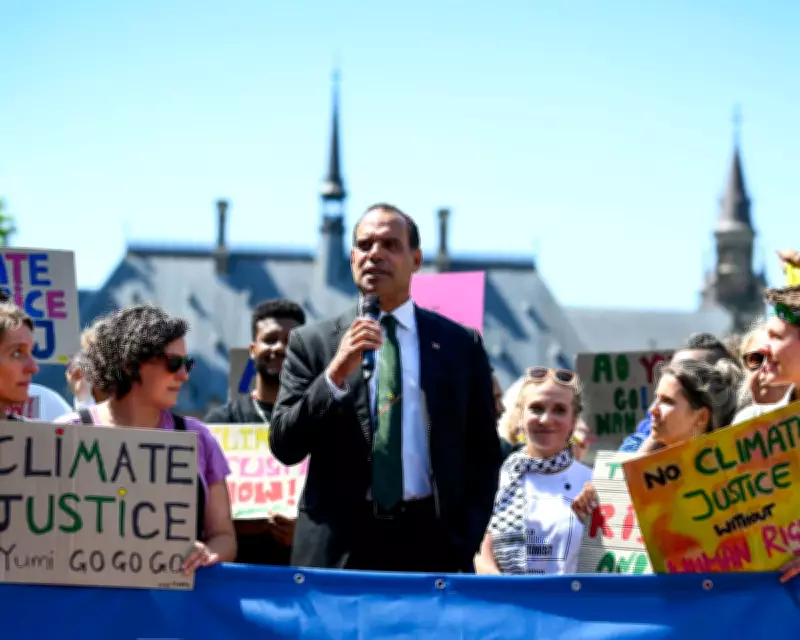
The United Nations General Assembly is set to vote next week on a pivotal resolution that would endorse the International Court of Justice's landmark advisory opinion on climate change. If passed, the resolution would compel governments to recognize their legal responsibility to reduce greenhouse gas emissions, including phasing out fossil fuels.
Background of the ICJ Advisory Opinion
The ICJ's advisory opinion, released last year after a series of hearings in The Hague, was requested by an unprecedented 132 states without opposition in 2023. It was hailed as a historic victory for small island nations, which are particularly vulnerable to the effects of climate change.
Vanuatu's Leadership Role
Vanuatu, a Pacific island nation, has been leading a coalition of states to draft a resolution that welcomes the opinion and seeks to implement it on the ground. Ahead of the May 20 vote, Vanuatu's climate change minister, Ralph Regenvanu, is seeking the broadest possible support, aiming to match or exceed the 132 co-sponsors of the original request.
Regenvanu described the initial resolution as "a collective act of multilateral confidence that law can help steer us through the climate crisis" and emphasized that the ICJ's unanimous decision provides legal clarity and a common reference point for UN members.
Changes to the Resolution Text
The final text of the resolution has undergone significant revisions since an initial draft in February. Notably, calls for a "rapid, just and quantified phase-out of fossil fuel production and use" were replaced with a more moderate urge to transition away from fossil fuels. Additionally, an original proposal to establish an international register of damage, loss, or injury was dropped entirely.
These changes were partly due to pressure from the United States, which lobbied to drop the resolution altogether. However, Vanuatu's climate justice envoy, Lee-Ann Sackett, who led the negotiations, said that many states raised concerns, and significant effort was made to keep the text both meaningful and unifying.
"Where delegations asked for reassurance we made it explicit," Sackett said. "Where delegations asked for restraint, we built in safeguards."
Key Provisions of the Final Text
The final text, published at the start of May, clearly states that the United Nations Framework Convention on Climate Change and the Paris Agreement are the primary international forums for negotiating a global response to climate change. Regenvanu stressed that the resolution does not adjudicate disputes, attribute responsibility to any particular state, create new obligations, or prejudice legal positions.
Despite these changes, Regenvanu insisted that the resolution is not merely a symbolic filing of the opinion. "It calls on all states to comply with their existing obligations as established by the court," he said, adding that it is intended to help member states think through how to implement these obligations.
Impact and Significance
The ICJ's advisory opinion is already being cited in climate litigation worldwide, with judges increasingly referencing it in their rulings. However, it has proven more challenging to use as a diplomatic tool. It failed to make a mark at last year's UNFCCC climate talks in Belem, where Saudi Arabia called its inclusion in final texts a "red, red line."
The opinion was more evident at the inaugural fossil fuel conference in Santa Marta, Colombia, where Regenvanu told state delegates that they were "frontrunners" in doing what is both legally and scientifically required. He noted that the ICJ's opinion considers international cooperation indispensable.
More broadly, the resolution is seen as a key test for the credibility of the international legal system. Sackett observed that state delegations that do not usually intervene on climate texts engaged closely because they recognize that this is about the authority of the court, the integrity of the UN system, and how legal clarification translates into multilateral cooperation.
Tania Romualdo, the permanent representative of Cape Verde to the UN representing the Alliance of Small Island States, emphasized that the importance of the resolution extends beyond the text itself. For small island developing states, she said, "this is about the affirmation and protection of our territories, sovereignty and fundamental rights of our populations. This process has not been easy. There have been many sacrifices along the way. These are not easy compromises but they reflect the reality of negotiation."




