
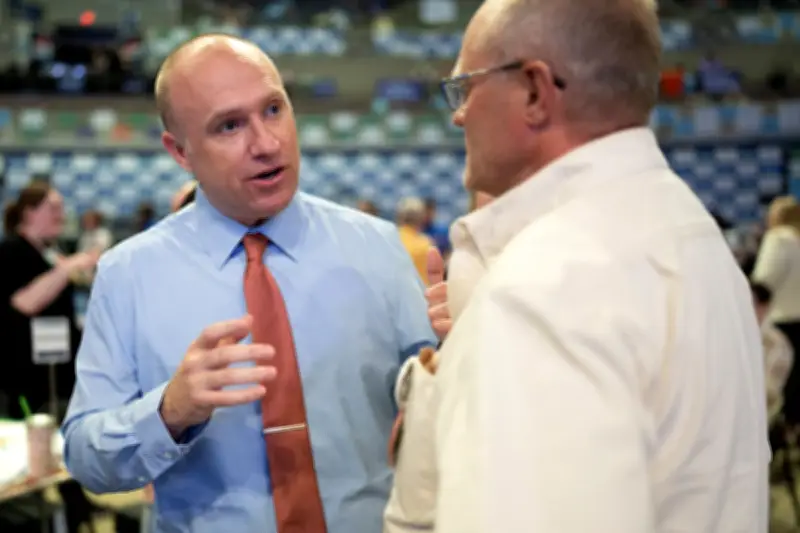
Jake Johnson, a high school math teacher from Stewartville, Minnesota, is running for Congress to reclaim the US House seat once held by Governor Tim Walz. Johnson, who grew up relying on food stamps and Medicaid, is emphasizing affordability and union advocacy as central themes in his campaign against incumbent Republican Brad Finstad.
Background and motivation
Johnson recalls his family's reliance on government assistance when he was a child. His father worked as a garbage collector, and his mother read meters for the local gas company. They depended on food stamps for groceries and Medicaid for healthcare. Pell grants and Stafford loans helped Johnson pay for college. “We were broke,” Johnson said. “I got to grow up living what I thought was an American dream, where you work hard and a lot of people invest in you.”
This upbringing motivated Johnson to run for the 1st Congressional District seat, which has not been held by a Democrat since 2018, when Tim Walz vacated it to run for governor. The district is one of 44 that Democrats consider “in play” in the 2026 midterms as the party seeks to regain a majority in Congress.
Union background and economic message
Johnson is a former member of the bargaining team and a government relations coordinator with Education Minnesota, the state's teachers' union. He has advocated for increased teacher benefits and fought to prevent school closures through union efforts. “To me, a lot of the great things that happen in public schools happen because of unions. We’re the ones fighting for smaller class sizes. We’re the ones fighting for reasonable wages,” Johnson said. “That’s happening because of teachers’ unions. We’re the ones that are raising the bar as far as teacher quality.”
Johnson criticizes Finstad for supporting policies that hurt the district, which is the ninth most agriculturally productive in the US. He highlights Trump-era tariffs that have surged prices and the Iran war that increased fertilizer costs. “A huge piece of affordability is ending the tariffs and rebuilding our export markets and lowering input costs for our farmers, small businesses and families,” Johnson said. “We’ve already got farmers who are planning ahead for the fall going, ‘I don’t know if I’m going to be able to get my fertilizer preordered for next season.’”
Healthcare and town hall criticism
Johnson also argues that healthcare cuts by the Trump administration—including reductions to Medicare, Medicaid, and research—have deeply affected the district, which is home to the Mayo Clinic. “Healthcare cuts have been particularly pronounced here. We have felt it acutely. We’ve had to close four clinics in our district alone,” he said.
Johnson criticized Finstad for refusing to hold in-person town halls, opting instead for virtual events. National Republicans have advised against in-person town halls amid protests at GOP events. “Finstad seems to have chosen his powerful political backers, his corporate donors over the people of this district,” Johnson said. “We want to make it very clear that that is who Brad works for, and I, who take no corporate Pac money, and am funded by the people of this district, am willing to meet with everyone to hear their concerns.”
Finstad’s office did not respond to multiple requests for comment.
Polling and district outlook
A February 2026 poll conducted by a Democratic polling firm found Finstad had a 35% approval rating in the district, with 38% disapproving. In a survey on the midterm election, Finstad led Johnson 44% to 41%, with 15% of voters undecided. According to the Cook Partisan Index, the district leans Republican by +6 points. However, Johnson believes Trump’s unpopular policies provide an opening for Democrats.
“Finstad continues to hitch his wagon to policies that are very, very unpopular in this district, I think gives us an opening, gives us an opportunity to speak exactly to where folks are at,” Johnson said. “They want the war to end, they want the tariffs to end, they want their schools fully funded, they want opportunity again so that they can live their American dream.”




