
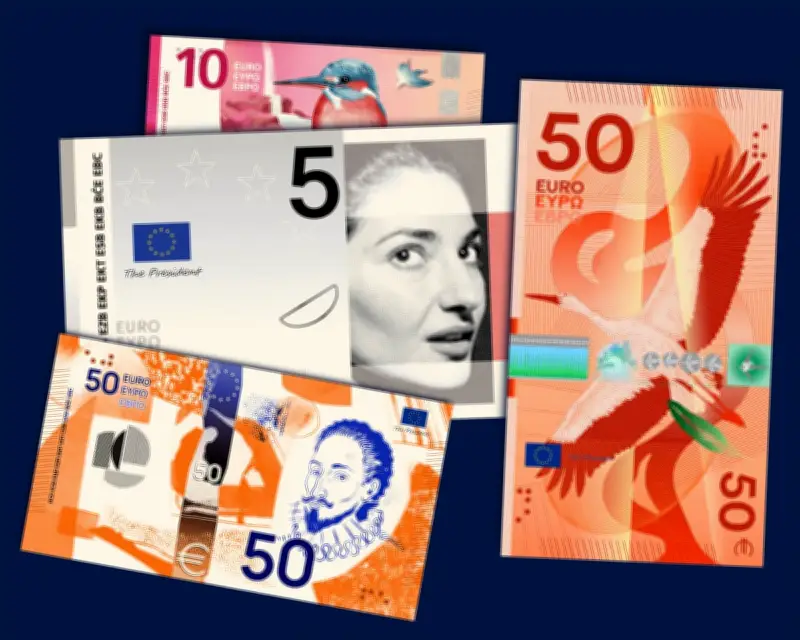
The European Central Bank (ECB) has unveiled 10 shortlisted designs for the first full redesign of euro banknotes since their introduction in 2002, offering Europeans a choice between celebrating cultural icons or wildlife. The public has responded enthusiastically, with over 6 million votes cast in a survey within the first week, as the ECB seeks to move away from the deliberately neutral motifs of the current notes.
Two themes: Culture and Wildlife
The shortlist, announced by ECB President Christine Lagarde, comprises five proposals under each of two themes: “European culture” and “Birds and waterways.” The culture theme features portraits of Maria Callas, Ludwig van Beethoven, Marie Curie, Miguel de Cervantes, Leonardo da Vinci, and Bertha von Suttner on the fronts, with scenes of artistic and intellectual activity on the reverse. The wildlife theme showcases the wallcreeper, kingfisher, bee-eater, white stork, avocet, and northern gannet across various European landscapes.
These designs will be applied to the €5, €10, €20, €50, €100, and €200 denominations, with the ECB having predetermined the colour schemes and motifs for each note.
Public Feedback and Decision Process
According to an ECB spokesperson, the survey on the ECB’s website, open until 21 September, will inform but not solely determine the final design. A second quantitative survey and a jury of designers will also influence the decision, which is expected at the end of 2026. A combination of the two themes is not anticipated. The new notes, which will remain paper-based, are slated to enter circulation in 2030 or 2031.
Philippe Geoffroy, head of section for new banknotes at the ECB, stated: “The feedback from the public has been very clear. They want money that feels European.” He added, “The main reason behind the re-design is to stay well ahead of counterfeiting. But along the way we want to increase identification with the single currency and make it more graphically meaningful. We want to move away from neutrality.”
Innovative Designs from Unconventional Creatives
The 10 shortlisted designs were selected from 1,241 applications submitted to an open call in 2025. Notably, all finalists are creatives who do not typically design banknotes, resulting in some radically different concepts. Dutch book designer Joost Grootens crops the cultural figures tightly around their eyes, emphasizing their vision rather than iconic status. German illustrator Jan Robert Dünnweller renders the personalities in a free-flowing, sketchy graphic novel style. French artist Isabelle Daëron and Finnish designer Ville Tietäväinen both use vertical layouts, with Tietäväinen depicting bird journeys in sequence from mountains to sea.
Balancing Representation and Identity
The selection of cultural icons reflects careful balancing to represent various eurozone regions, though the Baltics are notably absent. The figures chosen have transnational appeal, either through border-crossing work or migratory biographies. For instance, Callas was born in New York but flourished in Greece and Italy, while Curie’s career spanned Warsaw and Paris. The wildlife theme pairs birds with images of EU institutions in Brussels, Strasbourg, Luxembourg, and Frankfurt on the reverse.
This redesign marks a departure from the current notes, which feature imaginary bridges, doorways, and windows to avoid favouring any member state. The ECB introduced new notes in 2013 with enhanced security features, including a watermark of the mythological princess Europa, but without altering the overall design.
Contrast with UK Approach
The move contrasts with the Bank of England, which earlier this year faced criticism for replacing historical figures with wildlife on redesigned notes. Some commentators saw that as a struggle to find shared cultural symbols in polarizing times, while the euro redesign appears to embrace identity-building through bold choices.
As the ECB navigates this process, the final design will reflect a balance of public opinion, expert input, and the need to maintain security and functionality. The new notes are expected to be both visually striking and deeply symbolic of European unity and diversity.




