
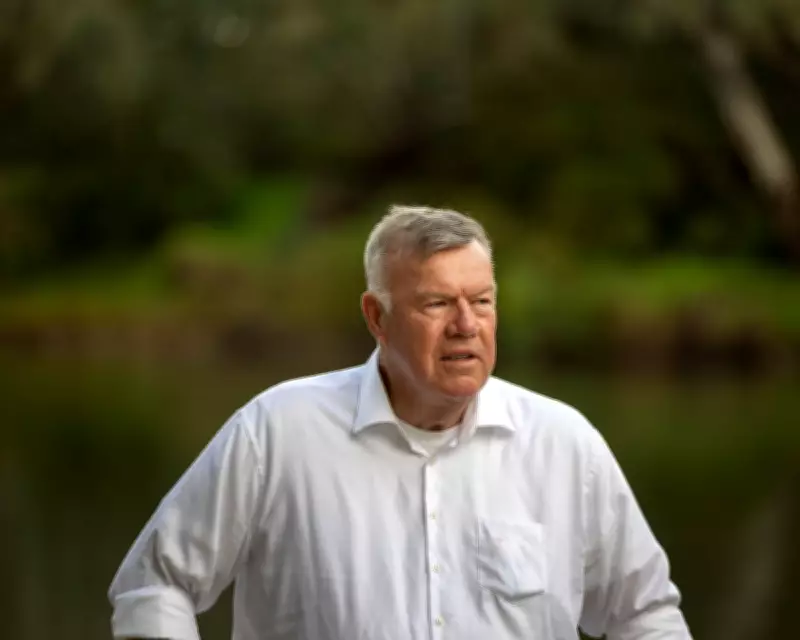
David Farley, a 69-year-old agribusiness consultant, has emerged as the frontrunner in Saturday’s Farrer byelection, based on limited opinion polling. If elected, he would become the first MP elected as a One Nation candidate, taking a long road to reach that milestone.
A Complex Political Journey
Farley’s historical allegiances to other political parties have raised questions about his selection for Pauline Hanson’s party. The former Nationals member has admitted to flirting with the idea of joining Labor or running as an independent, as he considered how to best translate his policy ambitions into political success.
He even met independent candidate Michelle Milthorpe, likely his closest byelection rival, to discuss water policy—a conversation that informed part of her final platform. Now, One Nation’s rise as a serious political contender has given Farley a chance at a seat in Canberra. He says the party’s “political courage and political tenacity” ultimately convinced him.
From Nationals to One Nation
The Narrandera grandfather’s resume is more typical of a Nationals candidate than One Nation. He was once the chief executive of the Australian Agriculture Company and held management and executive positions in agriculture and commodities companies, mostly in cotton. In 2018, he considered nominating for a NSW Senate seat with the Nationals before Perrin Davey secured it.
At a pub event in Holbrook in April, Farley pointed to an uneasy decoupling from the rural party that once dominated elections in Farrer. “The Nationals didn’t want me. And at the end of it all, quite frankly, I didn’t want them. It just didn’t work,” he told an audience of about 40.
After consulting in the US, parts of Africa, and the former Soviet Union, Farley returned to his hometown to find it had shrunk, was “knocked around,” and lacked investment.
Exploring Other Options
Farley says he tried Labor in Albury and got to “know it pretty well.” The Nine newspapers reported anonymous sources saying he was a member and had personally donated to the party in 2023. “It’s 2026. Democracy doesn’t live in a museum. It actually lives in a gymnasium. It’s active,” he said at a candidates panel on Thursday evening. “When I got in the door for Labor, it was obvious that, culturally, I didn’t fit. My comments on Julia Gillard don’t fit them, and I got out of the door.” (Farley had compared the former Labor prime minister to a “non-productive old cow.”)
Becoming an independent was also canvassed, he tells the audience, but he decided it was a much harder route without party infrastructure.
A Different Kind of One Nation Candidate
A former associate of Farley’s, who knew him while working in Griffith, says “Dave is for Dave” and that his long-term future in One Nation will depend on how he works with Hanson. The associate describes him as a “more intelligent” but less colourful Bob Katter—the fiercely unrestrained independent from far north Queensland.
Farley—a one-time buckjumper rider in local rodeos—is more tempered in his approach than Australians have come to expect from One Nation. He describes immigration levels as “loose,” but is hesitant to resort to hateful rhetoric that garners Hanson criticism and headlines.
The situation in Farrer is specific. The large rural electorate covering vast stretches of south-western NSW, including Griffith and Albury, has persistent workforce shortages in critical areas such as healthcare and industry. Immigration is key to filling vacant roles.
Farley is more careful to avoid denigrating entire communities in describing his stance on immigration, but still uses terms considered outdated, such as “assimilation”—a term heavily associated with the dismantled White Australia and Stolen Generation policies. “We need to have a migration program that fits the needs of Australia. Farrer has definitely got specific needs to it,” Farley says. “We don’t need an open door migration policy. We want people who are prepared to assimilate to the Australian values and to the Australian culture.” Those values, he says, are summed up as “laconic” and “egalitarian.”
Water and Climate Views
On energy and environment, Farley is anti-net zero and renewable energy in line with One Nation’s policy—a position that conflicts somewhat with his other work in recent years. In March 2021, he spoke at a conference organised by the regenerative farming co-op program Farming Together. His address centred on how the world could deliver food security for a fast-growing population by 2050, then just “29 harvests” away. “No matter how you do the math, at the moment, the existing model of agriculture has to change. It has to change if we want to feed the people. It has to change if we want to meet the Paris Agreement ... But more importantly, it has to change if we want to continue mankind on as we know it today,” he said.
His work leading the local water advocacy group, Speak Up 4 Water, also acknowledges the impact of climate change on water security. Now, Farley is less interested in discussing climate change, but his concern for water security remains. “We are a large, isolated island, and water needs to be viewed through the lens of sovereignty, as a sovereign asset for the nation, not just an environmental asset for the nation,” Farley says.
Water in the region is subject to buy-backs as part of the Murray-Darling Basin plan. A federal authority purchases water from users to redirect it toward maintaining the river’s environmental health. The river systems, which contribute billions to the economy through agriculture and tourism, are particularly vulnerable during droughts. Farley, a former cotton farmer, wants to end buy-backs. Like Milthorpe, he is demanding a royal commission into how the program is run.
Whether it’s Farley or Milthorpe who wins on Saturday, Farrer’s new member will make it their mission to put water back on the political map.




