
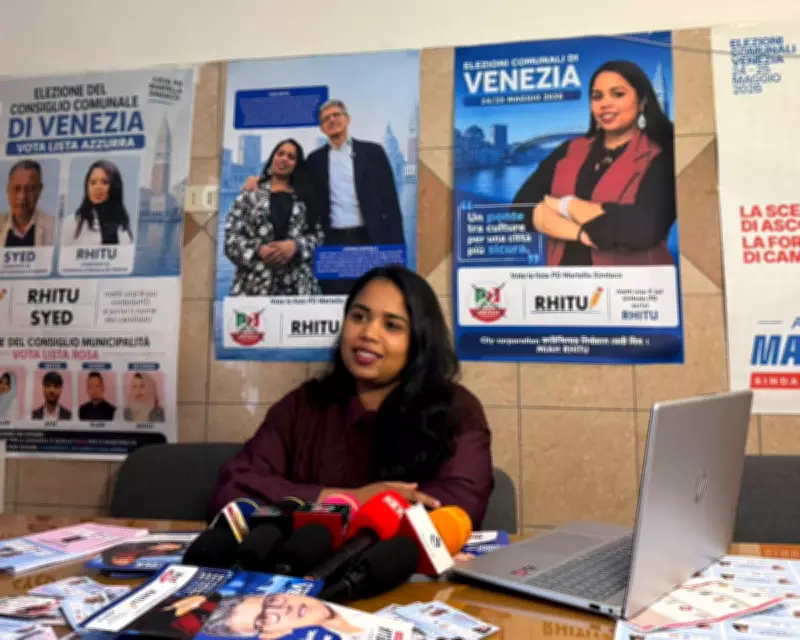
Rhitu Miah, one of seven candidates from the Bangladeshi-Italian community standing in Venice’s local election, is used to brushing off racist or sexist comments. But she was taken aback by the virulence of the negative comments online when she announced she would run for the council – potentially making her one of the first people of Bangladeshi origin ever elected in the lagoon city’s administration.
“There were hateful messages – one person told me to get on a camel and go back to my own country,” says Miah, an Italian citizen who moved to Venice with her family at three years old, through her father’s job at the Fincantieri shipyard, a huge importer of labour from Bangladesh. “I tried to let it be and reply with a smile … but it was difficult not to cry. This is also a reason why I’m running [to combat these prejudices].”
Historic Political Breakthrough
Miah, an architect whose social media accounts focusing on integration have more than 200,000 followers, is one of seven Bangladeshi candidates standing for election on Sunday and Monday on a centre-left Democratic party (PD) list. The contingent is aiming for seats in Venice council, comprising Mestre on the mainland, and in various other municipalities, led by the mayoral candidate Andrea Martella, a PD senator.
For Venice’s Bangladeshi community, which numbers roughly 20,000 people, predominantly living in Mestre, the ballot could mark a historic political breakthrough.
“It’s important – we’re an established, growing community with skills to help contribute to the city,” says Miah.
Far-Right Hostility and Campaign of Fear
Furthermore, a win for the centre-left would end 11 years of conservative rule in Venice, sending a further sign to Giorgia Meloni’s far-right national government, already rattled by a failed referendum on judicial reform in March, of an opposition regaining momentum.
After a decade shaped by overtourism, Venice’s election campaign has focused on familiar themes: from the deepening housing crisis, strained social services and security concerns, to the perennial challenge of curbing mass tourism, repopulating the historic centre and protecting the fragile lagoon.
But the Bangladeshi participation also provoked debate, while unleashing an onslaught of inflammatory rhetoric from far-right politicians. Pouncing on proposals for a mosque – which were, in fact, first mooted by the outgoing mayor, Luigi Brugnaro, a millionaire businessman – leaflets appeared around the city warning that “Allah” was on the verge of taking over.
“They ignited a campaign of fear against us, saying that we will change the rules and ruin Venice,” says Miah. “We’ve not even mentioned the mosque because there are more serious problems – housing, schools, health and security.”
Centre-Left vs. Conservative Camps
Final polls in early May pointed to the centre-left having the edge over the conservative camp, whose mayoral candidate is Simone Venturini, the current councillor for tourism and proponent of the controversial entrance fee for day-trippers, which he has pledged to increase if he wins.
Martella is supported by the broad leftwing alliance that is preparing for general elections next year. During one of his closing rallies, Martella said the city needed a total reset, after a leadership that focused on filling Venice with tourists while emptying its main island of inhabitants (there are now about 47,000, down from about 170,000 in the 1950s). One of his objectives would be to abolish the tourist entrance levy, which critics say has had little or no impact on tourist numbers.
“We must work to ensure our city is governed,” he says, on the sidelines of the rally. The primary focus should be the needs of its citizens, which is why he says it’s important to have the Bangladeshi community onboard. “These are Italian citizens, who live here, work here, study here … we must integrate them as much as possible.”
Venturini, whose policies include obtaining a special law for Venice that would grant the council unique powers to preserve it, did not respond to the Guardian’s request for an interview.
Voters’ Perspectives
In the days before the vote, many people were undecided, even if the general consensus is that Venice under Brugnaro’s administration was “disastrous”, says Gabriele Brunelli, a hotel manager. “It’s a close race, although I think Martella has more support,” he adds. “People view Venturini as being an extension of Brugnaro, who didn’t do anything. Those in the historic centre have felt ignored.”
Farrah Sopradassi, 35, a restaurant worker who was born in Venice and lives in the Castello district, says: “I haven’t made my mind up yet but I do know that we want and need change. The new mayor needs to have the capacity to incentivise Venice – it’s not a theme park but an ancient city where people live and work.”
Her friend, Alessandra Cappon, 37, says she has been concerned about security, especially after reading local news report last week about brawls between machete-wielding Tunisian clans in Mestre. “Venice has all these events like the biennale, which show off the city, but the reality is, those who live here deal with a lot of issues.”
Matteo Secchi, who set up the local activists’ group, Venessia, and is running for councillor with a small leftwing force, says that while Brugnaro can be credited for having balanced the books, he “went to the extremes” with tourism – the number of hotel beds on the main island now outnumber residents. “He took away from housing and social services – there was no focus on our needs,” says Secchi, who believes the conservatives “will be sent packing”.
Miah’s Vision for a United Venice
If she succeeds in entering Venice’s council, Miah, whose main remit would be integration, says she will “talk to everyone” to truly understand their feelings and needs. “Venice is beautiful from the outside, but inside there is a struggle,” she says. “I would like my daughter to grow up in a more united Venice, and for it to become even more beautiful, from the point of view of the people who live here, not the tourists.”




