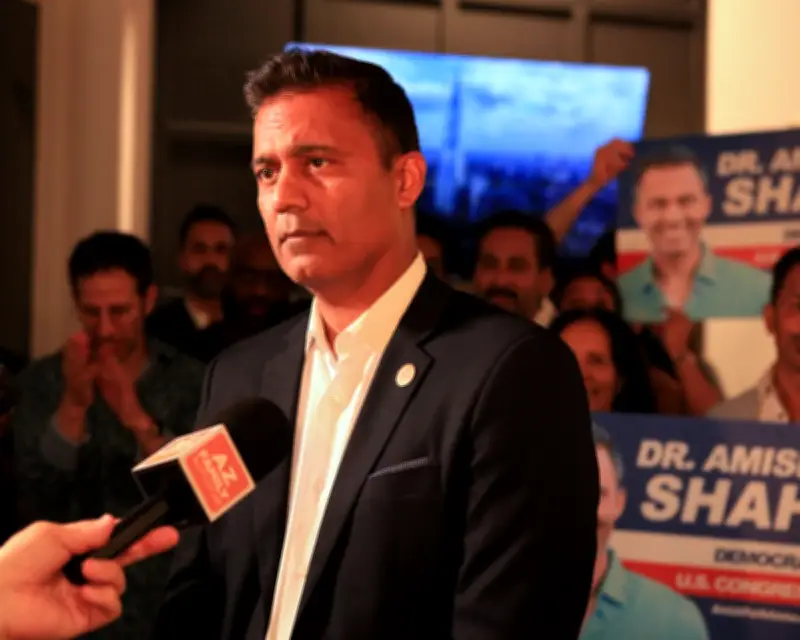
Amish Shah, an emergency room doctor, defeated the candidate favored by Democratic leadership in Arizona's 1st congressional district primary on Wednesday, marking the latest sign that party voters are increasingly willing to override the national machine. Shah won over Marlene Galán-Woods, a former Republican and television journalist who switched parties during Trump's first term and was endorsed by the Democratic Congressional Campaign Committee (DCCC) in Washington.
Key Battleground District
Shah will face Republican Jay Feely, a former NFL kicker endorsed by Donald Trump, in the November general election. The district, which includes affluent areas like north-east Phoenix, Scottsdale, Fountain Hills and Paradise Valley, is rated by both parties as one of the most winnable Republican-held seats in the country and is expected to help determine control of the US House of Representatives. Although Republicans hold a voter registration advantage, the district has shifted toward the center over the last decade. The seat is open because Representative David Schweikert ran for governor, losing to Representative Andy Biggs in the GOP primary on Tuesday.
Grassroots Victory Over Establishment
Unlike some intra-party battles between left and center, Shah and Galán-Woods are both moderates. Local Democrats struggled to explain why the DCCC intervened to endorse Galán-Woods given their policy similarities. “Our victory in this primary was a grassroots victory where Arizona voters made their voices heard,” Shah said on Wednesday night in a statement that did not address the DCCC snub. “Now, it’s my job to earn the support of every voter in this district.”
Suzan DelBene, US representative and DCCC chair, issued a statement calling Feely an “extremist” and saying Shah “will always put his community first,” but did not address the controversy surrounding support for Galán-Woods. The National Republican Congressional Committee quickly released a digital ad on Wednesday attacking Shah, labeling him a socialist and tying him to progressives in Congress. “I’m a political outsider committed to delivering results,” Feely said in a statement.
Broader Anti-Establishment Trend
The trend runs deeper than establishment-picked candidates losing to committee-backed alternatives; it also shows up as a broader revolt against long-serving incumbents and traditional pro-Israel financial networks. In June, Adriano Espaillat, a five-term New York congressman and chair of the Congressional Hispanic Caucus, lost his primary to Darializa Avila Chevalier, a 32-year-old democratic socialist backed by New York Mayor Zohran Mamdani. The result came despite about $2.9 million spent defending Espaillat by a group funded in part by the American Israel Public Affairs Committee (Aipac), making him the sixth House incumbent to lose renomination this cycle.
Similar dynamics played out in Pennsylvania, where state Representative Chris Rabb, an anti-Aipac democratic socialist, won the Democratic nomination for an open Philadelphia-area seat over establishment-aligned rivals, and in New Jersey, where former combat surgeon Adam Hamawy won a crowded primary with backing from a new anti-Aipac Super PAC and endorsements from Alexandria Ocasio-Cortez, despite attack ads against him. In California’s Central Valley, progressive Randy Villegas beat a DCCC-backed candidate last month, and in Maine, Matt Dunlap defeated a more moderate rival backed by the party.
Concerns Over Extremism
Anti-establishment fervor has spooked congressional leaders, who fear swing voters may see some insurgent candidates as too extreme and squander Democrats’ opportunity to capitalize on Trump’s unpopularity. Ocasio-Cortez, herself a DCCC dues-payer, argued the committee should be “rationing our resources to win general elections” rather than intervening in primaries, while Illinois Representative Delia Ramirez objected to her own dues underwriting campaigns she says the committee “shouldn’t be spending this money” on.
Shah’s race was in some ways a replay of 2024, when he narrowly won a crowded primary field that included Galán-Woods but lost the general election. The DCCC did not endorse in that primary but backed Shah in the general. “I wasn’t exactly my party’s pick,” Shah told supporters on Tuesday night. “And I was willing to stand up to that establishment. And that’s what the voters of this district want.” Still, he said he would work with the DCCC if nominated. He will need party support and donor money to win what will likely be a tough race in a district Trump carried narrowly in 2024. Joe Biden won the district in 2020 even as Schweikert was re-elected.
“The Democratic party needs to grow up and wake up,” said Maria Liong, a 24-year-old medical student who volunteered for Shah’s campaign. “They need to realize that they want candidates who listen to their people.” In the GOP primary, Feely defeated Joseph Chaplik, a former state lawmaker popular with grassroots activists, for the party’s nomination.