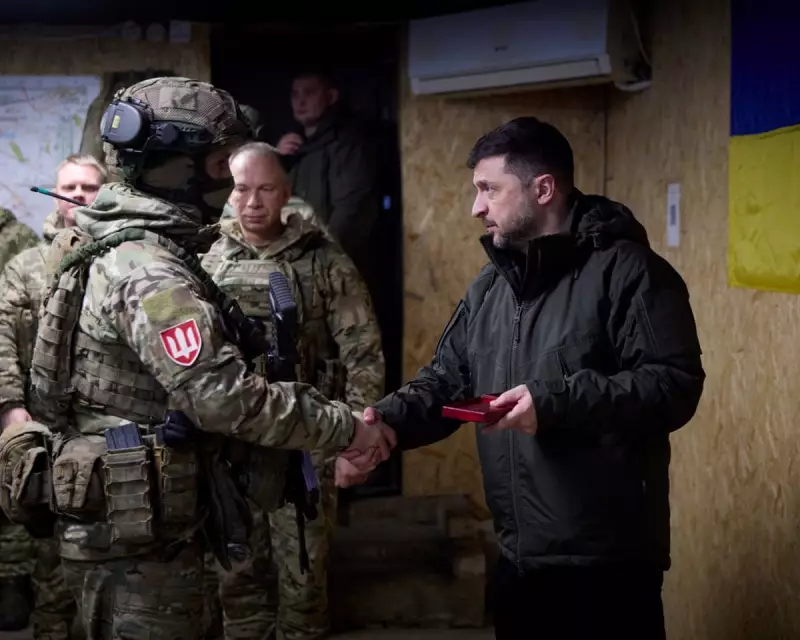
President Volodymyr Zelenskyy visited Ukrainian troops in the frontline town of Kupiansk on 12 December, underscoring the high-stakes defence as the conflict grinds into another year. The trip came as analysts assess Ukraine's prospects for 2026, where military options appear limited despite a vital new financial lifeline from the European Union.
The Costly Stalemate on the Ground
Ukraine's immediate future is secured by a recently agreed €90bn (£79bn) loan from the EU. This financing is expected to allow Kyiv to sustain its current level of defence until late 2027. However, experts caution it is unlikely to fundamentally alter the battlefield dynamics, where a pattern of incremental Russian advances has been established.
Russia has held the initiative since 2024, but its gains come at a staggering human cost. Through November 2025, Russian advances averaged 176 square miles per month, but at an estimated cost of 382,000 troops killed and wounded. The White House has reportedly suggested in peace talks that Ukraine is likely to lose the remaining 22% of Donetsk province, including the key cities of Kramatorsk and Sloviansk. At the current rate, this would take at least a year and potentially cost Russia another 400,000 casualties—a price Kyiv is determined to exact.
Frontline Vulnerabilities and Strategic Questions
Despite the high cost to Russia, questions persist about Ukraine's frontline resilience. In the past six months, the front has given way in three areas: east of Dobropillia in Donetsk in August, north of Kupiansk in Kharkiv in late summer, and east of Huliaipole in Zaporizhzhia in November.
In each case, exhausted defenders struggled to repel small groups of Russian infiltrators who bypassed drone defences. Near Kupiansk, attackers even utilised underground gas pipelines. While the Dobropillia incursion was contained after two months and the pipeline exits near Kupiansk were cut, the breaches highlighted a critical weakness. Ukraine's drone-led defence, effective at inflicting casualties miles behind the front, cannot fully compensate for shortages of frontline infantry or profound troop fatigue.
The strain is evident. The economist Janis Kluge estimates Russia still recruits roughly 30,000 soldiers a month, enough to replenish losses but not to decisively shift the war. Ukraine's recruitment, claimed to be 27,000 a month, may be closer to a third of that, though its casualty rate is also believed to be lower, potentially around 10,000 per month.
The Search for a Turning Point: Economy and Politics
With a military breakthrough elusive, Ukraine is increasingly looking to economic and political fronts to change its fortunes. While Russia has intensified strikes on energy infrastructure, causing blackouts in cities, Kyiv has kept power flowing to the front. Civilian morale, crucially, appears resilient.
In response, Ukraine has targeted Russia's economic lifeline. Drone attacks on oil refineries and, more daringly, on Moscow's shadow fleet of tankers in the Black Sea aim to cripple a vital revenue stream. The strategy shows some effect: Russian oil tax revenues fell by 34% in November.
Politically, the fastest-moving variable may be in Washington. The future of US support under President Donald Trump remains Ukraine's greatest uncertainty. A risk exists that Trump could limit intelligence sharing if Kyiv refuses territorial concessions, though a complete halt to arms sales is considered unlikely. Some in Ukraine hope that potential poor results for Republicans in the US midterm elections could check any pro-Kremlin drift from the White House.
For now, Ukraine's most realistic path is to hold Russia to the current near-standstill, inflicting maximum cost, while banking on economic pressure and political change. As war veteran Bohdan Krotevych has argued, the priority should be shifting to a "dynamic defence" to create vital reserves. The diplomatic task, therefore, is to buy time for regeneration. However, as long as Vladimir Putin believes he can gain more from fighting or negotiating with Trump, the pressure on him to stop remains minimal, leaving Ukraine in a precarious race against time.