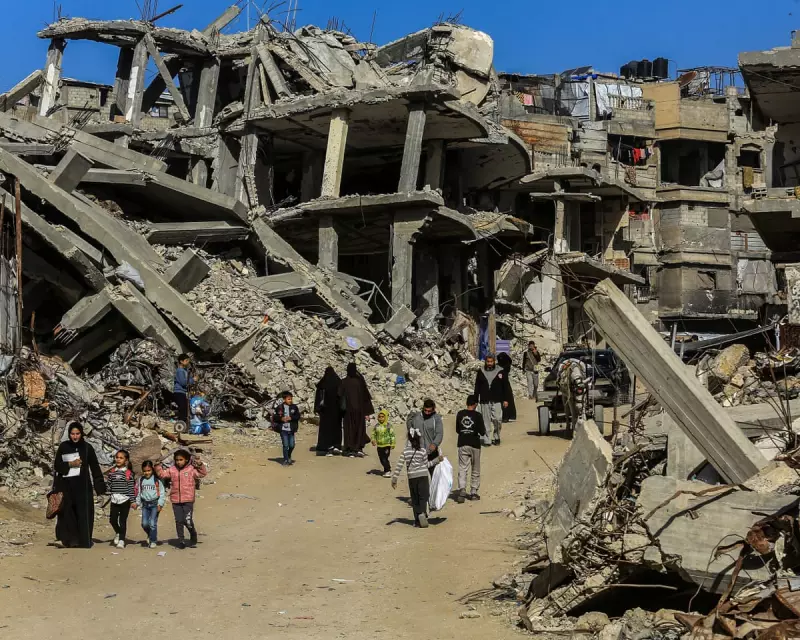
Turkey's top diplomat has declared that the immediate disarming of Hamas should not be the primary objective for any international force deployed to stabilise the Gaza Strip. This position marks a significant point of contention as discussions continue over the future security of the war-torn territory.
Ankara's Stance on Post-Conflict Security
Foreign Minister Hakan Fidan outlined Turkey's view during a press conference in Doha, Qatar, on Saturday, December 7th. He argued that the foremost duty of any proposed Gaza stabilisation force must be to prevent further attacks and ensure a lasting ceasefire, rather than initiating a complex and potentially destabilising disarmament process from the outset.
"The first duty of the force to be formed should be to prevent these attacks," Fidan stated, referring to the ongoing conflict. He emphasised that the force's mandate should focus on creating a secure environment. This perspective directly contrasts with the position held by Israel and some of its Western allies, who insist that demilitarising Hamas is a non-negotiable cornerstone for any lasting peace.
Diplomatic Context and International Dialogue
The Turkish minister's comments followed a meeting with Qatari Prime Minister Sheikh Mohammed bin Abdulrahman Al Thani. Qatar, alongside Egypt and the United States, has been a key mediator in ceasefire negotiations between Israel and Hamas. Fidan's statement injects a new diplomatic variable into an already intricate set of talks concerning Gaza's post-war governance and security architecture.
Discussions about an international security presence for Gaza have gained traction among global powers seeking a durable end to the hostilities. However, the composition, mandate, and leadership of such a force remain deeply divisive issues. Turkey, which has been highly critical of Israel's military campaign, is positioning itself as a vocal advocate for a approach that prioritises immediate stability over enforced demilitarisation.
Analysts suggest Ankara's stance reflects a broader concern that attempting to forcibly disarm Hamas as a first step could lead to renewed violence and undermine the force's legitimacy from the beginning. Instead, Turkey appears to favour a phased process where ceasefire enforcement builds the conditions for longer-term political solutions.
Implications for Regional Stability
The divergence in views on the force's primary task highlights the profound challenges in building an international consensus for Gaza's future. The debate touches on core issues of sovereignty, security, and the political horizon for Palestinians. Israel maintains that any force must have a robust mandate to prevent Hamas from rearming and regrouping, viewing this as essential for its own security.
Turkey's intervention, as a significant regional power with channels to Hamas, adds weight to the argument for a different sequencing of priorities. The coming weeks are likely to see intensified diplomacy as stakeholders attempt to bridge these gaps. The outcome will significantly influence not only the potential for a sustained Gaza ceasefire but also the long-term prospects for peace and reconstruction in the region.
As of now, no formal agreements on the deployment of a stabilisation force have been reached. The situation remains fluid, with military operations continuing alongside diplomatic efforts. The international community watches closely, aware that the decisions made in the near term will shape the geopolitical landscape of the Middle East for years to come.