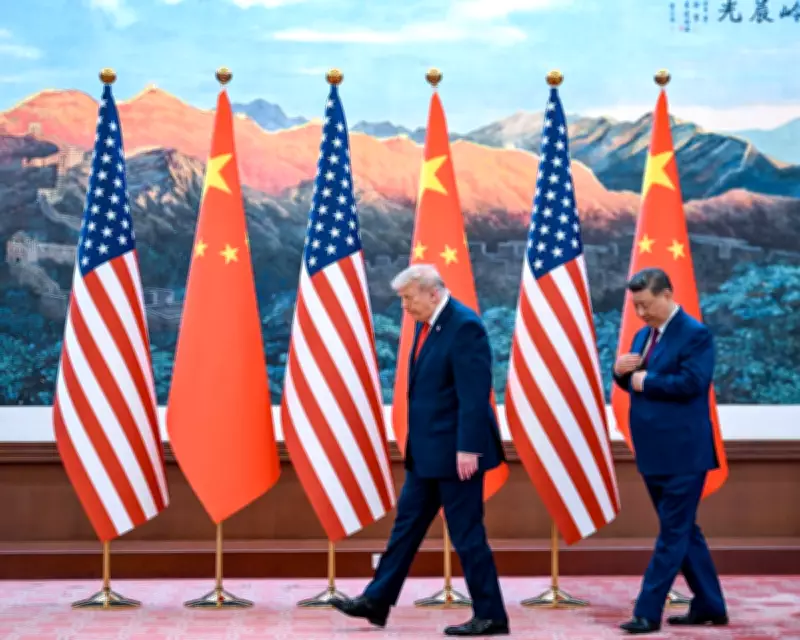
President Donald Trump's visit to Beijing was historic, but not as anyone had predicted. The self-declared teetotaler drank champagne after Xi Jinping assured him that China's "great rejuvenation" could go hand in hand with "Make America great again." A Chinese military band played Trump's campaign song, YMCA, at a state banquet in the Great Hall of the People.
The banquet featured an eclectic guest list including Elon Musk, Pete Hegseth, and Trump himself. The menu included lobster in tomato soup, crispy beef ribs, Beijing roast duck, and slow-cooked salmon in mustard sauce. The mood was convivial after the first day of the summit, which offered cozy choreography and promises of stability.
However, by Friday, when Trump boarded Air Force One, the generous helpings of food could not stave off an empty feeling. He left with little to show: no swift end to the Iran war, no definitive answer on Taiwan, and only vague outlines of corporate mega-deals. Underwhelmed observers said the summit failed to live up to the hype.
Rush Doshi of the Council on Foreign Relations said: "It was heavier on symbolism than on substance. A lot of pomp, a lot of pageantry, but not a lot of deliverables."
Beijing greeted Trump with self-confidence. Commuters used smooth subway trains and slick social media apps. Luxury malls and the National Centre for the Performing Arts showcased China's modernity. The National Museum displayed advances in green energy, robotics, and space exploration.
America, meanwhile, is plagued by self-doubt over internal divisions and external misadventures. Sensing a shift in power, Xi urged the two nations to avoid the "Thucydides Trap," the historical concept that an established power is threatened by a rising one, leading to inevitable clash.
The summit unfolded with pageantry at Zhongnanhai, the Communist party leadership compound. Xi personally escorted Trump through manicured gardens. Trump marveled at roses, and Xi promised to send him seeds.
Beijing flattered a president known to value personal diplomacy. Trump praised Xi as "all business" but also "a warm person." Xi described the visit as "historic," saying they agreed on "a constructive, strategic and stable China-US relationship."
George Chen of The Asia Group said the summit resembled "a political reality show at times," but both sides restored direct leader-to-leader rapport. He added: "Neither side contradicted the other's account. That alone reflects a rare moment of mutual respect."
Still, disagreements were profound. Nothing loomed larger than Taiwan. Xi warned Trump that mishandling Taiwan could lead to "clashes and even conflicts." Trump claimed Xi asked directly if the US would defend Taiwan, but Trump declined to answer, saying: "There's only one person that knows that, and it is me."
For decades, the US adopted "strategic ambiguity" toward Taiwan, but President Joe Biden was explicit about using military force to defend the island. China has intensified military pressure on Taiwan and never renounced force.
Before the summit, Trump hinted he might reconsider an $11 billion weapons package for Taiwan. On Air Force One, he said he would decide "over the next fairly short period of time." This vagueness alarmed Taipei, which has watched Trump's rhetoric with nervousness.
Iran dominated the immediate agenda. China remains Iran's biggest oil customer. Trump insisted the US and China were broadly aligned on the conflict. He said: "We don't want them to have a nuclear weapon. We want the straits open."
The Strait of Hormuz has been effectively closed since the war began, sending oil prices surging toward $109 a barrel and raising fears of a global recession. Rising gas prices in the US have dragged Trump's approval rating to an all-time low.
Trump claimed Xi agreed that Tehran must reopen the waterway and promised China would not supply Iran with military equipment. Beijing's statements were more restrained, calling for shipping routes to reopen but stopping short of endorsing Trump's approach.
Trump also announced sweeping commercial gains, claiming China would buy "billions of dollars" worth of American agricultural goods, especially soybeans. The US trade representative expected "double-digit billions" in agricultural purchases over three years.
Trump announced what could become one of the biggest aircraft deals: China agreed to purchase 200 Boeing jets immediately, with the possibility of expanding to 750. But Chinese officials did not confirm the deal.
On nuclear arms control, Trump proposed a trilateral agreement among the US, Russia, and China to cap nuclear arsenals. He said he got a "very positive response." However, hopes for AI guardrails were dashed despite the presence of tech executives like Musk and Tim Cook.
The talks touched on human rights. Trump said he raised the cases of Jimmy Lai and a detained Chinese pastor. Xi appeared more open on the pastor, but Lai's case was "a tough one."
Trump was unnaturally subdued in Beijing, keeping quiet during public appearances and largely dormant on social media. Critics suggested he found a kindred spirit in illiberal China. Asked if Xi is a dictator, Trump replied: "I don't think about it. He's the ruler. I respect him."
As Trump's visit concluded, the Chinese government orchestrated a farewell as meticulous as the welcome. Schoolchildren waved flags and chanted "Warm farewell!" Trump pumped his fist, turned at the top of the stairs, and vanished into the aircraft without taking a final question.
He did draw one conclusion: "China has a Ballroom, and so should the U.S.A.!" He posted alongside a photo with Xi, referencing his pet project of a new $400 million ballroom at the White House. Democrats condemned Trump for squandering an opportunity, with ten senators saying he failed to advance objectives important to the American people.