Russian President Vladimir Putin received a ceremonial red carpet welcome as he touched down in New Delhi for the 23rd India-Russia summit, a meeting set against the backdrop of intense Western pressure over the war in Ukraine.
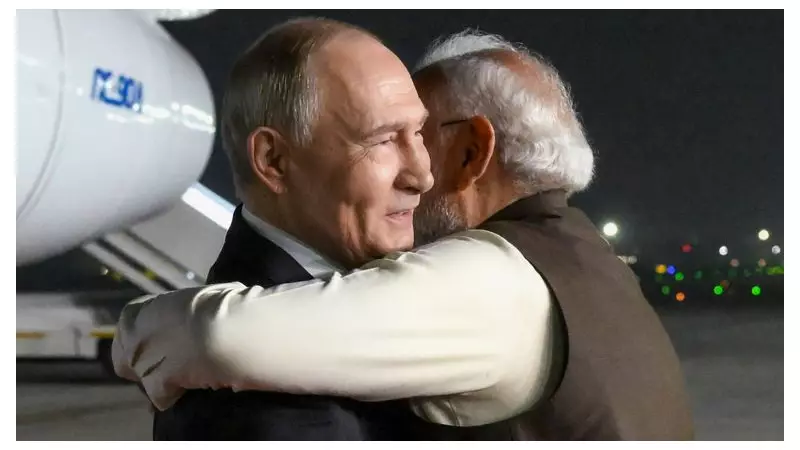
In a significant gesture, Indian Prime Minister Narendra Modi broke protocol to personally greet Mr Putin on the tarmac at Palam Air Base on Thursday evening. The two leaders shared a handshake and an embrace before departing in the same vehicle for a private dinner, reciprocating the hospitality shown when Mr Putin hosted Mr Modi at his residence outside Moscow in July last year.
Trade and Defence Top the Agenda
The summit, a fixture for over two decades barring the pandemic hiatus, is formally aimed at bolstering strategic ties in defence, civil nuclear energy, oil, and trade. President Putin arrived with a substantial business delegation, underscoring the commercial focus of this visit.
Bilateral trade for the 2024-25 period stood at just under $69 billion, a figure heavily skewed towards Russia with Indian exports accounting for less than $5 billion. A key objective for the Russian leader is to insulate this crucial economic and defence partnership from US sanctions imposed due to the conflict in Ukraine.
"Neither I nor PM Modi has ever, despite pressure, used our collaboration to act against anyone," President Putin told India Today. "India and Russia do not cause harm to others, and want other countries to take note of this."
A Deepening Strategic and Military Bond
The talks follow the recent ratification by Russia's State Duma of the Reciprocal Exchange of Logistic Support (RELOS) agreement. This pivotal military pact establishes procedures for the mutual deployment of armed forces, warships, and aircraft, and organises their logistical support.
For India, the agreement promises access to Russian naval facilities along the strategic Northern Sea Route in the Arctic. The summit represents a chance for New Delhi to assert its strategic autonomy and reinforce defence ties independently, countering pressure from Western allies.
"The world should return to peace, and we support every effort towards peace," Prime Minister Modi told President Putin ahead of their formal discussions. "India is not neutral; India is on the side of peace."
Energy Security and Diplomatic Balancing Act
Under Mr Modi's government, a pragmatic realpolitik has guided foreign policy. Since the Ukraine war began, India has dramatically increased its imports of discounted Russian crude oil, from just 2% of its total in 2021 to nearly 40% over the last three years.
This move attracted punitive action from Washington. In August, the Trump administration imposed an additional 25% tariff on India for buying Russian oil, bringing total duties to 50%. US officials argued the revenues were fuelling Moscow's war effort, with one trade adviser controversially labelling the conflict "Modi's war".
India has rejected the allegations, stating its oil imports are driven by the "objective of ensuring energy security of 1.4 billion people". In a pointed retort, President Putin highlighted that the US itself continues to buy nuclear fuel from Russia, asking, "Why should India not have the same privilege?"
In a bid to manage diplomatic relations, India has simultaneously ramped up purchases of US oil and gas and begun to scale back Russian imports. The country is also in the final stages of negotiating a free trade agreement with the United States.