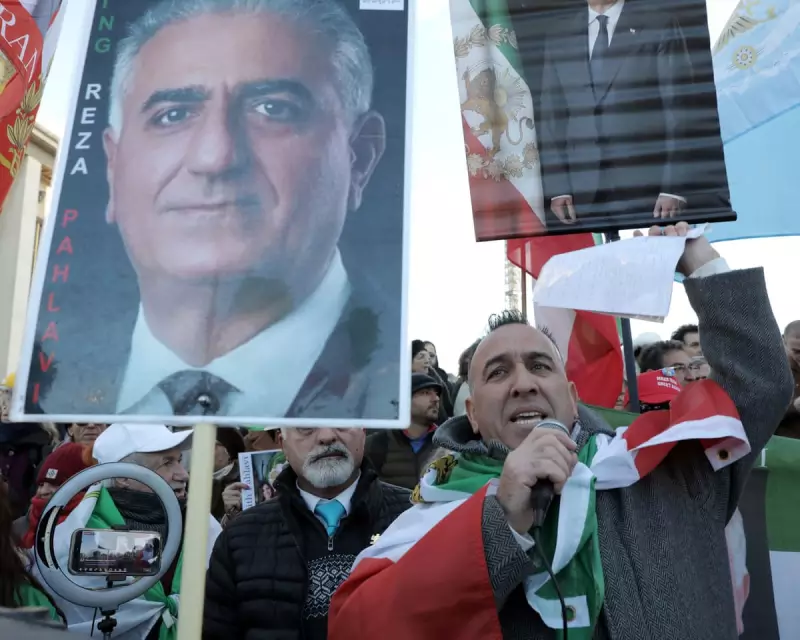
In a powerful display of international solidarity, people have gathered on the streets of Paris near the Eiffel Tower to voice their support for the rapidly growing protest movement inside Iran. The demonstration underscores the global attention on the ongoing unrest within the Islamic Republic.
A Claim to Leadership Amidst Uncertainty
Supporters of Reza Pahlavi, the exiled son of Iran's deposed shah, have been quick to claim the crowds protesting inside Iran are a direct response to his calls for action. They frame the situation as a referendum on his leadership, suggesting the public response signifies a victory for his cause.
However, the critical question of a viable alternative leadership for Iran remains profoundly unresolved. While many Iranians are desperate to end the 47-year rule of the clerics, a return to monarchical rule is still viewed with deep suspicion by significant segments of society.
International Caution and Internal Divisions
On the global stage, Donald Trump has notably refrained from endorsing Pahlavi. Analysts suggest the US president is wary of the United States becoming entangled in a potential civil war, mirroring his cautious approach towards opposition figures in other regions like Venezuela.
This leadership vacuum has, paradoxically, benefited Pahlavi to some extent. In the absence of a clear, unified political manifesto from the protesters—whose demands broadly centre on ending corruption, repression, and inflation—Pahlavi at least possesses immediate name recognition after decades of advocating for the monarchy.
Other potential leaders within Iran, such as activists Narges Mohammadi and Mostafa Tajzadeh, have been repeatedly imprisoned, leaving a gap in secular, organised opposition. As one Iranian analyst told the Guardian, the country is experiencing an era of "no manifesto politics."
The Cry of a Society at a Dead End
An internal analysis provided to the Guardian offers a poignant interpretation of the slogans heard in Iran. It argues that calls for the shah are not necessarily a genuine desire to restore the monarchy, but rather "an escape from a dead end."
The analysis describes a society exhausted by decades of broken promises, where the constant refrain of "wait" has led only to worsening conditions. "When the horizon is empty, society looks back because it sees nothing ahead," it states, suggesting the monarchist slogan is more a declaration of disgust for the current regime than love for the Pahlavi dynasty.
This sentiment is echoed by groups like the Iranian Writers' Association, which warns against "externally imposed solutions," and the Syndicate of Workers of Tehran and Suburbs Bus Company, which opposes the reproduction of old, authoritarian power structures.
A Regime With Few Options Left
Facing this surge of discontent, Iran's current reformist leadership appears to have few effective solutions. Its ability to rally nationalist sentiment, briefly heightened by a 12-day war in June, has evaporated. The regime's remaining tactics seem limited to blaming foreign malice and rioters, while hoping technocrats can stabilise the crippled economy.
As Ahmad Naghibzadeh, an emeritus professor of political science at the University of Tehran, warned, the ultimate solution may be historic rather than technocratic. He suggested Iran may eventually have to follow Europe's path in decisively settling the dispute between religion and state in favour of the state.
With Omani officials—traditional mediators—due in Tehran, and desperation growing, the supreme leader shows no sign of compromising on key symbolic issues like Iran's uranium stockpile. For now, the protest movement continues, fueled by deep societal fatigue, with its ultimate direction and leadership still fiercely contested both inside and outside the country's borders.