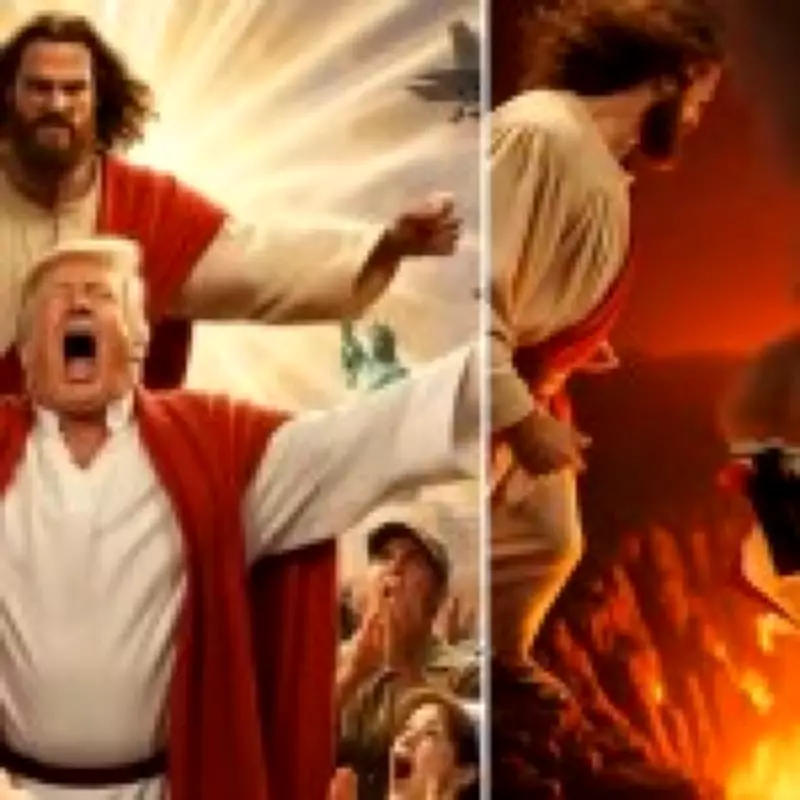
In a provocative move, an Iranian Embassy has released an AI-generated video showing Jesus throwing former U.S. President Donald Trump into hell. This action comes in response to Trump sharing a photo of himself as a Messianic figure on Truth Social earlier this week.
Escalating Tensions Over Religious Imagery
The video begins with the original image Trump posted, which depicted him as a healing figure. In the AI rendition, Jesus descends surrounded by bald eagles, declaring, 'Your reckoning has come.' The scene intensifies as Jesus punches Trump, causing blood to squirt from his nose before he falls into a fiery pit, with the AI Trump screaming, 'What is this? No!'
Trump's Defense and Backlash
Trump defended the image, telling reporters it was not a depiction but rather him as a doctor, specifically a Red Cross worker. He stated, 'It was supposed to be me as a doctor making people better, and I do make people better. I make people a lot better.' However, the post faced significant backlash on Truth Social, with followers labeling him 'the AntiChrist' and accusing him of blasphemy. One user commented, 'The book of Revelations speaks of this, are you literally depicting yourself as a saviour or messiah? Just asking, as the Book of Revelations tells us the Antichrist will claim he is.'
International Reactions and Feud with Pope Leo
Trump has also drawn criticism from Christians for the image and his ongoing dispute with Pope Leo, whom he accused of not doing a 'good job.' Iranian President Masoud Pezeshkian entered the feud, condemning Trump's remarks on X. He wrote, 'I condemn the insult to Your Excellency on behalf of the great nation of Iran, and declare that the desecration of Jesus, the prophet of peace and brotherhood, is not acceptable to any free person. I wish you glory by Allah.'
Pope Leo responded to Trump's image, telling Reuters he plans to continue advocating for peace and dialogue, stating, 'I don't want to get into a debate with him. I don't think that the message of the Gospel is meant to be abused in the way that some people are doing. I will continue to speak out loudly against war, looking to promote peace, promote dialogue and multilateral relationships among the states to look for just solutions to problems.'
Broader Implications and Context
This incident highlights the intersection of technology, politics, and religion in modern diplomacy. The use of AI to create satirical content reflects growing tensions between Iran and the U.S., particularly under Trump's administration. It also underscores the volatile nature of social media in amplifying political and religious controversies.
As debates over free speech, religious sensitivity, and international relations continue, this event serves as a stark reminder of how digital tools can be weaponized in geopolitical conflicts. The backlash from both domestic and international audiences suggests that such actions may further polarize public opinion and strain diplomatic ties.