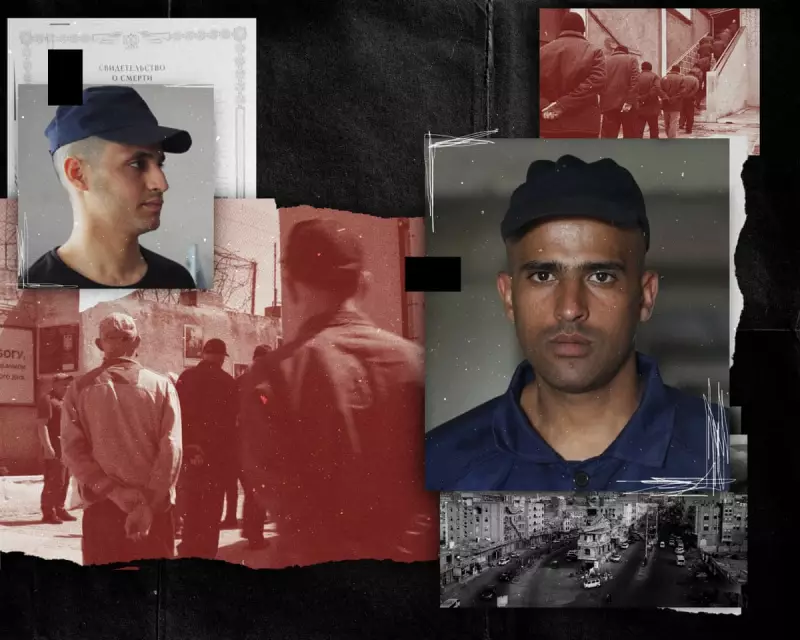
Exhaustion, not anger, defined the voice of Hussein's mother when she first spoke to a journalist. Her 28-year-old son had vanished into the brutal conflict in Ukraine, a war he did not understand, after being lured from Yemen by the promise of a life-changing salary. For months, she scoured the internet for any sign of him, only to receive an official death certificate from Russia. Yet, in a remarkable twist, journalist Nawal Al Maghafi discovered Hussein alive, held in a Ukrainian prisoner of war camp alongside another young Yemeni man, Khalil.
The Pipeline of Exploitation: Targeting Global Poverty
Russia's relentless demand for manpower in its protracted war against Ukraine has spawned a global recruitment drive. An estimated 20,000 foreign fighters have been drawn from countries including Nepal, Cuba, and South Africa. In March 2022, President Vladimir Putin publicly endorsed bringing men from the Middle East to fight, framing it as ideological volunteering. The reality, however, is a pipeline of exploitation.
Informal brokers and online channels connect desperate men to contracts with Russia's military, often promising a one-year term, a substantial salary, fast-tracked citizenship, and safety. The fine print, however, can trap them indefinitely, with a 2022 decree effectively binding soldiers to serve until the end of the military operation.
For young men in Yemen, where a devastating civil war has crippled the economy, these offers are irresistible. "The situation in Yemen is catastrophic," said Ali Alsabahi, founder of the International Federation of Yemeni Migrants. "It's normal for young men who are unemployed to be told: 'Come, we will give you thousands of dollars.' So they went." Alsabahi has tracked the journeys of roughly 400 Yemenis to Russia and confirms that more than 24 are known to have been killed.
Broken Promises and a Mother's Anguish
Khalil, the eldest son and sole breadwinner from Taiz, Yemen, told his mother he was going to Russia for restaurant or farm work. "He told me: 'Thank God, mother, I feel good things are going to happen. I'll finally make some proper money,'" his mother, Shafia, recalled. After he left, contact became sporadic, then stopped. She later learned he had been sent to the frontline and was reportedly killed in the battle for Russia's Kursk region in August 2024.
Hussein's family endured a similar torment, believing him dead until Nawal Al Maghafi's investigation led her to a prison in western Ukraine. There, she found both Hussein and Khalil, who had been captured after just six weeks in Russia. Their entire platoon of 20 Yemenis had been wiped out; they were the only survivors.
In a raw, emotional reunion facilitated by Al Maghafi, Khalil was able to call his mother for the first time in eight months. "I made the biggest mistake," he sobbed down the phone. "Forgive me." His mother, Shafia, replied with unwavering devotion: "I'd give you my eyes. I'd give you everything I have."
A Future Stolen, With No Way Home
In interviews, the two men described a harrowing descent into a war they never wanted. Hussein spoke of being loaded into a tank, unable to understand Russian commands, before a drone attack left him injured and captured. "I regret that I went to another country … to fight for what?" he said. Khalil admitted the promised salary of $2,400 a month was an unimaginable sum. "If I had known that [I would be fighting innocent Ukrainians], I wouldn't have joined this war," he stated.
Their plight highlights a cruel double abandonment. Prisoners told Al Maghafi that while thousands of Russian soldiers had been exchanged in prisoner swaps, none of the foreign fighters were included. Their fast-tracked Russian citizenship offered no protection, and their own Yemeni state has been unable to secure their return.
In a shocking revelation, Khalil confessed he felt he needed to return to Russia. Not out of loyalty, but because the money he was promised—and which his destitute family desperately needed—remained locked in a Russian bank account. His family had rented out their house and was living in one room, surviving on charity. "I dream of a life. Of my future that is lost," he said.
The investigation by Nawal Al Maghafi exposes a system that preys on global vulnerability, offering desperate young men a terrible choice between two fates: death on a foreign frontline, or an indefinite limbo in captivity. For their families back in Yemen, both outcomes feel like the same devastating loss.