In a dramatic escalation of long-standing tensions, former US President Donald Trump has declared that the United States will become "very strongly involved" in Venezuela's vast oil industry. This statement came hours after a US military operation resulted in the capture of Venezuela's authoritarian leader, Nicolás Maduro, and his wife.
Dawn Raid in Caracas Ends Maduro's Rule
The operation, which unfolded in the early hours of Saturday, 3 January 2026, saw explosions rock the Venezuelan capital, Caracas. For approximately 90 minutes, residents reported blasts, aircraft, and black smoke. The assault also targeted areas in the states of Miranda, Aragua, and La Guaira.
In a phone interview with Fox News, Trump described watching the raid "in real time." He detailed how elite US special forces, including the Army's Delta Force, stormed a heavily fortified residence where Maduro was hiding. "He was trying to get into [a safety space], but he got bumrushed so fast that he didn't," Trump remarked.
The Venezuelan president and his wife, Cilia Flores, were subsequently flown by helicopter to the USS Iwo Jima, an amphibious assault ship stationed in the Caribbean. They are now expected to be transferred to New York to face justice.
Trump's "Victory Lap" and Oil Ambitions
Trump was unequivocal about the US's future role in Venezuela's economic heart. When questioned about the nation's oil reserves—the largest proven in the world—he stated, "We're gonna be very strongly involved in it... We have the greatest oil companies in the world... and we're going to be very much involved in it."
This confirms Maduro's long-held accusation that Washington sought to control Venezuela's natural resources. The US President framed the intervention as a necessary action, claiming he had offered Maduro chances to surrender in recent weeks. "This was a very important symbol," Trump said, adding that the operation was so "lethal" and "powerful" a second wave of attacks was unnecessary.
US Vice-President JD Vance supported this narrative on social media, writing, "Maduro is the newest person to find out that President Trump means what he says."
International Condemnation and Domestic Division
The military action represents the most direct US intervention in Latin America since the 1989 invasion of Panama. The global response has been sharply divided.
Venezuela's allies, including Russia, Cuba, and Iran, swiftly condemned the strikes as a gross violation of sovereignty. Iran called on the UN Security Council to halt the "unlawful aggression." Conversely, Argentina's President Javier Milei praised Venezuela's new "freedom." Brazil's leader and Mexico criticised the US action.
Domestically, the move bypassed Congress, drawing fierce criticism from Democrats. Senator Mark Warner warned of dangerous precedents, asking, "If the United States asserts the right to use military force to invade and capture foreign leaders... what prevents China from claiming the same authority over Taiwan's leadership?"
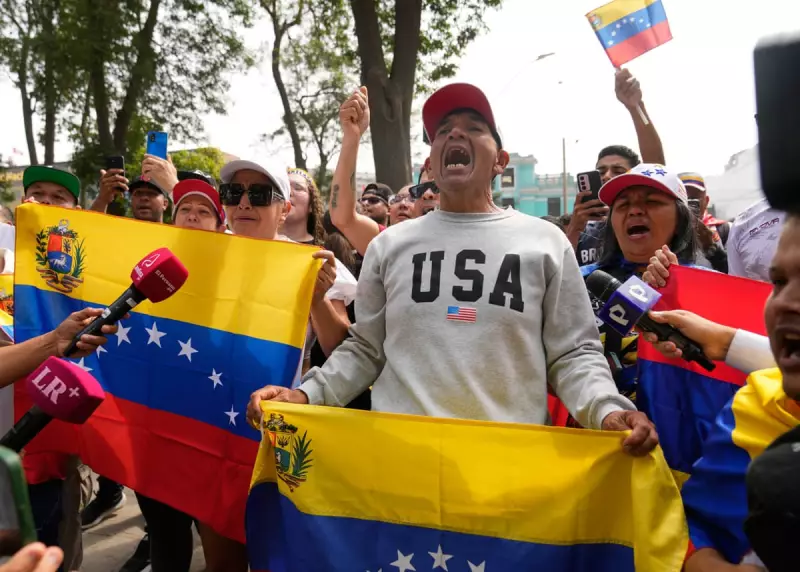
Meanwhile, in a poignant display abroad, crowds of Venezuelan expatriates in Lima, Peru, were photographed celebrating the news of Maduro's capture.
The future of Venezuela remains uncertain. It is unclear whether the US will permit other senior figures from the ruling party to assume power or seek a broader purge. Trump indicated decisions are being made, stating, "We can't take a chance on letting somebody else run it... We want to do liberty for the people."