
Washington and Tehran are set to engage in another round of nuclear discussions in Geneva this week, indicating that the Trump administration perceives the Iranian government as presenting substantial proposals to diminish its highly enriched uranium reserves and demonstrate a non-nuclear weapons agenda. This development unfolds against a backdrop of heightened military movements by the US in the region, sparking fears of potential conflict.
Diplomatic Efforts and Domestic Unrest
Iranian Foreign Minister Abbas Araghchi expressed optimism about reaching a diplomatic resolution, noting that negotiators are likely to convene on Thursday to pursue a swift agreement. However, he issued a stark warning, asserting Iran's right to self-defense if the US launches an attack, referencing American military assets in the area as possible targets.
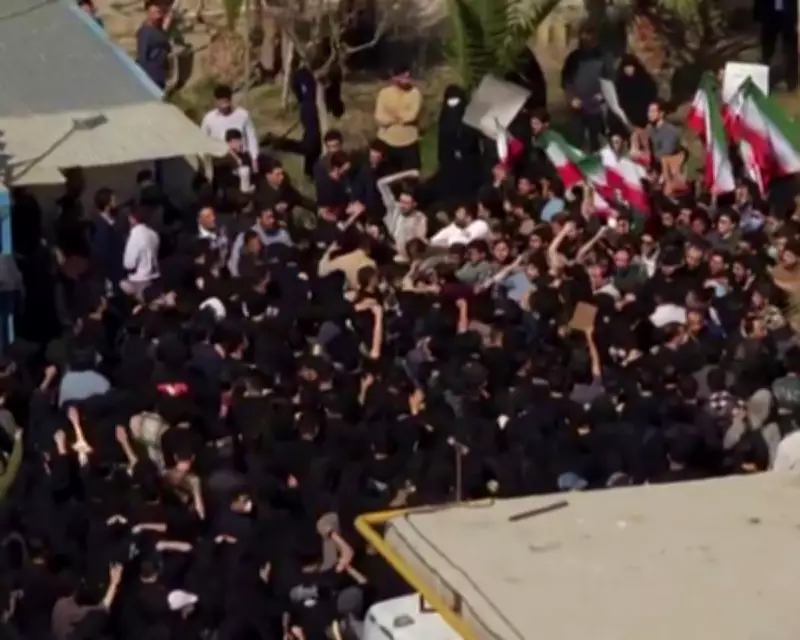
Simultaneously, the Iranian regime faces renewed internal pressure as student protests erupted at universities in Tehran and Mashhad. Videos verified by AFP TV show clashes between students and the state-backed Basij militia turning violent, marking a second day of demonstrations. These universities had just reopened after closures during earlier protests in December and January, which resulted in thousands of casualties.
Contested Death Toll and International Scrutiny
The exact number of deaths from the previous unrest remains disputed. While the Iranian government reports just over 3,000 fatalities, human rights organizations estimate a minimum of 6,000. Iran has resisted allowing a UN-led fact-finding committee into the country, maintaining that its internal investigation is adequate. This stance is expected to provoke walkouts at the UN human rights council when Iran's deputy foreign minister, Kazem Gharibabadi, addresses the body this week.
US Political Dynamics and Nuclear Negotiations
Initially, President Trump voiced strong support for the protesters, hinting at potential military intervention. Recently, his focus has shifted to Iran's nuclear program as the US amplifies its military presence in the region. Steve Witkoff, Trump's special envoy, questioned why Iran has not yielded to US pressure, suggesting bewilderment over their lack of capitulation despite significant naval power deployments.
Iran's negotiating stance emphasizes retaining the right to enrich uranium for peaceful purposes under a new verification system managed by the International Atomic Energy Agency (IAEA). In exchange for diluting its highly enriched uranium stockpile and granting IAEA full access to nuclear sites, Iran seeks sanctions relief. This approach has weakened calls from some US Republicans, like Senator Lindsey Graham, for military action against Iran.
Challenges and Leadership Shifts
For Trump, a key political hurdle is framing any new agreement as superior to the 2015 nuclear deal, which he withdrew from in 2018. Araghchi suggested that a new deal could offer improvements by committing Iran to a permanently peaceful nuclear program, unlike the time-limited 2015 accord. Experts note that while Iran might retain theoretical rights to enrich uranium for energy, its practical capacity would be severely restricted.
US officials believe that Iran's supreme leader, Ali Khamenei, and President Masoud Pezeshkian are increasingly marginalized in the negotiations, with Araghchi and Ali Larijani, chair of the supreme national security council, driving the strategy. Pezeshkian's political relevance has been further undermined by the mass arrest of his supporters in the Reform Front coalition, many of whom face charges related to criticizing the military's crackdown on protests.
Notable figures, such as Ebrahim Asgharzadeh and Javad Imam, have been released on bail after brief detentions, along with Azar Mansouri, head of the Union of Islamic Iran People party. However, the precise number of individuals incarcerated or charged remains unclear, highlighting the ongoing turmoil within Iran's political landscape.




