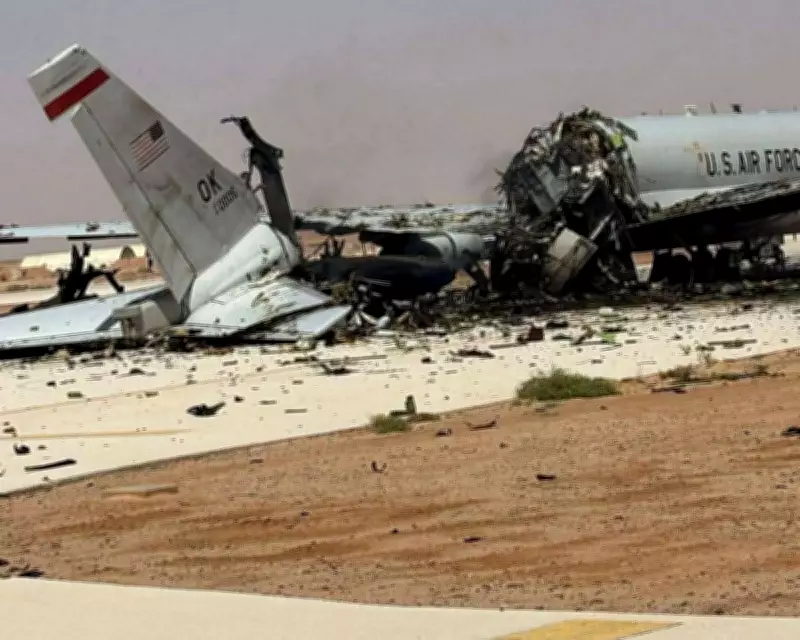
Iranian Attack Destroys Critical US Surveillance Aircraft at Saudi Airbase
The destruction of a US Air Force E-3 Sentry airborne warning and control system (AWACS) aircraft during an Iranian strike on Prince Sultan airbase in Saudi Arabia has raised significant concerns about regional security and intelligence vulnerabilities. The attack, which occurred on March 27, 2026, targeted one of only 16 operational E-3s in the US fleet, highlighting Iran's continued ability to strike high-value assets despite ongoing US and Israeli military operations.
Sophisticated Surveillance Platform Lost
The destroyed E-3 Sentry represented a crucial surveillance asset that first entered production during the 1960s. These aircraft carry sophisticated monitoring equipment capable of detecting airborne threats including missiles, while simultaneously surveilling communications, troop movements, and air defense installations across vast battle spaces. Each E-3 can track up to 600 targets simultaneously, serving as essential "eyes and ears" for fighter pilots and command centers.
Heather Penney, a former F-16 pilot and director at the Mitchell Institute for Aerospace Studies, emphasized the severity of this loss: "The destruction of this E-3 creates significant operational challenges, given how vital these battle management platforms are for airspace coordination, targeting, and providing critical battlefield effects that the entire force depends upon."
Evidence of Precision Targeting
Images from the attack scene reveal a direct strike on the E-3's distinctive radar dome located near the aircraft's tail section, indicating a high degree of targeting accuracy. The attack also injured US service personnel and damaged several aerial refueling aircraft parked nearby. This precision strike occurred despite the aircraft being stationary at the Saudi airbase, raising questions about protective measures for such valuable assets.
The E-3 was one of six reportedly deployed to Prince Sultan airbase, part of a fleet that has struggled with maintenance issues. According to Air and Space Forces Association data, the US Air Force's E-3s maintained only about a 56% mission-capable rate in 2024, meaning fewer than half were fully operational at any given time.
Russian Intelligence Involvement Alleged
Ukrainian President Volodymyr Zelenskyy revealed that Ukrainian intelligence had obtained information indicating Russian spy satellites photographed Prince Sultan airbase three times in the days preceding the attack—on March 20, 23, and 25. "When they capture images once, they are preparing. A second time represents simulation. The third time indicates an attack will occur within one to two days," Zelenskyy explained.
These allegations follow earlier reports suggesting Moscow has been providing Tehran with intelligence regarding US force locations throughout the Middle East. Russian Foreign Minister Sergei Lavrov has denied these claims, but the satellite imagery timeline raises serious questions about potential intelligence sharing between Russia and Iran.
Strategic Implications and Iranian Capabilities
Military analysts note that Iran appears to be deliberately targeting key enablers of US airpower, including radar systems and support aircraft, as part of a calculated campaign. This comes despite initial successes by US and Israeli forces in controlling Iranian airspace during earlier conflict phases.
While US and Israeli commanders have reported decreased Iranian missile launch capabilities, experts anticipated this reduction as Tehran conserves military resources and adjusts war strategy. Some analysts suggest Iran may be extending conflict timelines to maximize economic disruption globally.
The destruction of this critical surveillance platform underscores Iran's persistent strike capabilities against high-value targets throughout the region, challenging assumptions about degraded Iranian military effectiveness following sustained US and Israeli operations.