
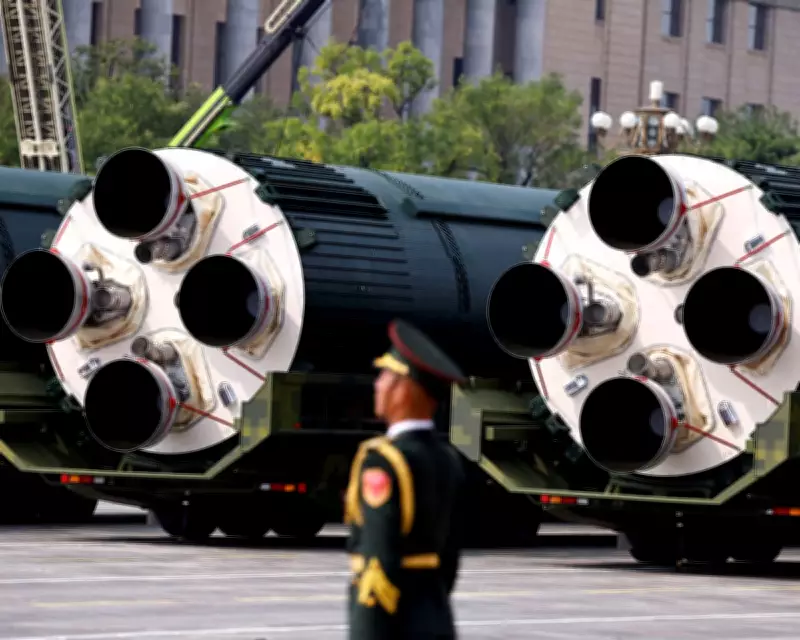
US Accuses China of Massive Nuclear Buildup Amid Arms Race Fears
The United States has leveled serious accusations against China, claiming the nation is dramatically expanding its nuclear arsenal while allegedly conducting secret nuclear tests. These allegations come amid growing international concerns about a potential new global arms race, particularly following the expiration of the New Start treaty earlier this month.
Diplomatic Confrontation in Geneva
During a heated session at the Conference on Disarmament in Geneva, Christopher Yeaw, the US assistant secretary of state for arms control and non-proliferation, delivered a stark warning about China's nuclear activities. "Despite its claims to the contrary, China has deliberately and without constraint, massively expanded its nuclear arsenal without transparency or any indication of China's intent or end point," Yeaw stated unequivocally.
He specifically criticized the recently expired New Start treaty between the US and Russia, calling it "seriously flawed" because it "did not account for the unprecedented, deliberate, rapid and opaque nuclear weapons buildup by China."
China's Firm Rejection
Chinese ambassador Shen Jian responded with equal force, telling the conference that his country "firmly opposes the constant distortion and smearing of its nuclear policy by certain countries." He insisted that Beijing would not "engage in any nuclear arms race, with any country" and defended China's nuclear posture as being "not in the same league as the countries possessing the largest nuclear arsenals."
The diplomatic exchange highlighted the deepening tensions between the world's two largest economies, with nuclear capabilities becoming a central point of contention.
Treaty Expiration and Strategic Implications
The expiration of New Start on February 5th marks a significant turning point in global nuclear diplomacy. For the first time in decades, there is no active treaty limiting the deployment of the planet's most destructive weapons between the world's major nuclear powers.
Washington claims that Russia has already exceeded New Start's limit of 1,550 deployed nuclear warheads, while asserting that China is rapidly approaching this threshold. "Beijing is on track to have the fissile material necessary for more than 1,000 nuclear warheads by 2030," Yeaw warned.
Allegations of Secret Testing
In perhaps the most explosive allegation, Yeaw provided detailed claims about what he described as secret Chinese nuclear testing. He told the conference that data gathered in nearby Kazakhstan indicated China conducted a 2.75-magnitude explosion underground on June 22, 2020.
"The estimated yield of the event was a 10-tonne nuclear explosion, or five tonnes conventional equivalent, which assumes the explosion was fully coupled in hard rock below the water table," Yeaw stated, adding that China appeared to be preparing for more explosions with larger yields.
These allegations come after former President Donald Trump said last October that the US planned to resume nuclear testing to match what he claimed were secret explosions by China.
Diverging Evidence and Perspectives
Ambassador Shen called the testing accusations "groundless" and suggested Washington was using them "as a pretext" to resume its own nuclear testing. This position finds some support in independent analysis.
A recent report from the Center for Strategic and International Studies did not find conclusive evidence of an explosion, noting that satellite imagery did not show unusual activity at Lop Nur, China's historic testing site in Xinjiang.
Diplomatic Engagement Continues
Despite the public acrimony, diplomatic channels remain open. A US state department source revealed that a "preparatory" meeting had taken place with a Chinese delegation in Washington the day after New Start expired, with a more "substantive" meeting scheduled in Geneva.
Yeaw emphasized that the US is not "walking away from or ignoring arms control," stating: "Our goal is a better agreement toward a world with fewer nuclear weapons." He suggested that the lapsing of New Start presented an opportunity to strike a "better agreement" that included Beijing in future arms control frameworks.
Global Context and Concerns
The confrontation occurs against a backdrop of significant nuclear disparities. According to the International Campaign to Abolish Nuclear Weapons, Russia and the US each possess more than 5,000 nuclear weapons, far exceeding any other nation's arsenal.
Yeaw also accused Moscow of helping "boost Beijing's capacity to increase its arsenal size," suggesting potential cooperation between the two nations that could further complicate global security dynamics.
As the diplomatic standoff continues, the international community watches with growing concern about the potential for a renewed nuclear arms race in an increasingly multipolar world where traditional arms control frameworks appear to be unraveling.




