
Ukraine's Drone Hunters: A Daily Battle Against Russian UAVs in the Donbas
The war in Ukraine has evolved into a grueling test of endurance, where territorial gains are measured in mere meters rather than miles. In the frozen, scarred landscapes of the Donbas, the conflict feels endless, with profound implications not only for Ukrainians but for Europe and the global order—challenging whether borders can be altered by force. On the ground, the struggle is less about grand strategy and more about the daily fight to survive.
On the Front Lines with the 117th Brigade
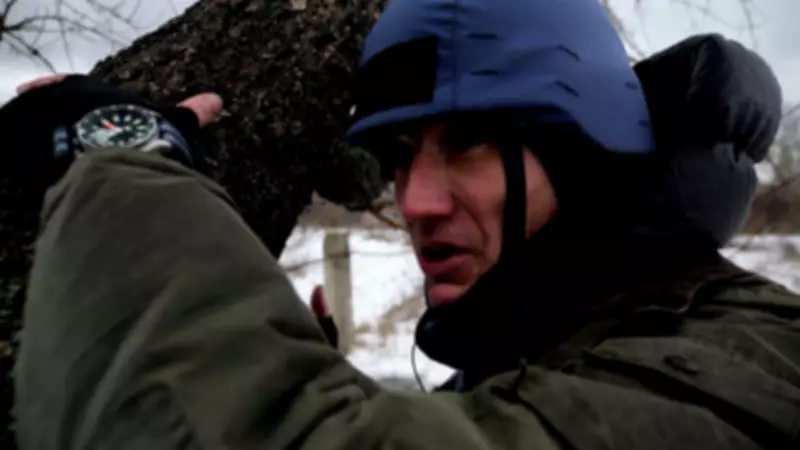
Sky News embedded with a unit from Ukraine's 117th Brigade, tasked with defending one of the most heavily contested regions in the Donbas, known as the "fortress belt." Reaching their positions requires nerve-wracking journeys across open ground, where the landscape is littered with the remnants of war. Once, soldiers only feared the scream of artillery shells; now, the menacing buzz of drones fills the sky, making every movement perilous.
As the team advanced, a drone was detected overhead, hunting for targets. Radio alerts confirmed it was tracking back, and handheld drone detectors beeped incessantly, signaling that their presence had been spotted. The soldiers heard the whizzing sound before seeing the unmanned aerial vehicle (UAV), its noise growing louder as it approached. In response, the deputy commander and another soldier opened fire with assault rifles, a routine but challenging task given the small, fast-moving targets. Relief came only when the drone fell from the sky, but there was no time to celebrate—more drones could follow, and artillery strikes might be imminent.
The Tools of the Trade: From Shotguns to Kalashnikovs
The journey continued on quad bikes over icy roads, past abandoned Ukrainian vehicles that served as stark reminders of the danger. Overhead, Ukrainian drones provided some protection by tracking their movement. Inside a bunker, the "drone hunter" unit, which operates in the shadows to protect the logistical hub of Sloviansk, showed off a cheap, mass-produced Russian drone they had shot down that morning. Bohdan, commander of the anti-aircraft battery unit, explained the tactics: "There are men working with pump-action shotguns because the drones fly at their lowest altitude there. That is within the effective range for a shotgun. But here, they fly higher and faster, so the Kalashnikov is the most effective tool."
A Desperate Fight for Survival
The relentless drone attacks have battered the region for years, yet amid the devastation, two civilians, Alexander and his wife, have survived under constant bombardment for four years. They remain because they lack the money and means to leave, living in fear with nowhere to go. As the team spoke with them, they had to take cover as another drone was spotted overhead. For the soldiers defending this territory, danger is constant. One soldier described their daily rhythm: "It happens two, three times a day: icy roads, sleeper drones, flying drones, and the Russians. It couldn't be more dangerous. Threats from everywhere—within seconds." Life in eastern Ukraine is a desperate fight for survival.
Secret Bunker: The High-Tech Heart of the War
Deep in a forest, the team was taken to a secret underground bunker, the tightly restricted headquarters of the 117th Brigade. Inside, a labyrinth of screens and monitors reflected the modern nature of this conflict—a fusion of microchips and mud, where drones create digital kill chains and soldiers do whatever it takes to endure. Colonel Dmytro Yaroshenk, the brigade commander, highlighted the transformation: "The war has changed fundamentally. We used to fight 'on horseback,' so to speak; now we fight in the sky. We're even taking down helicopters with drones. Not my brigade specifically, but there are units doing it."
On one screen, he displayed the aftermath of a Russian probing attack thwarted by surveillance drones and algorithms that see everything. He added, "Logistics are currently a nightmare because technology has evolved so much; drones are flying almost everywhere. If the enemy spots a vehicle, it's highly likely to be quickly destroyed." Another image showed a Russian bunker struck by attack drones, with no survivors emerging from the smoke.
The Grim Reality: 21st-Century Trench Warfare
This war has merged the high-tech capabilities of the 21st century with the brutal trench battlefields reminiscent of the First World War, resulting in a grim and relentless struggle. While the fighting may seem remote to those far away, its implications are global. After four years of merciless combat, the battle for the Donbas transcends territory—it is about shaping the world that will emerge when the guns finally fall silent, testing whether might makes right in our modern era.




