
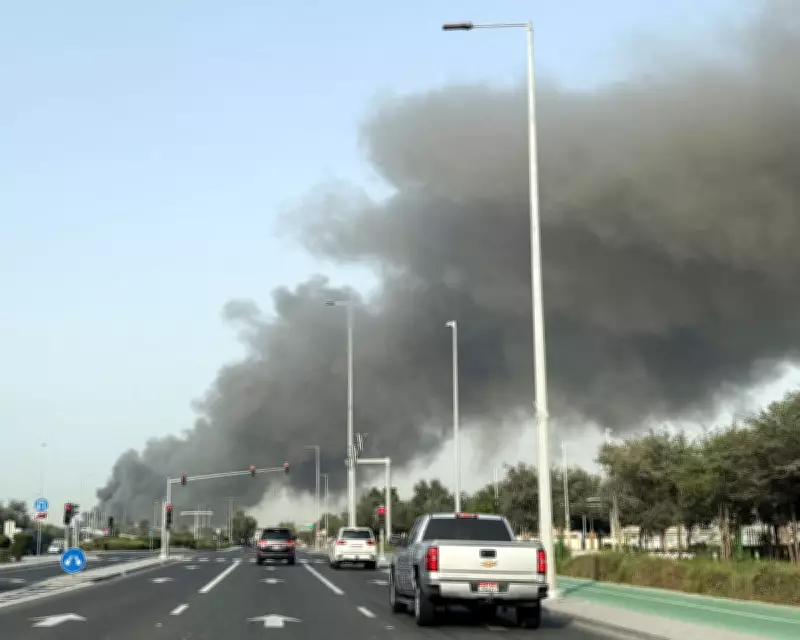
Foreign Office Initiates Unprecedented Evacuation Planning for British Nationals
The United Kingdom's Foreign Office has commenced urgent planning for the potential evacuation of tens of thousands of British citizens from the Middle East as regional tensions escalate dramatically following coordinated US-Israeli military strikes against the Iranian regime. This unprecedented consular operation comes as at least 76,000 British nationals have registered their presence in affected areas across the volatile region.
Thousands Stranded as Airspace Closures Create Travel Chaos
More than 50,000 of these registered Britons are believed to be currently located in the United Arab Emirates, with the majority consisting of holidaymakers and business travelers rather than permanent residents. Dubai, a major global tourism and commercial hub, has become particularly problematic as its airspace remains closed, leaving thousands of British tourists without viable options for returning home.
The Ministry of Defence is now collaborating closely with the Foreign Office to develop comprehensive evacuation strategies. Whitehall sources confirm that all possible options are being examined, including potential overland evacuation routes to neighboring countries with operational airspace, such as Saudi Arabia, should current restrictions persist and tensions continue to intensify.
Government Issues Stringent Travel Advisories
The Foreign Office has issued updated travel guidance advising against all travel to Iran, Israel, and Palestine. Additionally, the government recommends against all but essential travel to the United Arab Emirates, Qatar, Kuwait, and Bahrain. Further warnings have been issued regarding specific regions of Pakistan.
For British nationals currently in Saudi Arabia, the official advice is to remain at home whenever possible. Those in Jordan, Oman, Syria, Lebanon, Yemen, and Iraq are urged to exercise extreme caution and implement additional security precautions due to the heightened regional instability.
Political Leadership Responds to Escalating Crisis
Foreign Secretary Yvette Cooper is scheduled to deliver her first public remarks regarding the unfolding crisis on Monday, following a weekend dedicated to coordinating the government's response. Cooper has been engaged in intensive diplomatic efforts, consulting with regional counterparts alongside US Secretary of State Marco Rubio and other G7 foreign ministers.
Defence Secretary John Healey addressed the situation on Sunday, describing the Iranian regime as "evil" and highlighting its history of sponsoring terrorist plots against Western nations. While carefully distancing the UK from the recent US-Israeli strikes, Healey emphasized that approximately 300 UK troops were dangerously close to an Iranian missile strike targeting a base in Bahrain.
Healey confirmed that UK military aircraft are actively operating throughout the Middle East to protect British citizens and national interests. He further noted that Iran has engaged in indiscriminate attacks targeting civilian infrastructure including hotels in Dubai and Bahrain, as well as an airport facility in Kuwait.
Cross-Party Reactions Reveal Political Divisions
The US-Israeli military action has generated significant political controversy within the United Kingdom. Labour leader Keir Starmer expressed solidarity with Middle Eastern nations facing Iranian aggression, while Emily Thornberry, Labour chair of Parliament's foreign affairs committee, declared the attacks violated international law.
Green Party leader Zack Polanski condemned the assassination of Iranian Supreme Leader Ali Khamenei, stating no justification existed for the bombing. Conversely, Shadow Foreign Secretary Priti Patel criticized Starmer for insufficient support of the US-Israeli operation, and Reform UK's Nigel Farage called for greater British military cooperation with American forces.
The government's current priority remains ensuring the safety of British citizens throughout the region, with evacuation planning representing the most extensive consular operation in recent memory as the Middle East confronts one of its most dangerous crises in decades.




