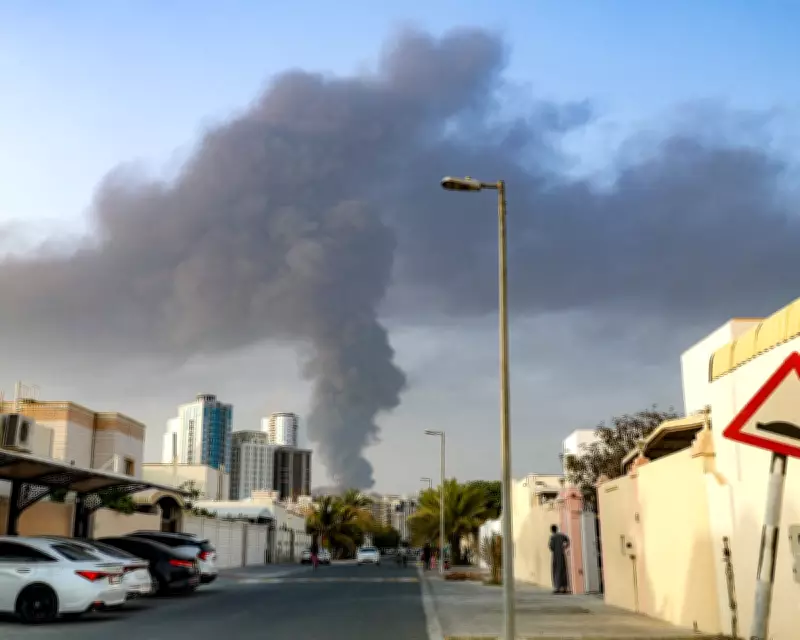
Industrial Blast in Fujairah Marks Dangerous Regional Escalation
Residents watched in alarm as a towering plume of smoke billowed from Fujairah's industrial zone in the United Arab Emirates on March 3, 2026, following a significant explosion. This incident represents the tangible consequences of escalating tensions between Iran and the US-Israel alliance, with ordinary citizens across the Gulf region now paying the price for geopolitical confrontations they did not choose.
Personal Connections Stretched Across Conflict Zones
For Aniseh Bassiri Tabrizi, an associate fellow at the Chatham House Middle East and North Africa programme, the crisis has created an impossible personal divide. While she resides in Abu Dhabi, her family remains in Tehran, forcing her to navigate concerns for loved ones in both locations simultaneously. "When I saw that Israel and the US had attacked Iran, I started worrying for family, thinking about potential consequences," she explains, noting that Donald Trump's subsequent regime-change rhetoric immediately signaled this confrontation would surpass previous escalations.
Communication with Tehran has become extraordinarily difficult, with internet access limited to mere minutes daily. Conversations are brief and practical, focused on safety assessments rather than meaningful connection. Despite authorities attempting to project normalcy by insisting people continue working, the reality in Tehran involves navigating fragmented information and unanticipated risks.
Methodical Responses Amid Growing Uncertainty
In the UAE, responses have been systematic yet underscore deepening anxiety. Schools have transitioned to online learning, workplaces have implemented remote arrangements, and air defense systems have become visible fixtures of daily life. While preparedness measures are evident, fundamental questions persist about duration and long-term implications. "Life continues, but every day brings more questions: how long will this last? What will prolonged instability mean for our lives, for our children?" Tabrizi observes, highlighting how even prepared communities cannot escape uncertainty's pervasive reach.
Strategic Miscalculations with Regional Consequences
The conflict's escalation reveals significant miscalculations by Washington and Israeli administrations regarding Tehran's response capabilities. Trump himself acknowledged surprise at Iran's retaliatory strikes across the Gulf region, despite experts having warned precisely about such outcomes if Iran felt cornered existentially. This underestimation has transformed what began as targeted actions into a regional crisis with expanding geographical impact.
Three primary drivers fuel continued escalation: For Iran, regime survival, territorial integrity, and deterrence credibility create existential stakes. Israel perceives a narrow window to permanently degrade Iranian military and nuclear capabilities, accepting wider escalation risks. The United States balances regime-change ambitions against alliance credibility and domestic political pressures while avoiding deeper Middle East entanglement.
Broader Implications Beyond Immediate Conflict Zone
Gulf states face structural threats to internal security, economic stability, and their carefully cultivated positions as global trade and investment hubs. Global markets and supply chains confront systemic consequences as instability affects energy flows and maritime choke points. Meanwhile, ordinary people from Tehran to Beirut, Gaza to Tel Aviv, and increasingly across the Gulf region absorb costs through disrupted lives and constantly shifting definitions of normalcy.
Tabrizi emphasizes that while Iran, the US, and Israel continue their strategic calculations, "this isn't just about military strategy and deterrence; for those across the region, it is about human endurance." As Gulf states quietly strengthen defenses and update contingency plans, and global markets remain alert to potential spillovers, the human dimension of this conflict continues to expand across borders originally uninvolved in the confrontation.