
Trump's Military Timeline: How a US Attack on Iran Could Unfold
Donald Trump has assembled the largest concentration of US air power in the Middle East since the 2003 Iraq invasion, as tensions with Iran reach critical levels. Military analysts suggest strikes could commence as early as this weekend, though any conflict would likely extend far beyond initial engagements.
Massive Military Buildup Signals Imminent Action
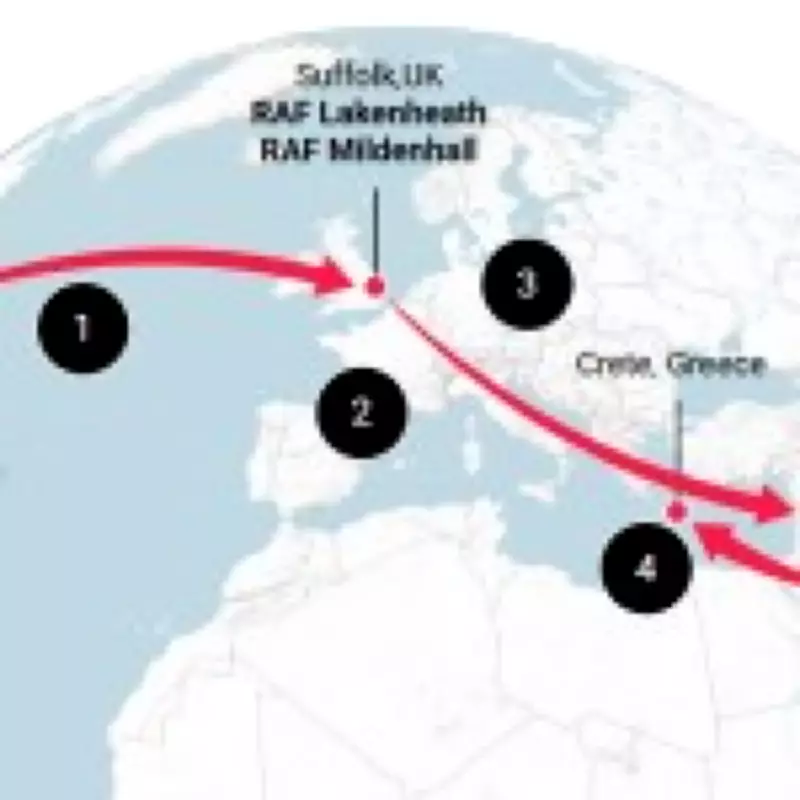
The United States military has positioned aircraft across strategic locations including Bahrain, the United Arab Emirates, Jordan, and Greece. Naval assets currently patrol the Red Sea, Arabian Sea, and near the crucial Strait of Hormuz. The world's largest aircraft carrier, the USS Gerald R. Ford, is en route to the Middle East and expected to reach the Arabian Sea by Sunday.
While CBS reports indicate Trump hasn't finalized a decision to strike, the unprecedented military movement strongly suggests potential action within days. Recent nuclear negotiations with Iran have stalled completely, with Trump essentially delivering an ultimatum: reach an agreement or face military consequences.
Potential Strike Scenarios and Targets
Security expert Will Geddes explains that the US would likely conduct precision mapping of Iran to ensure strikes target regime assets rather than civilian populations. "Nuclear development capabilities and military installations would be primary objectives," Geddes told Metro. "The ultimate goal would be disabling Iran's military power and pressuring regime change."
Recent satellite imagery reveals Iran has constructed concrete shields over new facilities at sensitive military sites, covering them with soil. This defensive preparation suggests Tehran anticipates attacks similar to last summer's brief conflict between Israel and Iran, where US forces destroyed multiple nuclear facilities.
In that previous engagement, B-2 stealth bombers departed Missouri, entered Middle Eastern airspace, struck nuclear sites at Fordo and Natanz, then returned to US bases without entering Iranian territory. Experts predict similar tactics would target nuclear facilities and government gathering points.
Experts Warn of Unpredictable Consequences
Dr. Bamo Nouri, Professor of International Relations at the University of West London, cautions that while initiating conflict might be straightforward for the US, controlling its escalation would prove extremely difficult. "An outright war would carry enormous and unpredictable costs for both nations," Dr. Nouri explained.
"For Washington, military strikes could backfire dramatically by unifying Iran domestically, accelerating rather than halting its nuclear program, and dragging the US into prolonged regional confrontation," he continued. "For Iran, direct war with the United States threatens regime stability and risks devastating infrastructure losses."
Dr. Nouri emphasizes that neither nation would structurally benefit from full-scale war. "What we're witnessing currently represents pre-negotiation positioning rather than structured diplomacy," he analyzed. "This appears to be high-risk brinkmanship designed to shape negotiations, not an imminent decision for all-out conflict."
Regional Implications and Historical Context
The current military buildup marks the most significant US force concentration in the region in over two decades. The strategic positioning of assets across multiple countries creates a complex web of potential launch points, while naval deployments near critical waterways signal readiness to control maritime access.
Iran's defensive preparations, including hardened facilities and soil-covered installations, demonstrate lessons learned from previous conflicts. The regime appears to be anticipating precision strikes rather than traditional invasion forces, suggesting both sides recognize the limitations of conventional warfare in this geopolitical context.
As the weekend approaches, diplomatic channels remain largely silent while military movements accelerate. The international community watches anxiously, aware that any miscalculation could trigger consequences extending far beyond the immediate region, potentially reshaping global energy markets, security alliances, and nuclear non-proliferation efforts for years to come.




