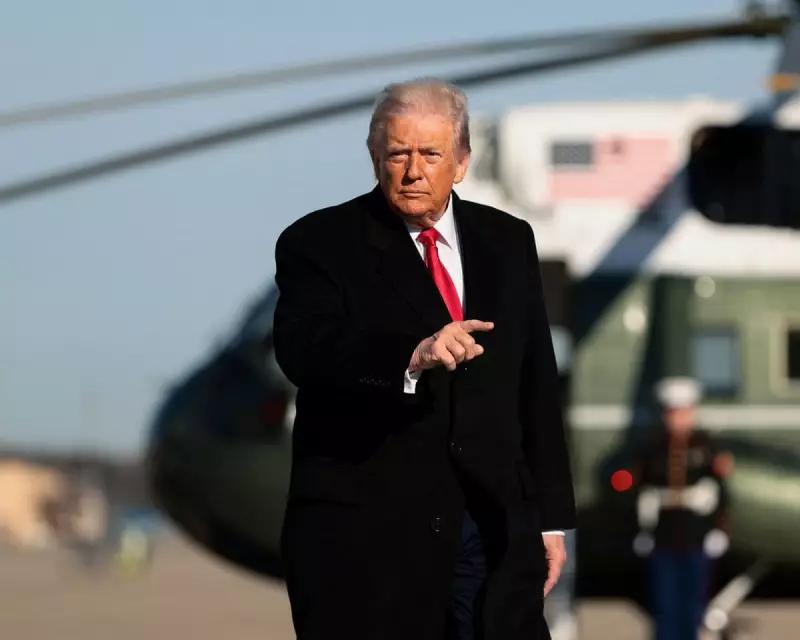
US President Donald Trump has issued his strongest indication yet of potential military action against Iran, while simultaneously imposing severe new economic penalties. Speaking from Andrews Air Base near Washington, Trump directly addressed Iranian citizens, urging them to continue their defiance against the regime.
'Help is on the Way': A Direct Call to Protesters
In a post on his Truth Social platform on Tuesday, the President wrote: "Iranian Patriots, keep protesting – take over your institutions!!! … help is on its way." He further stated he had cancelled all meetings with Iranian officials until the "senseless killing" of demonstrators ceased.
This public encouragement comes as reports suggest the death toll from the government crackdown has risen sharply. While Iranian officials admitted to 600 deaths, groups like Human Rights Activists in Iran report a figure of at least 2,000 killed, including 135 government-affiliated personnel. The severity of the state response had appeared to subdue protests in preceding days.
Trump's remarks are seen as a clear rejection of Iran's recent offer to reopen talks on its nuclear programme, pivoting instead towards a posture of direct support for the protest movement.
Escalating Economic Warfare: A 25% Tariff Hammer
Aligning with his rhetorical stance, President Trump has unleashed a significant new economic measure. He announced that, effective immediately, any country conducting business with the Islamic Republic of Iran will face a 25% tariff on all business with the United States.
This move directly targets over 140 nations that still trade with Iran, albeit often in small amounts. The tariff is paid by US importers of goods from those countries. Key trading partners now in the crosshairs include:
- China: Iran's largest partner, buying 77% of its oil exports in 2024.
- India: A major trader, already facing a 40% US tariff for trading in Russian oil.
- United Arab Emirates, Japan, and South Korea: Other significant partners.
The announcement sparked an immediate rebuke from Beijing. Liu Pengyu, spokesperson for the Chinese embassy in Washington, stated China would "take all necessary measures to safeguard its legitimate rights and interests," warning that "tariff wars and trade wars have no winners."
Military Options on the Table as International Condemnation Grows
While economic pressure ratchets up, military action remains a distinct possibility. Trump's national security team was scheduled to meet at the White House to discuss options, which are reported to include cruise missile strikes on Iranian police headquarters and targeted assassinations.
White House Press Secretary Karoline Leavitt confirmed airstrikes were among the "many, many options" under consideration, though she stressed "diplomacy is always the first option for the president."
The UK has joined the international response, with Foreign Secretary Yvette Cooper announcing sectoral sanctions on Iran covering finance, energy, transport, and software. She condemned the "horrendous and brutal killing" of peaceful protesters and summoned the Iranian ambassador, dismissing the regime's narrative of foreign interference as "lies."
In a stark assessment, German Chancellor Friedrich Merz commented: "I assume that we are now witnessing the final days and weeks of this regime. When a regime can only maintain power through violence, then it is effectively at its end."
As the crisis deepens, the Iranian regime has slightly eased some restrictions, allowing mobile calls abroad for the first time in days, but has kept severe internet blackouts and texting bans in place. The protests, which began over economic hardship, have evolved into a direct challenge to the country's clerical establishment, met with mass arrests and warnings that participation could carry the death penalty.