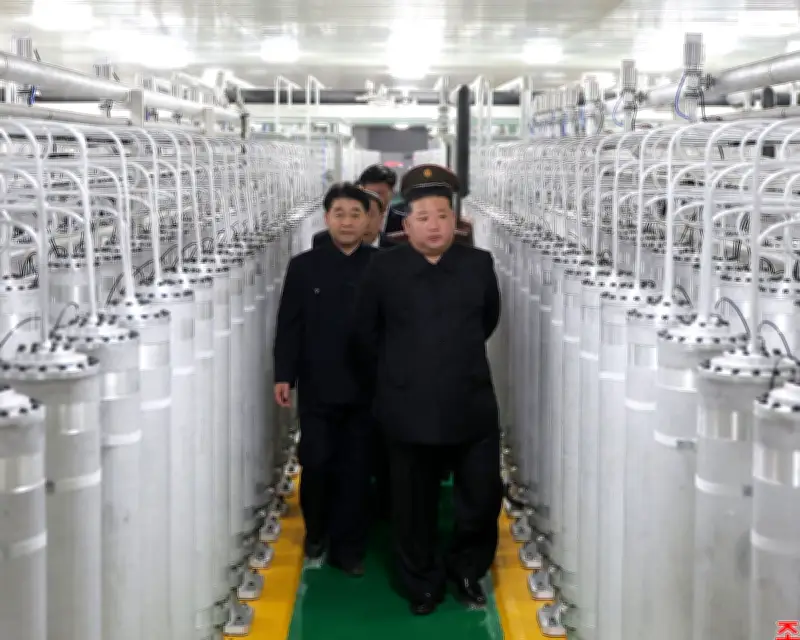
Kim Jong-un pledges exponential nuclear expansion
At a ruling Workers' party meeting that concluded this week, Kim Jong-un declared that steadily expanding North Korea's nuclear forces was the 'most correct and unique way' to cope with an increasingly unstable world, citing what he described as growing threats from the US and its allies. The remarks were just the latest in a recent stream of commentary from North Korea's leadership that has seen Kim pledge to equip warships with nuclear missiles, double weapons-grade production, and expand the country's nuclear arsenal at 'an exponential rate'.
Analysts question the need for a large arsenal
North Korea often makes exaggerated claims about the strength of its defense capabilities, but behind the heightened rhetoric, analysts say the question is no longer whether North Korea has nuclear weapons, but why it appears to need so many. 'It is a force so large and so dispersed that no single strike could eliminate it, and [appears] increasingly difficult to dismantle through diplomacy,' says Peter Ward, a research fellow at the Sejong Institute in Seoul, who believes North Korea is using the spread of its arsenal to protect against intervention of the kind seen in Iran. 'We don't know where all of them are. We don't know what they might do. And their threats are deliberately vague.'
Lessons from Iran: nuclear weapons as deterrence
The recent US-led strikes on Iran reinforced a lesson North Korea has long since absorbed: states that stop short of a fully operational nuclear arsenal invite attack rather than deterrence. 'A country that remains at the threshold level is drawing a big fat target on its back,' says Ward. Designed to survive a first strike, North Korea's arsenal spans rail and road-mobile launchers, hardened underground facilities, and an expanding submarine fleet. This year North Korea began test-firing nuclear-capable cruise missiles from a new 5,000-tonne destroyer, and on Wednesday Kim pledged that the country would build another two warships every year for the next five years.
Beyond minimum deterrence
Analysts say Pyongyang believes it needs a much larger arsenal to match the scale and complexity of the forces aligned against it. 'It faces the US nuclear umbrella, combined US-South Korean forces and trilateral cooperation with Japan,' said Hong Min, a senior research fellow at the state-funded Korea Institute for National Unification. 'It goes beyond minimum deterrence.' Nuclear weapons are now also embedded in the country's constitution. A revision earlier this year gave Kim constitutional command over nuclear forces and the power to delegate launch authority to a separate command, a move analysts interpret as a safeguard against a decapitation strike.
Denuclearization no longer applicable?
Lee Ho Ryung, a senior research fellow at the Korea Institute for Defence Analyses (KIDA), says Pyongyang was seeking to cement the idea that denuclearization no longer applied to North Korea and to build a level of capability that would force Washington to take it seriously. 'Their point is that this is not something that can be reduced through negotiations right now,' she says. Officially, denuclearization remains Seoul's stated objective when it comes to dealing with the North. South Korea's president, Lee Jae Myung, has made it a central plank of his government's policy. In May, Donald Trump and Xi Jinping reaffirmed what the White House described as a 'shared goal' of denuclearizing North Korea. But when Xi travelled to Pyongyang, Chinese readouts made no mention of it.
Deepening ties with Russia and China
North Korea's deepening military ties with Russia and its strengthened relationship with China have further insulated Pyongyang from the kind of external pressure that once made negotiations conceivable. The three states, despite their differences, share an interest in checking American power. KIDA's Lee Ho Ryung says Washington and Seoul would continue to uphold denuclearization as their formal objective, but in practice the focus was likely to shift towards arms control – limiting and gradually reducing the arsenal rather than eliminating it. 'In the end,' she says, 'there may be no other path.'