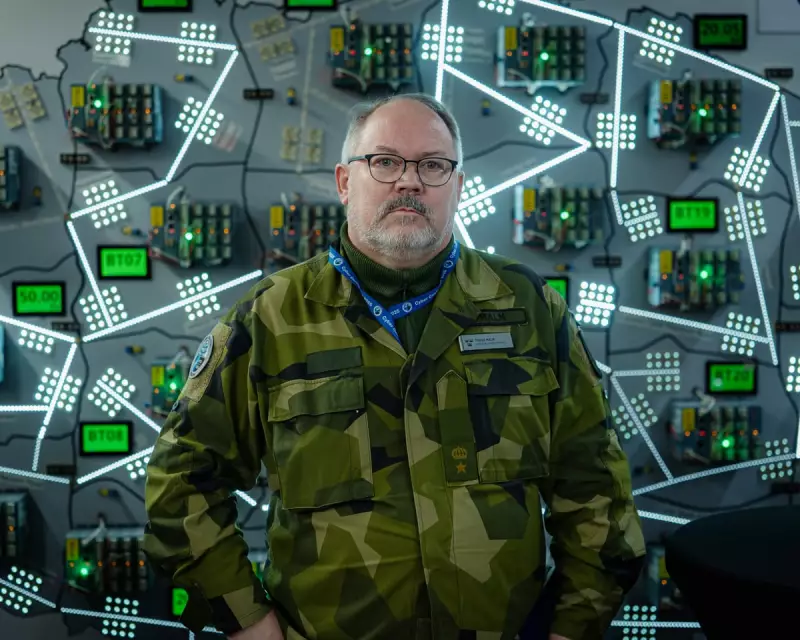
In a high-stakes simulation just 130 miles from the Russian border, NATO has concluded its largest-ever cyber warfare exercise, designed to test the alliance's resilience against a sustained digital assault. The week-long event in Tallinn, Estonia, saw hundreds of military personnel from 29 NATO nations and seven partner countries, including Ukraine, grapple with simulated power blackouts, jammed satellites, and widespread public chaos.
A Fictitious Conflict with Real-World Stakes
The war game, hosted at the Estonian defence ministry's CyberRange14 facility, was framed around a fictional conflict. The scenario involved the aggressive state of Harbadus attacking the ally Andvaria over the imaginary North Atlantic island of Icebergen. While Russia and China were not explicitly named, the nature of the threats mirrored tactics attributed to both nations in recent years.
Participants described the experience as "very stressful" and "quite exhausting," despite the combat being confined to computer terminals. The exercise director, US Navy Commander Brian Caplan, emphasised the borderless nature of the threat. "Adversaries can go into one nation and pivot into another," he said, highlighting the need for constant communication and trust-building among allies.
Cascading Crises: From Email to Orbit
The simulated attacks began deceptively small but rapidly escalated. Swedish forces, for instance, first dealt with malware in an unclassified email system at a base in Lithuania, which soon crippled their logistics. The situation deteriorated dramatically when exercise organisers triggered a multi-stage attack on a satellite internet provider akin to Starlink.
This move severed space-to-Earth communications, causing cascading failures in intelligence gathering, power-grid monitoring, GPS systems, banking, and military coordination. Deputy exercise director Ezio Cerrato described how participants "completely lose control ... right to the point of the wiping of the system," demonstrating how a space-based problem can swiftly affect every domain on Earth.
Other scenarios included malware in fuel management systems, forcing troops to ration supplies and disconnect networks. Fake news headlines on big screens reported dumped classified documents, fake train schedules causing public chaos, and states of emergency declared in regions with blackouts.
Innovation and Legal Grey Zones
NATO revealed it is experimenting with an AI-powered chatbot, built on an OpenAI model, to help commanders achieve situational awareness and make decisions during fast-moving cyber conflicts. While not yet deployed in the exercise, officials stated it has shown "very strong potential." The tool is undergoing rigorous checks for output accuracy.
The exercise also highlighted complex legal questions. Military lawyers were present to advise on the legality of responses to attacks often launched by shadow proxies against civilian infrastructure. "How do you cross those streams?" asked US Air Force Major Tyler Smith, noting the alliance is working on pre-agreed frameworks to avoid ad-hoc decisions during a crisis.
The backdrop to the simulation is a stark reality: according to Microsoft analysis, Russian cyber-attacks against NATO states increased by 25% in the year to June. Most aim for espionage, but smaller businesses are also targeted to create bridgeheads for larger assaults. NATO has directly attributed attacks to Russia's GRU military intelligence and accused China of "malign hybrid and cyber operations."
As the digital fog of war cleared in Tallinn, officials assessed the alliance's performance. The consensus was that NATO is learning to survive the onslaught, with one official summarising the outcome cautiously: "I see people surviving at the end of the day." The exercise underscores that in modern conflict, the front line is as likely to be a server rack as a battlefield trench.