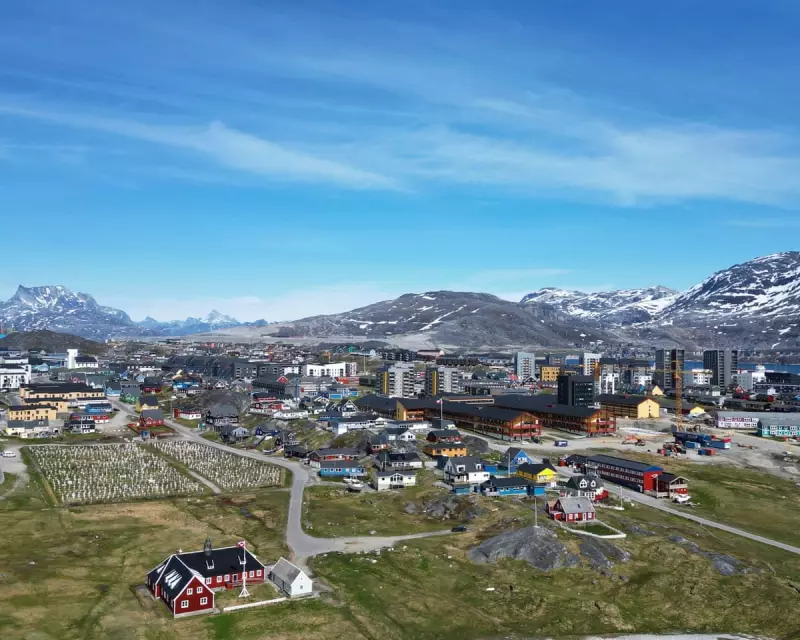
The Trump administration has repeatedly declared that the United States must gain control of Greenland, framing the move as essential for national security. President Trump has warned that the US will act on the territory "whether they like it or not," creating a significant geopolitical dilemma for European allies.
A Diplomatic and Strategic Quagmire
This stance places both the European Union and the North Atlantic Treaty Organisation in a profoundly difficult position. Greenland is a largely self-governing territory within the Kingdom of Denmark. While Denmark is a full member of both the EU and NATO, Greenland itself is not part of the European bloc but is covered by NATO's collective defence guarantees through Denmark's membership.
European leaders have uniformly defended the sovereignty and territorial integrity of Greenland and Denmark. However, a clear strategy to deter President Trump—or to respond if he makes a tangible move—has yet to be fully formulated.
Potential Pathways for a European Response
Diplomatic Outreach and Arctic Security: Diplomats, led by Denmark's ambassador to the US, Jesper Møller Sørensen, and Greenland's envoy, Jacob Isbosethsen, have begun lobbying US lawmakers. Their goal is to dissuade the president from his territorial ambitions, however slim the hope.
A key argument is that an existing US-Danish defence treaty from 1951, updated in 2004, already permits a massive expansion of the American military footprint on the island, including new bases. Furthermore, they stress that an aggressive US move against Greenland would effectively pit one NATO ally against another, a scenario Danish Prime Minister Mette Frederiksen said would mean "the end of NATO."
Concretely, NATO ambassadors have reportedly agreed to boost military spending and activities in the Arctic. This includes deploying more equipment and holding larger exercises to address US security concerns without ceding sovereignty. EU officials suggest modelling a response on operations like Baltic Sentry, designed to protect critical infrastructure.
Economic Leverage and Its Limits: Theoretically, the EU's single market of 450 million people grants it substantial economic leverage. Potential retaliatory measures could range from restricting US military bases in Europe to banning European purchases of US government bonds.
The bloc's most powerful tool is the so-called "trade bazooka," or anti-coercion instrument. This allows the European Commission to bar US goods and services, apply tariffs, and restrict intellectual property rights. However, deploying it requires unanimous agreement from member states, who have been reluctant to risk economic self-harm or jeopardise US support on issues like Ukraine.
As former top UN official Jean-Marie Guéhenno noted, Europe remains dependent on US technology in critical areas from data protection to defence software, leaving it vulnerable to a loss of American goodwill.
The Military and Investment Options
Investing in Greenland's Future: Greenland's economy relies heavily on an annual Danish subsidy of around DKK 4 billion (approximately €530 million), covering half its public spending. The EU could counter Trump's promise of "billions" in investment by increasing its own financial commitments to the island.
A draft European Commission proposal from September suggests the EU could double its funding to Greenland from 2028. While Washington may offer more, independent-minded Greenlanders may be wary of US corporate influence and reluctant to sacrifice their Nordic-style social security system.
Committing Troops as a Deterrent: Analysts Moreno Bertoldi and Marco Buti of the Bruegel think tank argue the EU should "proactively protect Greenland from US expansionism" by activating its rapid deployment capacity. This framework can mobilise up to 5,000 troops from member states for crisis response outside the bloc.
Deploying European troops to Greenland, with agreement from Copenhagen and Nuuk, would signal a firm commitment to territorial integrity. Experts argue that while it wouldn't prevent annexation, it would complicate it immensely. The spectacle of the US taking allied troops prisoner would devastate US credibility and influence domestic American opinion.
A German government spokesperson confirmed Berlin is working on a plan "including European deterrence," while France's foreign minister, Jean-Noël Barrot, has previously floated deploying a French military contingent.
As German Green MEP Sergey Lagodinsky stated, "No one believes a war between the US and the EU is desirable or winnable. But a US military move against the EU would have devastating consequences for defence cooperation, markets, and global trust in the US." This calculus may ultimately be the strongest deterrent of all.