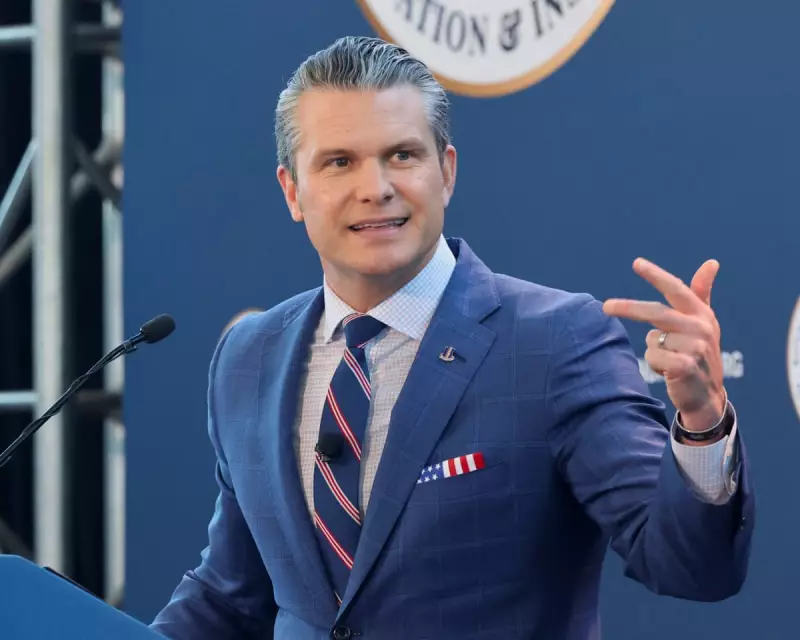
US Defence Secretary Pete Hegseth has delivered a defiant defence of American military strikes on suspected drug smuggling vessels in the Caribbean, arguing that President Donald Trump holds the authority to take military action "as he sees fit".
Forceful Defence at Reagan Library
Speaking at the Ronald Reagan presidential library in Simi Valley, California, on Saturday, Hegseth doubled down on the administration's controversial policy. The strikes, which have reportedly killed more than 80 people since September, are facing mounting legal and political scrutiny.
Hegseth justified the operations as necessary to protect American citizens, drawing a direct comparison between suspected drug traffickers and terrorist organisations like al-Qaida. "If you're working for a designated terrorist organisation and you bring drugs to this country in a boat, we will find you and we will sink you. Let there be no doubt about it," he declared.
He further emphasised the President's power, stating, "President Trump can and will take decisive military action as he sees fit to defend our nation's interests. Let no country on earth doubt that for a moment."
Mounting Legal and Political Challenges
Despite the secretary's robust stance, the Trump administration is confronting serious questions over the legality of its anti-narcotics campaign, with criticism emerging even from some Republican quarters.
The White House maintains the near two dozen strikes are lawful under the rules of war. It argues the US is in an armed conflict with fentanyl traffickers operating as part of designated terrorist groups, specifically naming Venezuela's Tren de Aragua and Colombia's National Liberation Army.
However, numerous legal experts have challenged this rationale. They point out the United States is not formally at war with an armed group in the Caribbean region, and the suspected traffickers have not attacked US assets or personnel abroad.
Additional concerns highlighted by critics include: the lack of criminal convictions for those targeted; scant public evidence supporting the official cartel designations; and analysis from regional experts suggesting the strikes are ineffective, as most fentanyl enters the US via Mexico, not Caribbean boat routes.
Scandal and Calls for Resignation
Scrutiny of the operations and Hegseth's leadership intensified in late November following a Washington Post report. It alleged a strike on 2 September was followed by a second attack on two survivors clinging to wreckage. The report claimed the commanding officer, Admiral Frank Bradley, ordered the follow-up strike to comply with instructions from Hegseth to "kill everybody".
Hegseth has denied this allegation. During a cabinet meeting, he stated Admiral Bradley "sunk the boat and eliminated the threat", adding that while he watched the initial strike, he did not monitor the subsequent hours.
As Hegseth shows no sign of retreating, demands for his resignation are growing. The New Democrat Coalition, the largest Democratic caucus in the House of Representatives, labelled the defence secretary "incompetent, reckless, and a threat" to service members. Its leaders accused him of lying, deflecting blame, and scapegoating subordinates.
In his California speech, Hegseth also reiterated Trump's vow to resume nuclear testing, criticised past Republican support for Middle East interventions, and dismissed concerns that climate change poses a serious challenge to military readiness.
The Associated Press contributed to this report.