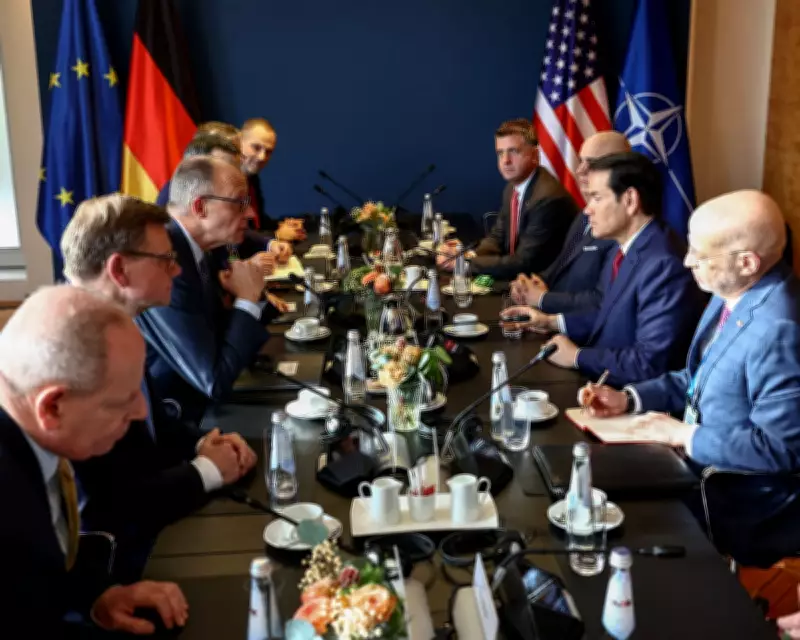
Germany Calls on France to Increase Defense Spending for European Self-Sufficiency
German Foreign Minister Johann Wadephul has publicly urged France to significantly boost its defense expenditures, emphasizing that European sovereignty requires concrete financial commitments from all member states. This call comes amid growing anxieties over the United States' long-term dedication to European defense under the current administration.
Pressure Mounts on Paris as Transatlantic Tensions Rise
Speaking in an interview with German public broadcaster Deutschlandfunk, Wadephul directly addressed French President Emmanuel Macron's frequent advocacy for European sovereignty. "Anyone who talks about it needs to act accordingly in their own country," Wadephul stated, highlighting a perceived gap between rhetoric and action in France's defense budget.
The backdrop to this diplomatic pressure is the escalating strain in the transatlantic relationship with the United States, leading European powers to seriously contemplate the possibility of standing alone for their collective defense. Nato member states had previously committed to increasing defense spending to 5% of GDP by 2035 during a summit last June, but progress has been disappointingly slow across the continent.
"Unfortunately, efforts in the French republic have also been insufficient to achieve this so far," Wadephul remarked. "France, too, needs to do what we are doing here amid tough discussions."
Germany's Defense Investment and Franco-German Friction
Germany has taken substantial steps by exempting most defense expenditures from its constitutional "debt brake" and allocating more than €500 billion for defense between 2025 and 2029. In contrast, France is embroiled in intense debates over public spending, ranking third in the European Union for its debt burden relative to GDP, trailing only Greece and Italy.
This criticism from Berlin exposes underlying friction within the traditionally robust Franco-German alliance, which has long been considered the engine of European cooperation. Disagreements persist on multiple fronts, including Macron's proposals for pooled EU debt to stimulate investment, collaborative plans for a next-generation European fighter jet, and negotiations for an EU trade agreement with South American nations.
Munich Security Conference Highlights Strategic Divisions
At the Munich Security Conference, German Chancellor Friedrich Merz delivered a stark warning about the imminent threat Russia poses to European stability. He also made a concerted effort to reaffirm mutual security commitments with the United States, acknowledging that the bilateral relationship requires significant "repair."
"In the era of great power rivalry, even the United States will not be powerful enough to go it alone," Merz asserted. "Dear friends, being a part of Nato is not only Europe's competitive advantage. It is also the United States' competitive advantage. So let's repair and revive transatlantic trust together."
In a revealing development, Merz disclosed preliminary discussions with President Macron regarding the possibility of Germany joining France's nuclear umbrella. This prospect of Europe independently pursuing nuclear defense capabilities beyond American protection has unveiled deep divisions within Germany's ruling coalition.
Internal Debate Over Nuclear Deterrence Strategy
Foreign Minister Wadephul, a member of Merz's Christian Democratic Union, expressed caution about Europe developing a more robust independent nuclear defense, noting that "there are enough atomic weapons in the world." He reassured that no one in Washington questions the US commitment to using its nuclear arsenal to defend Europe if necessary, warning against creating a misleading impression through public debate.
Germany's Vice-Chancellor Lars Klingbeil, a Social Democrat, confirmed Berlin's continued reliance on Nato's nuclear deterrence system, with no intentions to acquire its own atomic weapons—a commitment enshrined in existing treaties. He welcomed the exploratory talks with France but remained non-committal about the outcome.
However, senior Christian Democrat Armin Laschet voiced concerns that such proposals might signal to Washington that Germany is voluntarily distancing itself from the US protective shield. He also pointed out that France would likely retain exclusive control over the deployment of its nuclear arsenal.
Thomas Röwekamp, the CDU chair of the Bundestag defense committee, advocated for Germany to assume greater responsibility for European security but cautioned against hastily replacing US nuclear guarantees. He proposed a "European complement within Nato" to the American atomic arsenal, acknowledging France's longstanding contribution to European deterrence.
Unprecedented Joint Appeal for Rearmament
In a historic move, the highest-ranking military leaders of Britain and Germany published a joint article in the Guardian and Die Welt, making an unprecedented appeal to the public to recognize the "moral" imperative for rearmament and to prepare for the potential of armed conflict with Russia. This coordinated message underscores the heightened state of alert and the urgent need for unified European defense preparedness in an increasingly volatile geopolitical landscape.