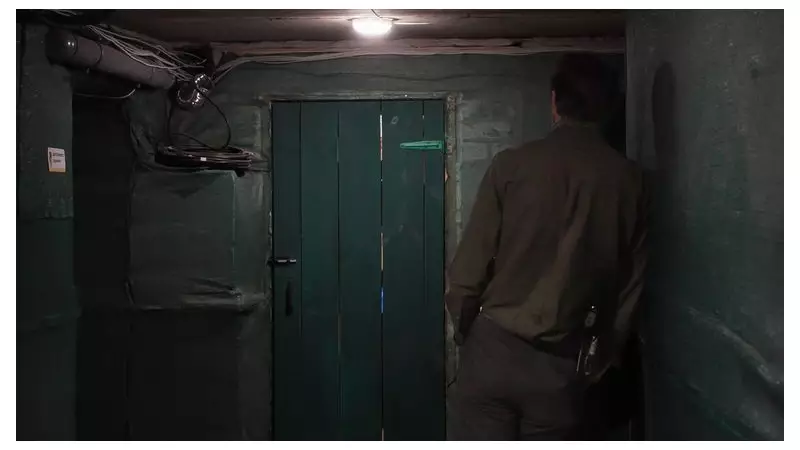
In an exclusive report, Sky News has been granted rare access to a highly classified underground military headquarters in eastern Ukraine, just before the unit stationed there is due to relocate.
A Subterranean Fortress in Donbas
The vast, hidden base, a labyrinth of war rooms, living quarters, and facilities, has served as a command centre for Ukrainian forces since the summer. Its location is so sensitive that soldiers change into civilian clothing before stepping outside to avoid detection. The unit preparing to move is the 1st Corps Azov of the National Guard of Ukraine, one of the country's most effective combat formations.
Speaking inside the base, Lieutenant Colonel Arsen Dimitric, known by his call sign 'Lemko', outlined the grim reality of the fighting around the frontline city of Pokrovsk. Seated by a large table covered with a map of the Donbas region, he stated their objective is clear: "We aim to destroy as much of the enemy as possible." He acknowledged the inevitable cost, adding, "Will we take losses? Yes. Will it hurt? Absolutely."
The Human Cost and Strategic Stakes
Lemko emphasised that allowing Russian advances would lead to greater suffering for Ukrainians. He argued that Moscow's primary edge is sheer manpower, noting almost 17,000 Russian soldiers had been killed or wounded in this sector alone between August and November 2025. "They don't care how many people they lose," he said.
This brutal conflict unfolds on land that, according to an initial draft of a US-proposed peace deal, could be ceded to Russia. However, Ukraine's military chief, General Oleksandr Syrskyi, has told Sky News that surrendering territory is "unacceptable." For Lemko, the soldiers' role is to shape the negotiating table through force. "Diplomats do their work, we do ours. Our job as soldiers is to give as many advantages as possible to our negotiating team," he explained.
A Stark Warning to Europe
Drawing on a decade of conflict since Russia's annexation of Crimea in 2014, Lemko issued a direct warning about the spread of hybrid warfare. He cited mysterious drone sightings, sabotage, and cyber-attacks suspected of originating from Moscow, now being seen in the Baltic States and wider Europe.
He cautioned that failing to counter these sub-threshold attacks risks full-scale war. "Ukraine once lost a hybrid war that had been waged since the very start of our independence," Lemko stated. "Because of that defeat, there was a physical operation against us in Crimea and then a physical operation in 2022... Now is the moment for all countries to unite and counter this hybrid war. Because the consequence may be a physical one."
As the Azov Corps prepares to vacate its underground stronghold, the fight above ground—and the broader geopolitical struggle it represents—intensifies, with implications far beyond the Ukrainian frontline.