
Europe's Existential Moment: Confronting Putin Without American Support
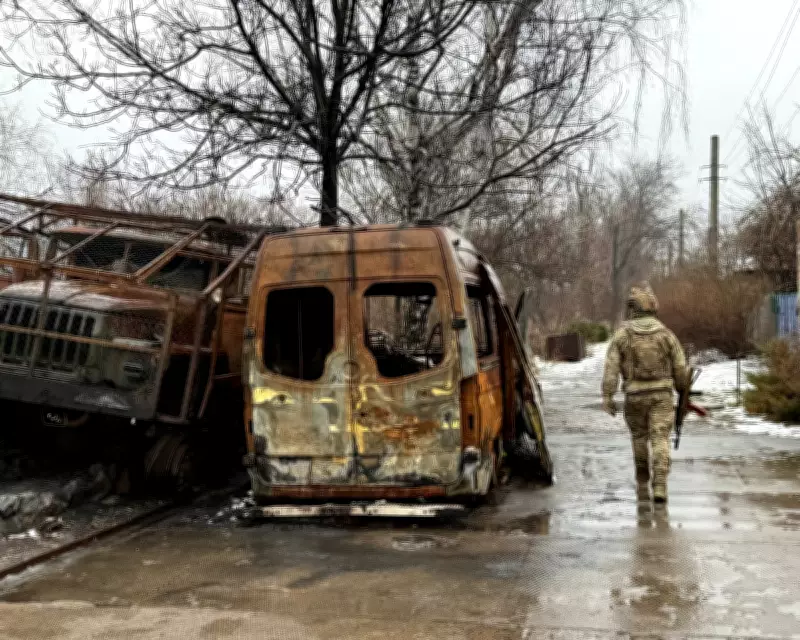
The frontline town of Kostiantynivka in Donetsk stands as a stark symbol of Ukraine's ongoing struggle, captured in a photograph dated 19 February 2026. As the war enters its fifth brutal year, Europe faces what foreign affairs commentator Simon Tisdall describes as "the biggest and most consequential of all the American betrayals."
The Collapse of Transatlantic Trust
From a European perspective, the United States' failure to defend Ukraine against Russian aggression represents the most significant in a series of recent American betrayals. This is not merely about the disturbing deference shown toward Vladimir Putin, an indicted war criminal responsible for mass killings. Nor is it solely about the victim-blaming rhetoric and pressure on Kyiv to make concessions. Even Donald Trump's crude attempts to profit from the war while undermining NATO allies and sovereign rights don't capture the full scope of the betrayal.
What truly shocks European observers is the profound bad faith demonstrated by a nation long considered a reliable friend. As 18th-century novelist Ann Radcliffe observed, "few circumstances are more afflicting than a discovery of perfidy in those whom we have trusted." Europe, like Trump warned after being rebuffed over Greenland, will remember this abandonment.
Global Power Shifts and European Vulnerability
As Putin's full-scale invasion enters its fifth bloody year, both Europe and Russia face significant challenges. However, the United States also finds itself in trouble, though Trump and his vocal supporters like Marco Rubio and JD Vance seem unaware of this reality. Most Europeans now view their primary partner as unreliable, if not an outright adversary. American global influence and leadership are rapidly diminishing, much to the advantage of a gleeful China. Autocrats worldwide celebrate this shift, as do Europe's advancing far-right political movements.
Wolfgang Ischinger, chair of this month's Munich Security Conference, emphasized the stakes: "The question of how this war is going to end is actually an existential question for Europe. It will determine – in more ways than one – the future of this continent."
The Trump-Putin Alignment and Its Consequences
The conflict has proven equally definitive for Trump and his narrow-minded Maga ideologues. At the Munich conference, Rubio ignored Russian atrocities while targeting globalization, "climate cults," and multiculturalism. The US secretary of state advocated for a return to ultranationalism, protectionism, closed borders, and Christian cultural dominance, declaring "yesterday is over."
This perspective reflects confusion, as Trumpism fundamentally seeks to recreate an imagined past. Putin suffers similar delusions, viewing the war as part of his revanchist project to restore Russian greatness and rebuild the Soviet sphere of influence. Similarly, China's Xi Jinping pursues his own backward-looking agenda by accumulating dictatorial powers unprecedented since Mao Zedong's era.
Historical Pattern of American Betrayal
The American betrayal of Ukraine, which foreshadows broader treachery, did not begin with Trump. Bill Clinton's 1994 security assurances for Kyiv following independence proved meaningless. Barack Obama hesitated when Putin seized Crimea in 2014. Joe Biden, haunted by cold war memories, responded with fatal overcaution to the 2022 invasion.
What distinguishes Trump's approach is its deliberate nature and current implementation. Each day brings fresh infamy. Last year witnessed Ukraine's highest annual civilian casualties since the war began, even as Putin expanded a conflict Trump promised to end within 24 hours. Direct US weapons supplies have dwindled to nearly nothing. Trump's laughable "peace process," managed by business associates and family members, indulges Putin's maximalist demands while excluding European partners.
The Flawed Peace Plan and Continued Aggression
Trump's 28-point "peace plan" – essentially a roadmap to Russian victory – was quickly discredited. Yet he continues insisting Kyiv surrender sovereign territory, establishing a dangerous precedent while withholding security guarantees. He still aims to profit from Ukraine's mineral resources and postwar deals with Russia. He persistently bullies Ukraine's admirable president, Volodymyr Zelenskyy, while belittling European allies and courting authoritarians like Hungary's Viktor Orbán, Argentina's Javier Milei, and Israel's Benjamin Netanyahu.
For shameless treachery, Trump has no modern equal. However, growing sentiment suggests this cannot continue indefinitely. How much longer can willing accomplices like NATO chief Mark Rutte speak of vital transatlantic ties while Trump systematically dissolves them? How dare Rubio lecture Europeans on Christian civilization while he and other "New World barbarians" ignore Israeli atrocities in Gaza? Now they contemplate attacking Iran and possibly Cuba – by what justification?
The Path Forward for Europe
Trump's perfidious tyranny, equally toxic domestically and internationally, will only worsen with continued tolerance. Despite obvious obstacles, Europeans and the anti-Trump American majority must begin speaking with one voice and matching words with actions. Ukraine represents both the actual and symbolic frontline in the battle between liberal democracy and the Trump-Putin axis.
Europe must implement several critical measures:
- Deploy troops from a European "coalition of the willing" to secure and defend Kyiv and other unoccupied cities, denying Russia any veto power
- Enforce a no-fly exclusion zone over Ukrainian territory
- Surge defensive missiles and drone capabilities to Ukrainian forces
- Target Russia's shadow fleet through coordinated action
- Intensify covert "active measures," including cyber operations and sabotage, to counter Kremlin hybrid warfare
- Seize Russian assets, expel spies, expose false narratives, and change the information landscape
Europe must demand an immediate ceasefire followed by phased Russian withdrawals, assuming leadership in any final settlement negotiations. The alternatives – endless war, continuous killing, or an unjust peace on Trump-Putin terms – are unacceptable.
Europe's Defining Challenge
Europe now operates with clear understanding: the United States cannot be trusted. This represents an existential challenge where everything Europe stands for and values hangs in the balance. For the sake of Ukraine's exhausted but undefeated people, and for Europe's own future peace and security, European nations (including Britain) must finally discover the unity, courage, and resources to take military, economic, diplomatic, and moral initiative.
Europe must bring the fight directly to Putin's doorstep. And Europe must unequivocally tell Trump to get lost. The time for dependence on unreliable American partnership has passed as the continent faces its most significant security challenge since World War II.




