Mexican Drug Kingpin 'El Mencho' Eliminated in Coordinated Military Strike
One of Mexico's most feared drug lords, known as "El Mencho," has been killed during a high-stakes military operation conducted by Mexican special forces with crucial intelligence assistance from the United States. The death of Nemesio Ruben Oseguera Cervantes, the notorious leader of the Jalisco New Generation Cartel, has unleashed a wave of retaliatory violence across multiple Mexican states, with cartel members blockading highways and setting vehicles ablaze.
Operation Details and Fatal Confrontation
The Mexican defense department confirmed that Oseguera Cervantes was wounded during an operation to capture him in Tapalpa, Jalisco state, on Sunday. He later succumbed to his injuries while being transported by air to Mexico City for medical treatment. During the confrontation, troops came under heavy fire, resulting in four individuals killed and three others wounded, including the cartel leader. Two additional suspects were arrested, and authorities seized armored vehicles, rocket launchers, and numerous firearms. Three members of the Mexican armed forces sustained injuries during the operation.
The U.S. Embassy in Mexico acknowledged the bilateral cooperation, stating that Mexican special forces executed the mission "within the framework of bilateral cooperation, with U.S. authorities providing complementary intelligence." U.S. Deputy Secretary of State Christopher Landau, who previously served as ambassador to Mexico, hailed the elimination of Oseguera Cervantes as a "great development" for both nations and the broader Latin American region.
Immediate Fallout and Security Measures
Following confirmation of the drug lord's death, cartel operatives initiated coordinated attacks across several states, blocking major highways with burning vehicles and torching businesses. These tactics, commonly employed by criminal organizations to impede military movements, paralyzed significant portions of the country. In the popular tourist destination of Puerto Vallarta, Jalisco, terrified visitors described scenes resembling a "war zone" as thick plumes of smoke filled the sky.
Multiple airlines, including Air Canada, United Airlines, Aeromexico, and American Airlines, suspended flight operations on Sunday due to security concerns. The U.S. State Department issued warnings to American citizens in Jalisco, Tamaulipas, Michoacan, Guerrero, and Nuevo Leon states, advising them to remain in secure locations during ongoing security operations. Jalisco Governor Pablo Lemus ordered residents to stay indoors, suspended public transportation services, and closed schools throughout the state on Monday.
Political Response and International Context
Mexican President Claudia Sheinbaum addressed the situation via social media, stating: "There is full coordination with the governments of all states; we must remain informed and calm... in most parts of the country, activities are proceeding normally." She extended recognition to the Mexican Army, National Guard, Armed Forces, and Security Cabinet while emphasizing ongoing efforts to enhance cooperation with the United States in combating cartels. However, she firmly asserted Mexico's sovereignty and cautioned against any unilateral military action by the U.S. within Mexican territory.
The operation occurred against a backdrop of escalating tensions between the two nations regarding cartel violence. Earlier this month, the Trump administration designated the Jalisco New Generation Cartel as a foreign terrorist organization. In January, following the U.S. capture of Venezuelan President Nicolas Maduro, former President Donald Trump remarked that "the cartels are running Mexico" and threatened military action against cartel operations.
Criminal Legacy and Cartel Power
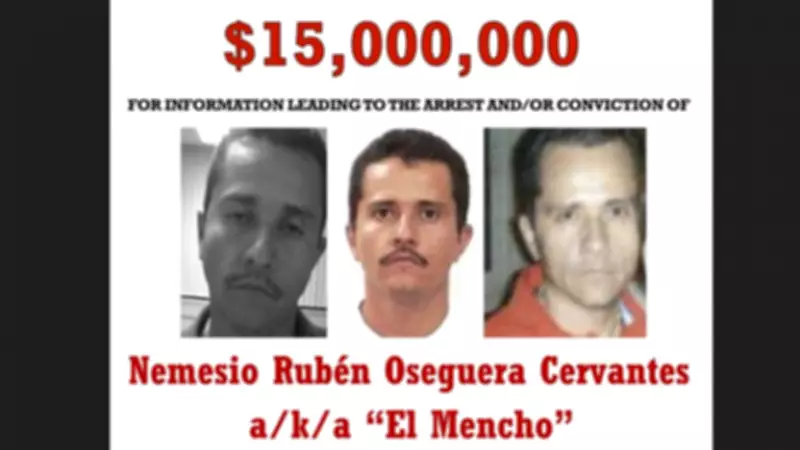
Nemesio Ruben Oseguera Cervantes had been deeply entrenched in drug trafficking since the 1990s. He was convicted of conspiracy to distribute heroin in U.S. District Court for the Northern District of California in 1994, serving nearly three years in prison before returning to Mexico to resume his criminal enterprises. Since 2017, he faced multiple indictments in the United States District Court for the District of Columbia, with the U.S. State Department offering a $15 million reward for information leading to his arrest.
The Jalisco New Generation Cartel represents one of Mexico's most powerful and rapidly expanding criminal organizations, with operations extending across all 50 U.S. states. The U.S. Drug Enforcement Administration considers it equally formidable as the infamous Sinaloa cartel. The organization generates billions of dollars through methamphetamine and fentanyl production while maintaining a dominant position in cocaine supply to the U.S. market. In 2020, the cartel demonstrated its audacity by attempting to assassinate Mexico City's police chief, who now serves as head of federal security, using grenades and high-powered rifles in the capital's central district.