Cyprus Escalates Calls for UK Military Base Withdrawal Following Drone Strike
Britain is confronting intensifying demands to withdraw its military installations from Cyprus as local residents amplify protests against facilities perceived as jeopardizing their security. This surge in opposition follows an unprecedented drone assault on RAF Akrotiri, a key British airbase on the Mediterranean island.
Protests Erupt in Nicosia Amid Security Fears
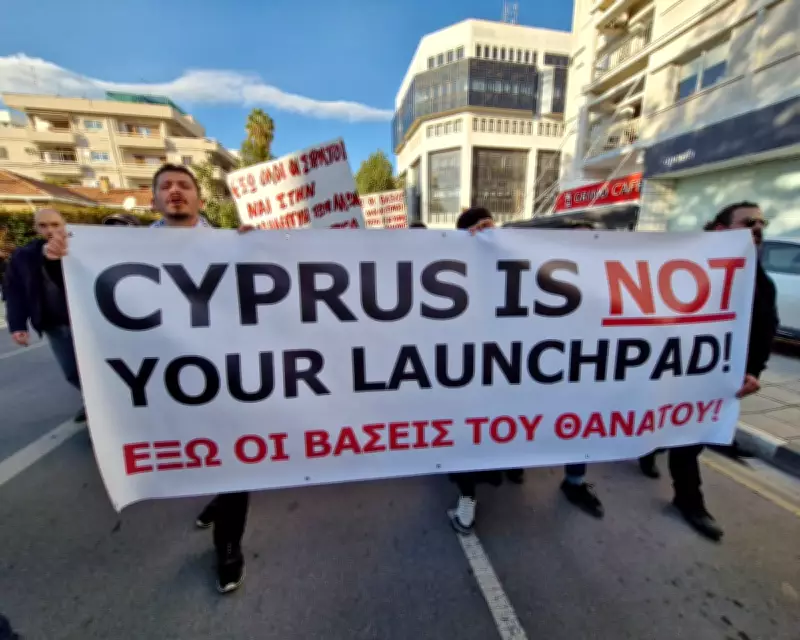
Anger over the British bases spilled onto the streets of Nicosia, the Cypriot capital, where demonstrators chanted "out with the bases of death" during a march to the colonial-era presidential palace. The protests reflect deepening fears that Cyprus could be drawn into the broader conflict involving Iran, heightening tensions on the island.
Mathaios Stavrinides, a prominent protester, voiced strong criticism, stating, "They are a danger to our security and should never have been here in the first place. We want them closed." The bases, established as part of Cyprus's independence agreement in 1960, occupy approximately 3% of the island's landmass and are viewed by many as unwelcome remnants of colonial rule.
Foreign Minister Confirms Drone Attack Origins
In a significant revelation, Cypriot Foreign Minister Constantinos Kombos confirmed to the Guardian that the Iranian-made drone which struck RAF Akrotiri was launched from Lebanon. This region is known to host Hezbollah, an Iranian proxy group, and units of the Islamic Revolutionary Guard Corps.
Less than twelve hours after the explosive-laden drone crashed into the base late Sunday, two additional combat drones were intercepted off the Cypriot coast. Minister Kombos confirmed these were also deployed from Lebanon, approximately 150 miles east of Cyprus.
"Right now it's a fact that we have to be looking towards the Lebanese front," Kombos stated, acknowledging the drones' provenance for the first time. "We cannot exclude anything from the broader direction of the north-east. We have to be very careful ... we have to make sure that the systems in place are covering all possibilities of threat."
Cyprus Raises Security Concerns with UK
Cypriot officials, who emphasize the nation's neutrality and humanitarian role as the EU's closest state to the Middle East, assert that the British bases—not the Republic of Cyprus—have been specifically targeted since the onset of US-led operations against Iran. Nicosia had repeatedly warned London about potential threats to the facilities during discussions beginning last year, but these alerts were reportedly ignored.
RAF Akrotiri serves as the UK's primary forward-operating post for Middle Eastern missions and is considered the most strategically important territory retained by Britain after Cyprus gained independence. "We've consistently communicated that the bases could be a target if things move in a specific direction regionally," Kombos emphasized, noting that the outcome of these conversations became starkly evident following Sunday's attack.
Defense Cooperation and NATO Aspirations
Minister Kombos highlighted that while not all defensive measures met expectations, cooperation is improving. The swift deployment of warships and air assets from several European nations, requested by Cyprus, aims to bolster the defense of the installations. The UK has also reinforced air defense systems, including Royal Navy Wildcat helicopters and F-35 fighter jets, though many view these efforts as insufficient and delayed.
Despite the unprecedented security cordon around Cyprus, Kombos affirmed the government's continued pursuit of NATO membership, a goal long hindered by Turkish opposition. "In the meantime, we are trying to make sure that we have the capacity to be able to link up to the NATO systems and structures as far as possible for someone who is not a member of the alliance," he explained.
Government Response and Public Distrust
Facing the most severe security crisis since Turkey's invasion in 1974, Cypriot President Nikos Christodoulides has reiterated that the country will not engage in military operations and has called for calm. Defense Minister Vasilis Palmas disclosed that the drone evaded detection by flying at an altitude of one thousand meters and speeds of 90 to 100 miles per hour, making it difficult for radar systems to track.
Public anger is further fueled by perceived inconsistencies in official accounts of the Akrotiri incident. Stavrinides, displaying a banner reading "Cyprus is not your launch pad," expressed widespread skepticism: "At first we are told it hit a runway, then there's pictures of a hangar being destroyed, a hangar we then find out is used by American military assets, specifically U-2 spy planes stationed there. It's lie after lie. Anything they tell us we have to take with an ocean of salt, and that's why these protests will continue."
The combination of historical resentment, immediate security threats, and transparency issues ensures that protests against the British bases will persist, placing increasing pressure on both the Cypriot and UK governments to address these critical concerns.