
China's Cold War Defense Strategy Returns Amid Deteriorating US Relations
As diplomatic relations between Beijing and Washington continue to sour, China is quietly reviving a decades-old cold war defense strategy originally conceived by Mao Zedong. The ambitious Third Front program, which once mobilized millions of workers to fortify China against potential attacks from the United States and Soviet Union, is experiencing a surprising resurgence in the country's remote inland regions.
The Original Third Front: Mao's Mountain Fortress
Launched in 1964 at the height of cold war tensions, Mao Zedong's Third Front represented China's most ambitious industrial defense project to date. The program deployed approximately 15 million workers to construct top-secret military factories in remote, mountainous regions of Sichuan, Gansu, and Ningxia provinces. These locations were deliberately chosen for their natural fortifications and distance from China's vulnerable coastal areas.
The strategic thinking behind the Third Front created three distinct defensive layers. The "first front" consisted of factories along China's eastern coastline, while the "second front" included smaller inland cities behind these coastal facilities. The "third front" placed critical military infrastructure deep within China's interior, protected by natural barriers like the Huaying mountain range in Sichuan province.
This massive undertaking attracted over 200 billion yuan in government investment and remained largely secret for approximately fifteen years. The program coincided with China's first nuclear weapons test in 1964, marking a pivotal moment in the country's military development during the cold war era.
Abandonment and Rediscovery
Following Mao's death in 1976 and the warming of relations with Western nations, the Third Front factories gradually fell into disuse. In 1985, Chinese leader Deng Xiaoping declared that "there will be no large-scale war for a fairly long time," reflecting China's shifting strategic priorities toward economic development rather than military preparation.
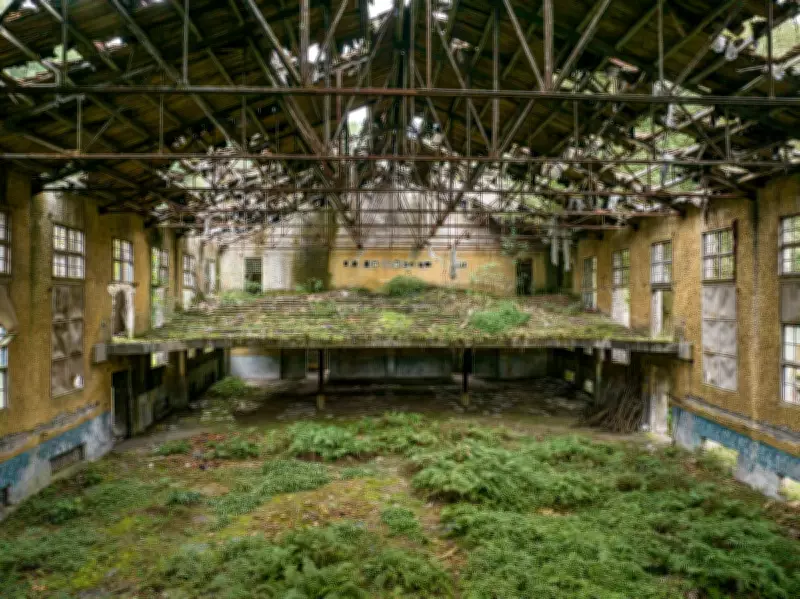
The abandoned facilities now present eerie scenes of industrial decay. Former factories like the Hongguang instrument facility, which once manufactured military lasers and fighter jets for nearly 2,000 workers, have been reclaimed by nature and agriculture. One former factory site now grows cabbages and canola, harvested by elderly farmers using traditional woven baskets.
Local residents describe dramatic population declines in areas surrounding these abandoned facilities. "Back in the 1990s, it was prosperous, a lot of people were here," explained one man living near the Huaguang instrument factory ruins. "People have more money now, so they're all heading to the cities."
Strategic Revival in a New Cold War Climate
Recent geopolitical developments have breathed new life into the Third Front concept. In July 2024, China's Communist Party leadership passed a resolution to "develop China's strategic hinterland and ensure backup plans for key industries"—a clear reference to utilizing remote inland provinces to enhance national resilience against potential invasion or international isolation.
President Xi Jinping, China's most powerful leader since Mao, has made national self-resilience a cornerstone of his political ideology. This renewed focus on strategic independence coincides with China's expanding nuclear capabilities. The country currently maintains an estimated 600 nuclear warheads, with US intelligence projecting this number will more than double within the next decade.
Satellite imagery analysis suggests much of this nuclear buildup is occurring in the same remote regions that once hosted Third Front facilities. While China's defense spending remains significantly lower than America's $317.6 billion military budget, the gap has narrowed substantially. In 2012, when Xi assumed power, China's defense expenditure was just one-sixth of US spending. By 2024, that figure had risen to one-third.
Changing Strategic Calculations
According to Covell Meyskens, a China historian at the US Navy-funded Naval Postgraduate School who has written extensively about the Third Front, China's strategic position has transformed dramatically since the 1960s. "The thing that's different than before is that China is in such a stronger position than it was before," Meyskens explains. "They're trying to build up their ability to make sure they have a second strike capability against the United States. Before, they had no strike capability."
Second strike capability refers to a nuclear-armed state's ability to respond to a nuclear attack with a devastating counterstrike. In the 1960s, China was "a very poor third world country," Meyskens notes. Today, "at least in the western Pacific, China is a peer. They could fight us either to win or stand still."
One significant difference between the original Third Front era and today involves economic interdependence. The deeply intertwined US and Chinese economies theoretically reduce conflict risks, but ongoing trade tensions have prompted both nations to disentangle critical supply chains. China has particularly leveraged exports of vital commodities like rare earths, while simultaneously reducing its dependence on foreign arms imports by more than 70% between 2021 and 2025, according to the Stockholm International Peace Research Institute.
Echoes of History in Modern Strategy
Xi Jinping's rhetoric frequently echoes Mao's aspirations for Chinese global supremacy, but with the crucial difference that China now possesses the economic and military capacity to realize these ambitions. The revival of Third Front principles reflects this confidence, even as it signals renewed geopolitical tensions.
"It's definitely going back to the hostile," observes Meyskens regarding current US-China relations. "We're in some sort of cold war." The historian emphasizes that the primary strategic goal remains preventing this cold war from turning hot. "Better to have munitions factories that are crumbling than cranking out new supplies," he concludes, highlighting the delicate balance between military preparedness and conflict avoidance that defines this new era of great power competition.




