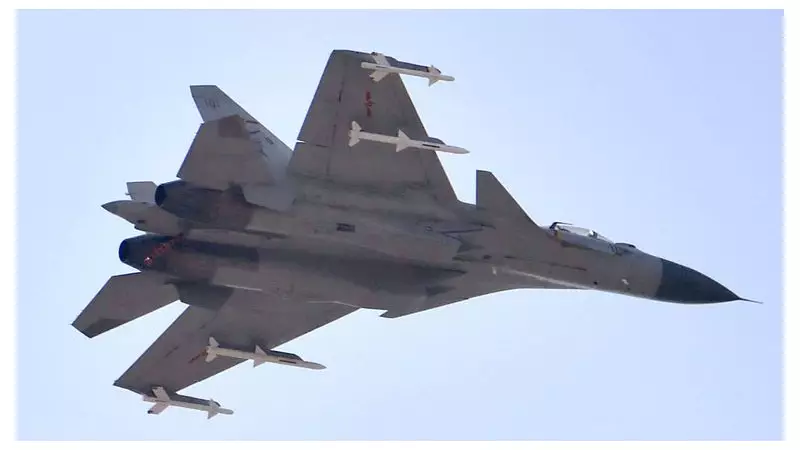
Japan has formally accused a Chinese military aircraft of performing a highly provocative fire-control radar lock on its fighter jets in airspace near Okinawa, labelling the act as dangerous and threatening.
A Dangerous Encounter Over the East China Sea
The incident, which occurred on Saturday 7 December 2025, saw a Chinese J-15 fighter jet target Japanese F-15 fighters on two separate occasions. According to Japan's defence ministry, the radar lock was applied intermittently for approximately three minutes in the late afternoon and again for about 30 minutes in the evening.
A fire-control radar lock is considered one of the most aggressive actions a military aircraft can take. It simulates the final step before launching a missile, signalling a potential imminent attack and often forcing the targeted aircraft to take urgent evasive manoeuvres to survive.
Carrier-Based Launch and Diplomatic Fallout
The Japanese defence ministry stated the involved Chinese J-15 was launched from China's Liaoning aircraft carrier. The carrier was operating south of the Okinawan islands alongside three missile destroyers. Japanese fighters had scrambled in response to a potential airspace violation, detecting the radar lock during their intercept mission.
In the early hours of Sunday 8 December, Japanese Defence Minister Shinjiro Koizumi announced that Tokyo had lodged a formal protest with Beijing. He condemned the move as having "exceeded the scope necessary for safe aircraft operations" and said Japan demanded China implement strict preventive measures to avoid a repeat.
However, a Chinese navy spokesperson swiftly refuted the claims, asserting that Japan's allegations were "completely inconsistent with the facts". The spokesperson countered that a Japanese Self-Defence Force aircraft had repeatedly approached and disrupted a Chinese naval training exercise.
Escalating Tensions in a Wider Dispute
This radar lock incident, believed to be the first of its kind between Japanese and Chinese military aircraft, occurs against a backdrop of sharply deteriorating relations. Tensions have been inflamed in recent weeks following remarks by Japan's Prime Minister, Sanae Takaichi, concerning Taiwan.
Prime Minister Takaichi suggested Japan's military could potentially become involved if China were to take action against Taiwan, the self-governing island Beijing claims as its own territory. Chinese Foreign Minister Wang Yi stated these comments had "crossed a red line", representing a significant hardening of rhetoric compared to previous Japanese administrations.
While Japan confirmed there was no breach of its sovereign airspace and no injuries or damage resulted from Saturday's encounter, the event marks a serious escalation in military posturing between the two Asian powers in a strategically vital and contested region.