Chernihiv's Unbreakable Spirit: A Hero City's Struggle in Ukraine's War
The basement trembles violently as aircraft thunder overhead, a relentless assault that continues day and night. Tetiana Mosich takes refuge below her home, clutching an axe for protection while she strives to shield her two young children from the chaos unfolding above. "A rumor spread that Russians were walking around the houses," she recalls. "I couldn't get out. There was such a panic. I didn't know what was going on." By Michael Drummond, foreign news reporter.
The Siege Begins
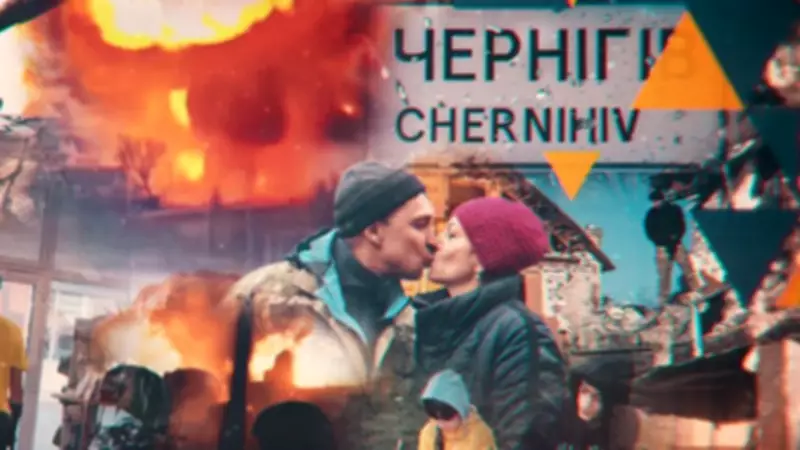
Just hours after Russia invaded Ukraine on February 24, 2022, its forces encircled Chernihiv, laying siege to the city. Tetiana and her family had no opportunity to flee their home on the outskirts. The Russian strategy aimed to capture Chernihiv swiftly and advance toward Kyiv within three days, but the 1st Tank Brigade, comprising 2,000 Ukrainian troops, mounted a fierce resistance.
Shelling ravaged the city on March 3, 2022. Tetiana's husband, Sasha, joined the defenders, while she huddled in the basement with their 13-year-old son and six-year-old daughter. They endured without water or electricity, surviving on meager rations of tomatoes, pickles—which her children despised—and bread tossed over the fence by a neighbor.
"It was very scary when our neighbor's garage, three houses away, was hit twice by shelling," Tetiana says. "Our dog was injured. I was overwhelmed. My son dragged him into the cellar and pulled out the shrapnel." The German shepherd still bears a scar on its cheek. For over a month, they ventured outside only when it seemed safe enough to cook over an open fire.
A Pivotal Victory
After weeks of intense combat, heavily outnumbered Ukrainian forces finally broke the encirclement of Chernihiv, allowing Sasha to reunite with his family. Located merely 90 miles north of Kyiv, the city's staunch defense halted a Russian advance of 30,000 troops. This crucial triumph earned Chernihiv the honor of being designated a Hero City by President Volodymyr Zelenskyy.
As the conflict enters its fifth year, Sky News has interviewed ordinary Ukrainians in Chernihiv and another Hero City, Sumy. They depict a daily, sometimes hourly, struggle to resist the invaders—whether on the battlefield, rescuing the wounded from rubble, or simply trying to feed their families in frigid, dark conditions. They also express their hopes for the future and skepticism about imminent peace.
Under Fire: Yurii's Story
When Russian forces attacked Chernihiv in March 2022, blocking the motorway, Yurii Vietkin found himself trapped. A former army major who had returned to civilian life, he chose to come out of military retirement to join the resistance. Serving with the 1st Tank Brigade, Yurii was on the frontline of the city's defense. "We held the enemy, defending our city of Chernihiv," says Yurii, 58.
"On March 5, during the clearing of enemy forces, our group came under mortar fire. My leg was torn off. One person was killed, another was wounded. I was saved by the guys." His left leg was amputated in a military hospital, but he required further treatment abroad. With Russian forces bombing civilian escape routes, Yurii's only option was to flee across a river by boat.
He received a prosthetic leg in Munich and returned to Chernihiv. As a qualified psychologist, Yurii adapted to his new circumstances and began assisting fellow veterans dealing with depression from limb loss. "I think that the first thing a person should do after a serious injury is to restore their physical strength," he emphasizes.
A turning point came when he was invited to participate in a musical performance, sparking a journey that led him to establish a theater in Chernihiv dedicated to veteran rehabilitation. Yurii now performs on his prosthetic leg and has toured stage shows across Europe. "Why should I be ashamed that I have no limb? Putin should be ashamed of it," he declares. "Others should not turn away. They should see that war is brutal, but we are standing."
Desperate Rescue: Ruslan's Ordeal
"I just had one thought: Will I ever see my family again?" Ruslan Ivanov was driving when the war erupted. "I saw that Kyiv was being bombed, rockets, explosions," he recounts. "People were in panic. I stopped, left my car and immediately went to protect Kyiv." At the time, Ruslan lived with his family in Chernihiv and worked as an art director at a film studio in Kyiv. He joined the 114th Territorial Defence Brigade, while his family volunteered in Chernihiv.
"Fear was always present," the 50-year-old admits. "There was uncertainty, total uncertainty." When he finally contacted his wife days after enlisting, she informed him that their 16-year-old son, Dima, had joined the Territorial Defence as a paramedic. "I said to him, 'Dima, why did you go to war? Why?' And he asked me: 'Why did you go to war? Did you ask us?' I said I understood. We wished each other good luck."
In 2023, Ruslan was stationed near Bakhmut on the Donbas frontline. He and his comrades were ordered to hold a railway line, enduring five days of constant counter-attacks, artillery, mortars, cluster munitions, and FPV drones. When a 120mm shell struck a nearby position, Ruslan and his comrade Ihor ventured out to help, only for a shell to explode between them.
"Ihor and I crawled back. I was wounded in my arm, my neck, my legs. Both of his legs were badly wounded," Ruslan describes. He applied a tourniquet to his own arm, while a comrade tended to Ihor's legs. "I hugged Ihor. He said, 'Ruslan, I'm leaving'. I heard a wheeze, a sigh. I held on to him with my remaining arm." Ihor succumbed to his injuries.
The horror persisted as the Russians counter-attacked. "My arm was already hanging. I looked and saw my bones sticking out through my jacket," Ruslan says. "I said, Oleh, load the weapon and let's go. I'll shoot with one hand." Reinforcements from the 28th Brigade eventually arrived, repelling the assault. After more than 12 hours, Ruslan and Oleh were able to leave their post for medical aid.
Upon waking in the hospital, Ruslan discovered his arm had been amputated. A doctor explained they had written "no" on him due to an undetectable pulse. "We were about to take you to the morgue," the doctor told him. "Then you started wheezing and groaning."
Putin's Strikes on Chernihiv
Since the invasion began, the Armed Conflict Locations and Events Database (ACLED) has recorded 198 conflict events in Chernihiv, including strikes, artillery fire, explosions, and armed clashes. At least 249 civilians were killed in the first year, with the siege destroying 70% of the city.
Although attacks decreased after the siege ended, Moscow has regularly targeted Chernihiv. Over the past four years, the city has lost cultural institutions and landmarks such as the Museum of Antiquities, the National University of Technology, and Hotel Ukraine, which had welcomed visitors for over six decades.
Last year, Russia launched 58 air and drone strikes on Chernihiv—an average of nearly five per month. Strikes have intensified in the last six months, with energy facilities repeatedly hit. An attack on September 26 left 70,000 people in the region without power, while shelling on October 4 plunged tens of thousands into darkness and struck oil storage tanks. As temperatures dropped below zero, Russia targeted a power plant on December 7.
No End in Sight
"People here believe in our victory." Like the rest of Ukraine, Chernihiv's future remains uncertain. Tetiana and Sasha have welcomed a third child since the war began, raising their baby boy in a warzone has been extraordinarily challenging.
Tetiana, 35, says ongoing strikes keep her in constant fear. She sleeps in her clothes to quickly rush her children to the basement and often schools them at home for safety. "I can't send Sashka to kindergarten, because they are constantly in the basement there," she explains.
Yurii reflects on the damage inflicted on the city, stating it "feel like my personal wounds." "I really love this city," he says, reminiscing about the parks and fountains that once offered solace. "Now, it is very painful. It hurts me very much to look at these ruins, especially when they are in the city centre."
With peace talks stalled, Tetiana doubts the war will end soon and worries about her eldest son's desire to join the army. Ruslan agrees, asserting that Russia would find any pretext to resume fighting. "If you ask people in Chernihiv, we will fight to the end. Many houses were destroyed. But people here believe in our victory. You can't drive them out or break them," he affirms.
"We talk among ourselves as veterans, amputees, discharged, disabled. If it happens again, we'll go again. We plan where we meet, where we go, what we do. I say 'I'll shoot, you load my weapon'. Yes, we suffer. But people of Chernihiv don't give up."