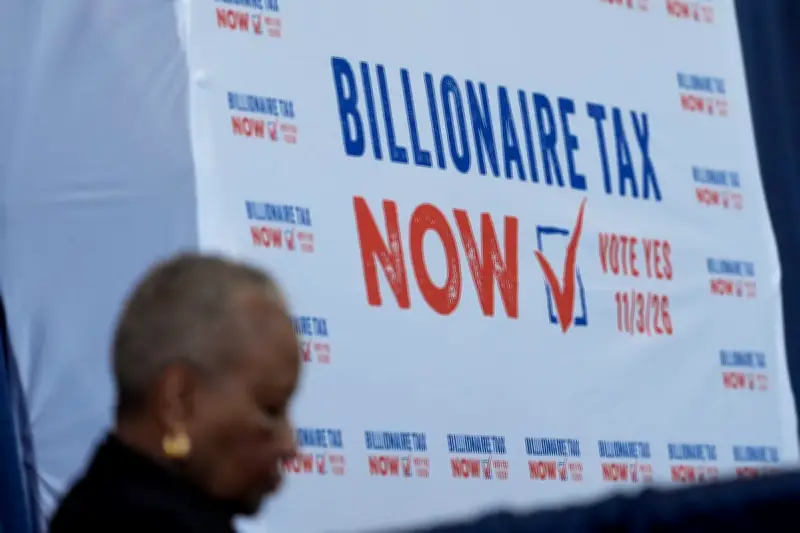
California's proposed billionaire tax is officially heading to voters in November after the secretary of state certified the ballot measure on Thursday. The initiative received more than double the necessary signatures to qualify.
The confirmation came after backroom negotiations between Governor Gavin Newsom, who opposes the proposal, and the labor union backing it failed to produce a deal.
What the billionaire tax would do
The California Billionaire Tax Act would impose a one-time 5% tax on any California resident worth more than $1 billion. The measure is backed by the Service Employees International Union-United Healthcare Workers West (SEIU-UHW) to fund food assistance, education, and healthcare programs, including low-cost health coverage and preventing hospital closures.

“Regular working people pay higher effective tax rates than the wealthiest Americans,” Suzanne Jimenez, SEIU-UHW chief of staff, told the Guardian. “Asking those who have benefited most from the economy to contribute more – particularly to stabilize healthcare systems under direct threat – is a reasonable step.”
The tax would apply retroactively to all billionaires who were California residents as of January 1, 2026. California is home to approximately 200 billionaires, many of whom have increased their wealth during the AI boom.
Opposition from Newsom and labor groups
Governor Newsom has been a vocal opponent, arguing that state-level wealth taxes “drive a race to the bottom” and could chase billionaires out of California, stripping the state of revenue. He reportedly tried to negotiate a deal with SEIU-UHW to withdraw the measure before certification, but the union's offer to reduce the tax from 5% to 2% was rejected.
Other opponents include the California Teachers Association, the State Building and Construction Trades Council of California, the California Medical Association, and Planned Parenthood Affiliates of California. These groups argue the measure lacks a sustainable funding path and does not guarantee funds will reach those in need. A Planned Parenthood spokesperson said the group “agrees the wealthy must pay their fair share” but called the measure “short-sighted” and not a sustainable solution.
Prominent progressives like Senator Bernie Sanders have championed the initiative. “Never before have so few people had so much wealth and so much power,” Sanders said in a February speech. “These billionaires are going to learn that we are still living in a democratic society where the people have some power.”
Tech billionaires pour millions into opposition
Silicon Valley has mounted the strongest opposition. Google co-founder Sergey Brin, worth around $260 billion, has spent at least $82 million to fight the tax. Crypto billionaire Chris Larsen, worth over $11 billion, has contributed at least $13.2 million. Other donors include Palantir co-founder Peter Thiel, former Google CEO Eric Schmidt, DoorDash CEO Tony Xu, and Stripe CEO Patrick Collison.
This spending has helped place two competing initiatives on the November ballot. One would prohibit new taxes on individually owned assets and savings and bar retroactive taxation. The other would require audits of state programs funded by voter initiatives and prohibit new state taxes enacted after January 1, 2026.
California's November ballot will now feature three taxation measures, likely causing voter confusion. Election watchers expect Silicon Valley to escalate spending, with residents facing a barrage of mailers, robo-calls, and ads. “What you’re seeing now … it was just like a drop in the bucket of what’s going to happen,” said Francesco Trebbi, a public policy professor at UC Berkeley. “It’s going to be exponential.”