
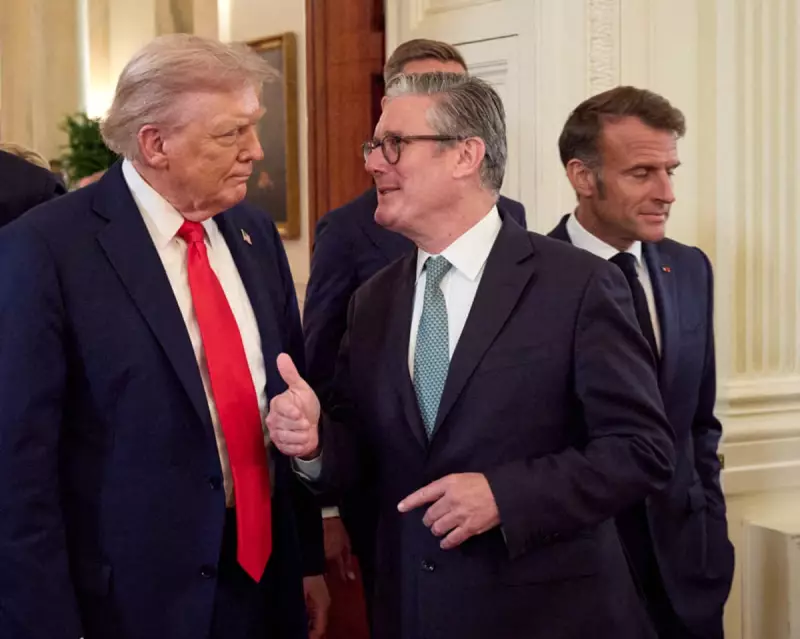
The carefully laid domestic plans of Prime Minister Sir Keir Starmer have been abruptly derailed by the turbulent return of Donald Trump to the White House. The US president's unilateral actions, from tariffs to territorial ambitions, have created a volatile international climate that demands London's constant attention, pulling focus from the home agenda.
A World Upended by Trump's "America First" Agenda
The chaos was starkly illustrated in August 2025 at a White House meeting involving Trump, Starmer, and French President Emmanuel Macron. This gathering of Ukraine's allies was overshadowed by Trump's renewed claim over Greenland, a move that forced NATO partners like Denmark to treat the threat with sober seriousness. The situation escalated further when American special forces boarded a Russian-flagged tanker in European waters to enforce a blockade against Venezuela.
These events confirm a clear pattern: President Trump sees no value in America's historic alliances and holds a visceral disdain for multilateral institutions. His vision for transatlantic relations reduces Europe to a collection of client states, ideally under far-right leadership, prioritising US economic interests over collective European power.
Britain's Precarious Post-Brexit Balancing Act
This new reality places the United Kingdom in a profound strategic bind, a direct consequence of its Brexit decision. The nation is now detached from the European single market yet remains deeply reliant on it for trade. Simultaneously, its traditional security dependency on the United States is undermined by a Washington that is no longer a reliably friendly capital.
Sir Keir Starmer's government has attempted a delicate balancing act, pursuing closer economic ties with Europe while cautiously negotiating a parallel trade deal with the Trump administration. However, ministers have begun speaking more plainly about the significant costs of Brexit, acknowledging the duplicitous terms on which it was sold to the public and the scant rewards it has delivered.
The Domestic Politics of a Foreign Policy Crisis
The prime minister's foreign policy tightrope walk is inextricably linked to his domestic political challenges. His difficulty in articulating a compelling national story is mirrored by his awkward position between European solidarity and courting a mercurial American president. This is not two separate struggles but one core contest of values.
Downing Street has drawn a firm red line, refusing to consider any reintegration with the single market that would require restored free movement of labour, a move feared for its potential to provoke opposition over immigration. This limitation severely curtails the potential economic value of Starmer's European outreach programme and demonstrates how foreign policy and domestic politics are completely intertwined.
The situation demands unambiguous, principled leadership and hard choices about where Britain's strategic future lies. With Trump destabilising the global order, the case for deeper, faster continental solidarity with Europe has never been stronger, requiring an explicit repudiation of the divisions wrought by Brexit.




