
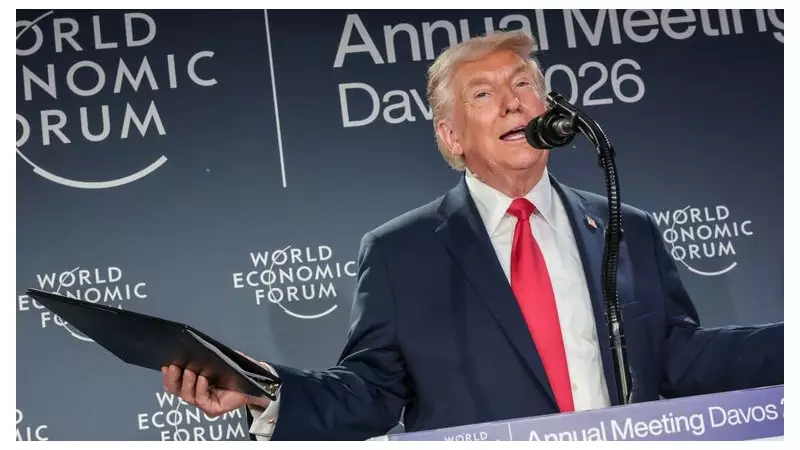
The World Economic Forum in Davos has concluded, but its reverberations will be felt across global politics and economics for months to come. This year's gathering was unprecedented in its singular focus on one dominant figure: former US President Donald Trump.
A Comprehensive Hijacking of the Global Stage
Switzerland's traditional neutrality provided the backdrop for what became a full-frontal assault on Europe's established economic and political frameworks. While Davos has always attracted political heavyweights to lend relevance to its annual meetings, never before has one individual so completely commandeered the agenda.
Trump arrived at the head of the largest American delegation in the forum's history, ensuring his presence would dominate proceedings from the outset. His provocative threats against Greenland, delivered as delegates were preparing to depart, guaranteed he maintained a complete monopoly on attention throughout the event's closing stages.
Diplomatic Fallout and European Response
The diplomatic consequences dominated public discussions across multiple platforms. European Commission President Ursula von der Leyen spoke of developing a new "European independence" in response to the shifting geopolitical landscape. French President Emmanuel Macron, appearing in distinctive mirrored sunglasses, condemned Trump's approach as outright bullying.
Perhaps the most significant commentary came from Canadian Prime Minister Mark Carney, the former Bank of England governor. He described the current situation as a fundamental "rupture" in international relations and called for middle powers to form new alliances to counter American and Chinese assertiveness. "If we're not at the table, we're on the menu," he warned starkly.
Trump's Signature Delivery: Bombast and Falsehoods
The official Davos theme promoted "a spirit of dialogue," but Trump's address represented something entirely different. His message could be summarised as "shut up and listen" – a familiar blend of braggadocio, bombast, and occasional falsehoods.
He made the extraordinary claim that China, home to the world's largest wind farms, had none whatsoever. In a historical revision, he told attendees they would all be speaking German "and maybe a little Japanese" without American intervention in the Second World War.
Amid the exaggerations, some home truths emerged, particularly concerning the United Kingdom. While his fixation with "windmills" and renewable energy appeared eccentric to many observers, and his projections for North Sea reserves faced serious questioning, his highlighting of soaring energy costs struck a chord with reality.
The Greenland Climbdown and Business Realism
Trump's eventual retreat from his threats against Greenland validated predictions from seasoned business leaders in attendance that cooler heads would ultimately prevail. As one British executive observed succinctly: "Cool cats win spats."
Yet even as the immediate tariff threats subsided, the broader challenge of American disruption remained firmly on the table. The US delegation arrived in Switzerland clearly prepared for confrontation, with Commerce Secretary Howard Lutkin adopting a belligerent stance at every opportunity.
"We have come with a clear message," Lutkin declared during one panel discussion, seated beside UK Chancellor Rachel Reeves. "Globalism is dead."
European Discomfort and Walkouts
The American approach generated visible discomfort among European counterparts. At a private dinner following Trump's Greenland retreat, one attendee described the triumphalism of US officials as "embarrassing." European Central Bank President Christine Lagarde made a pointed exit from another event following Lutkin's remarks about Europe.
US Trade Representative Jamieson Greer maintained equally strident rhetoric, telling journalists that no nation – not even traditional European allies – could take access to American markets for granted.
A Supporting Cast of Global Luminaries
The extent of American agenda dominance became evident in how the most powerful Davos lineup ever assembled was reduced to supporting roles. Only during this peculiar January week could one encounter Apple's Tim Cook, Elon Musk, David Beckham, MI6 chief Blaise Metrewelli, Matt Damon, and Rachel Reeves all within a single afternoon.
While the public festival of ideas was largely sidelined, Davos maintained its function as a gold-plated networking platform. Behind-the-scenes dealmaking continued unabated, even as the main stage was monopolised by transatlantic tensions.
The UK's Position in a Disrupted World
The substantial British delegation, led by Chancellor Rachel Reeves, presented a bullish front about their reception. Changes to visa regulations designed to attract overseas talent were well received, and investors proved more positive about Britain than domestic political discourse might suggest.
Privately, however, both British and American executives expressed scepticism about the clarity of the UK's pitch. While Britain emphasised strengths in higher education, life sciences, and rule of law, concerns persisted about taxation, energy costs, and decision-making speed.
"We need to tell a better story," acknowledged one supportive executive, highlighting the communication challenge facing UK representatives.
Britain's Strategic Dilemma
A broader question emerged for Britain from this disruptive Davos gathering: in a world increasingly defined by great power tensions and trade conflicts, how can a nation sitting outside the EU bloc – yet to fully exploit potential alternative opportunities – ensure its voice is heard?
One American banking executive highlighted the opportunity cost: "Just imagine the advantage Britain would possess today within the EU. There are American investors deeply uncomfortable with Trump who would consider relocating funds. With shared language, institutions, and rule of law, they would naturally view the UK as a bridge to Europe."
While there appears little appetite to re-fight Brexit battles, movements toward closer EU alignment are generating friction with Washington. Greer told Sky News that UK moves to align with EU agriculture regulations "were a problem," while Reeves maintained that "if others want to put up trade barriers, we are bringing them down because that is in our national interest."
The fundamental reality remains that Britain possesses limited economic weapons in this new landscape. For now, the UK was not alone in finding its voice drowned out by the Trump-dominated Davos discourse, but the strategic questions raised will require urgent attention in the coming months.




