
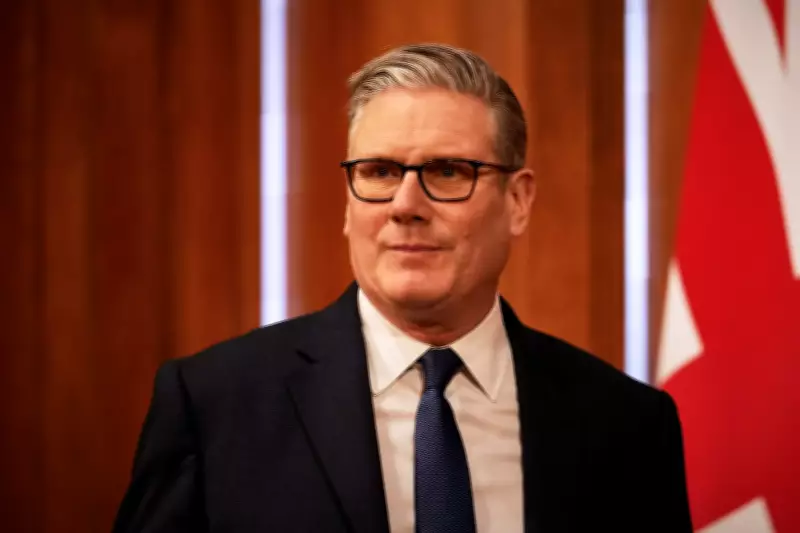
Prime Minister Sir Keir Starmer has outlined a significant policy shift toward building closer economic and security ties with the European Union, a move that comes directly in response to President Donald Trump's renewed threats to withdraw the United States from the NATO alliance. During a Wednesday press conference, Starmer positioned this diplomatic realignment as a crucial component of his government's broader strategy to alleviate the persistent cost-of-living crisis affecting British households.
Strategic Response to International Uncertainty
Starmer explicitly framed his government's approach as offering "clear and calm leadership" through diplomatic channels during a period of global instability. He announced that Foreign Secretary Yvette Cooper will soon host a high-level meeting with leaders from European and Gulf nations to address critical security concerns regarding shipping routes through the strategically vital Strait of Hormuz. The Prime Minister cautioned that any efforts to reopen these crucial trading corridors "will not be easy," underscoring the complex geopolitical challenges at hand.
Beyond Brexit: A New Economic Vision
The Prime Minister used the platform to advocate for a substantive reevaluation of the UK's post-Brexit relationship with Europe, arguing that the departure from the EU had inflicted "deep damage" on the British economy. "The UK will not just ratify existing commitments made at last year's summit," Starmer declared. "We want to be more ambitious. Opportunities to strengthen our economy, and the opportunities to strengthen our security and cut the cost of living, are simply too big to ignore."
Starmer emphasized that this policy direction extends beyond mere transactional diplomacy. "We have to go beyond just a numbers game," he stated, suggesting that enhanced collaboration with European partners could ultimately lead to improved relations with the United States as well. He referenced consistent calls from successive U.S. presidents for Europe to assume greater responsibility for its own defense and security, noting, "I have long argued that we should be doing more. That is not just on defense spending. It is also on how we spend, how we collaborate and co-operate."
Navigating Trump's NATO Provocations
The Prime Minister's policy announcement was partially overshadowed by a contemporaneous report in The Telegraph, which quoted President Trump declaring he was "considering" a withdrawal from NATO and derisively labeling the alliance a "paper tiger." Trump added, "And Putin knows that too, by the way," directly linking his skepticism of the alliance to perceptions of Russian strength.
When pressed on these provocative comments, Starmer offered a firm rebuttal. "Whatever the pressure on me and others – whatever the noise – I am going to act in the British national interest in the decisions I make," he asserted, refusing to be drawn into a direct confrontation while reaffirming his commitment to sovereign decision-making.
Domestic Focus: Easing the Burden on Families
Despite the international focus, Starmer consistently redirected attention to his government's domestic agenda, particularly efforts to reduce living costs. He highlighted specific energy bill measures and benefits changes stemming from the recent Budget, which are set to take effect this week. Chancellor Rachel Reeves elaborated on this approach, explaining that the government's support would be "targeted" and based on household income rather than applying a universal, blanket subsidy.
This represents a deliberate departure from the strategy employed by the previous Conservative government, which spent an estimated £40 billion to subsidize energy bills following the gas price shock triggered by Russia's full-scale invasion of Ukraine. "I want to learn the lessons of the past because when Russia invaded Ukraine, the richest, the best-off third of households got more than a third of the support. That makes no sense at all," Reeves stated. "We're looking at ways in which we can support people based on their household income."
The Chancellor did not disclose the projected cost of the new support scheme and indicated that any implementation would likely not occur until the autumn. This timeline coincides with concerning forecasts from energy consultants, who predict the Ofgem energy price cap could surge by approximately 18 percent after June, with bills expected to remain frozen until September. The current household energy price cap, effective from today until July, will remain insulated from recent fluctuations in international markets.
Opposition parties have intensified their calls for more immediate and robust government action. Reform UK's finance spokesman, Robert Jenrick, argued that people are "suffering" now and urged the administration to adopt a stronger, more responsive stance to the ongoing economic pressures facing the nation.




