
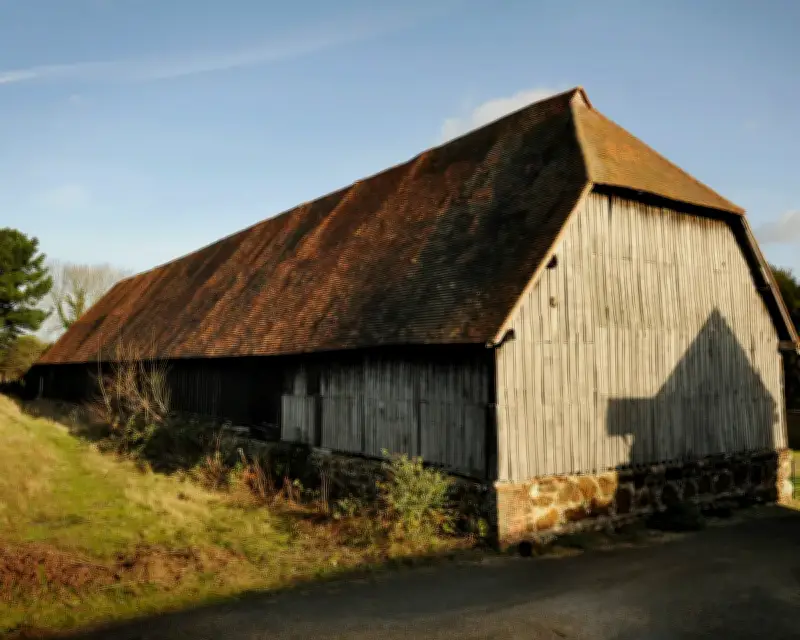
Campaigners are warning that England's largest surviving medieval timber-framed barn, the 600-year-old New Barn at Harmondsworth, could be "shaken to pieces" by vibrations from aircraft if Heathrow airport's expansion goes ahead. The public has until 1 September to submit objections to the expansion plans, which could threaten the barn's survival.
The barn, built in 1426, was purchased by English Heritage in 2011 and is considered a remarkable example of medieval architecture. Its significance lies in its extraordinary scale and the near-complete survival of its structural timbers.
The Barn's Historical Significance
The New Barn is nearly 60 metres long, 12 metres wide, and 11 metres tall, with 13 massive oak trusses supporting the roof. Former poet laureate Sir John Betjeman described it as a "cathedral," struck by its size and atmosphere. The barn was constructed to store agricultural produce exactly 600 years ago, on land bought in 1391 by the then bishop of Winchester.
Justine Bayley, English Heritage's former archaeological scientist and chair of the Stop Heathrow Expansion campaign, told the Guardian that the extended airport boundary would be only a few hundred metres from the barn. She said the structure "could be shaken to pieces by the vibrations from airplanes taking off."
Threat from Vibrations
Bayley emphasized the barn's unique authenticity: "Its structural timbers are more than 95% original. Most of the big medieval barns and other large timber-framed buildings have been repaired, and you're lucky if 50% of the original timbers are there." She questioned whether the barn would "still be here" if the third runway proceeds.
The government is currently consulting on amendments to the Heathrow expansion national policy statement, with Heathrow airport also running its own consultation later this year. Bayley criticized the Department for Transport's declaration of Heathrow as critical national infrastructure, arguing it allows environmental and climate legislation to be "ridden roughshod over." She noted the expansion "bulldozes two villages and makes another two or three uninhabitable."
Local Residents' Concerns
Christian Hughes, whose Longford home is slated for demolition, described the vibrations: "We can actually feel planes departing before we can hear them. The low frequency is so bad. My house is 200 years old. Longford has houses that date back to the 1600s and even older. They'll be demolished as well. It's criminal." He fears for the barn's survival, noting a relatively new house in a nearby hamlet has developed "significant cracking" from aircraft vibrations.
Marian Campbell, art historian and former curator at the Victoria and Albert Museum, called the barn "an exceptionally rare survival," noting that documents tell us exactly when it was built, where the trees came from, and who paid for it.
Consultation and Response
A Heathrow spokesperson said the company will "continue to listen to and work with our local communities," adding that the Development Consent Order process will examine potential impacts and necessary mitigations. English Heritage and the Friends of the Great Barn at Harmondsworth are hosting a conference in the barn and adjacent church of St Mary on 5 September, featuring papers on the barn's construction and recent archaeological investigations.
A Department for Transport spokesperson stated that "views on the potential impacts of expansion – including on the environment, heritage sites and neighbouring communities – will be carefully considered as part of our consultation before any final decisions are taken."




