
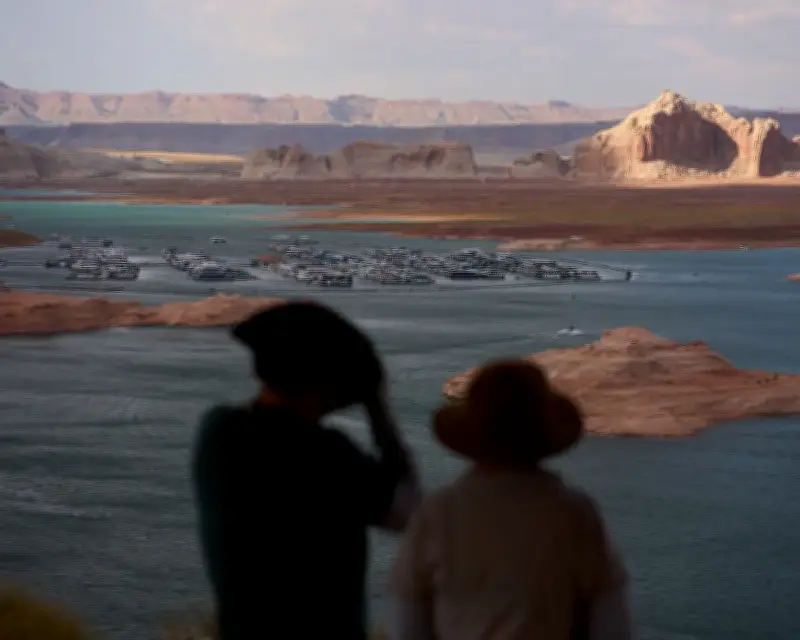
The US Bureau of Reclamation has released a long-awaited 10-year plan to govern the Colorado River, mandating water cuts of up to 40% for California, Arizona, and Nevada, but experts say the blueprint is a stopgap that won't resolve the crisis.
The plan, made public on Friday, sets operating guidelines for the river's lower basin, with mandatory reductions of 1.25 million acre-feet in 2027 and 2028, and the potential for larger cuts depending on conditions. The previous framework expires in October.
Plan details and immediate cuts
Under the new federal framework, the lower-basin states could collectively lose up to 3 million acre-feet of water per year, roughly 40% of their supply. One acre-foot, enough to cover a football field one foot deep, equals about 326,000 gallons (1.2 million liters), sufficient for three families for a year.
The document doesn't specify how the cuts will be distributed among the states. The plan also incentivizes conservation by allowing water users to store conserved amounts in federal reservoirs for future use, potentially encouraging up to 200,000 acre-feet of savings from upper-basin states.
Experts call it a stopgap
Noah Garrison, a water researcher at UCLA's Institute of the Environment and Sustainability, said, "This just kicks the can down the road." He added, "There is a potential for extremely serious consequences if we don't address this. We're putting the water supply for 40 million people at risk."
Dr John Berggren, regional policy manager at Western Resource Advocates, said, "In order to best protect the system, there needs to be pretty significant shortages. We're going to have to do more." More than 3 million acre-feet of cuts are needed to bring the basin into balance, an amount equal to more than a quarter of its annual average flow.
Historical context and current crisis
The Colorado River supplies roughly 40 million people across seven states, dozens of Indigenous tribes, and two countries, irrigating 5.5 million acres of farmland. The river has been overdrawn for over a century, with an outdated 1922 compact allocating more rights than available water. Since 2020, average flows have dropped by 32% compared with the last century.
Lake Powell and Lake Mead recently fell to their lowest combined levels since Lake Powell was built. At the start of summer, Lake Powell's water line hovered just 37 feet above the point where Glen Canyon Dam would fail to generate hydroelectric power for nearly 6 million households and businesses. A "deadpool" would be catastrophic.
Dr Jack Schmidt, director of the Center for Colorado River Studies at Utah State University, warned, "If we have another mediocre year of runoff – not an excessively low year, just a mediocre year – we'd go over the cliff." Brad Udall, a senior water and climate research scientist at Colorado University, said, "El Niño is not gonna save our bacon here," noting that a century of data shows no strong connection between El Niño's strength and water supplies.
State reactions and legal threats
JB Hamby, chair of the Colorado River Board of California, said in a statement, "This is a bridge, not a permanent solution. Three states cannot carry the responsibility of all seven." Bill Hasencamp, manager of Colorado River resources for the southern California metropolitan water district, told Cal Matters, "We need to plan for our future. And this deal does not let us do that."
Arizona Governor Katie Hobbs said some federal options were unacceptable, and Nevada Governor Joe Lombardo promised to fight "any outcome that imposes unreasonable impacts" on his constituents. Amy Haas, executive director of the Colorado River Authority of Utah, warned in a Senate committee hearing that lawsuits could tie up decisions for decades, with states preparing to sue each other.
Rhett Larson, a professor of water law at Arizona State University, said, "By this September or October, there's going to be a pretty compelling argument from the lower basin that the upper basin hasn't met its delivery obligation." Legal disputes would center on whether the upper basin is responsible for climate-related supply losses, with conflicts likely to go to the US Supreme Court.
Experts agree the federal plan is a starting point, not the final word. Garrison said, "We are going to have to at some point agree on reductions in supply across the seven basin states, and we have absolutely not been able to do that. But even more, we need to look at ways to maximize water supply, and that's going to require a host of solutions." He pointed to increasing recycled water use and setting new price signals for large water users. "Otherwise, in two years, we're going to be right back where we started – if not sooner."




