
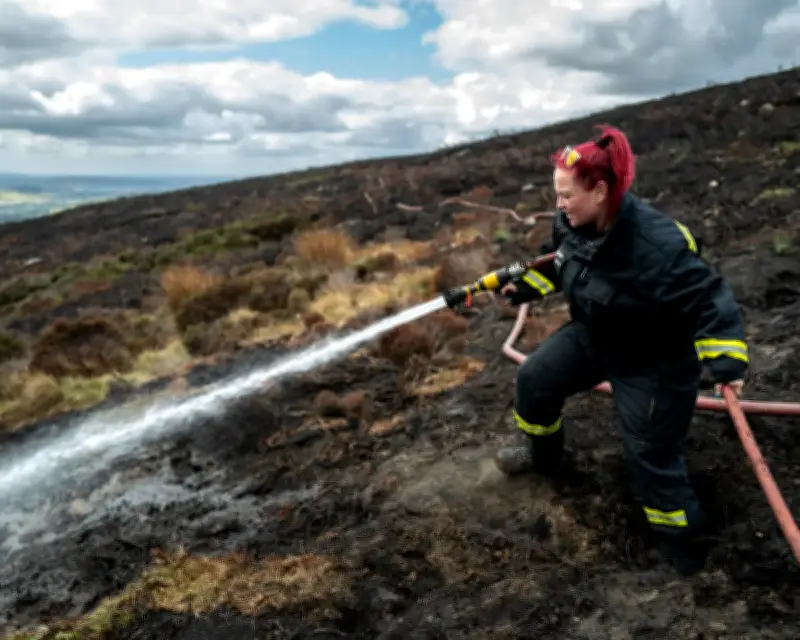
The Fire Brigades Union (FBU) has warned that firefighters across the UK are under increasing pressure from an 'unprecedented summer of dangerous and volatile wildfires', as the country braces for a fifth heatwave of the year. With almost three-quarters of England now officially in drought, the union is calling for a 'national priority' to ensure crews are properly equipped to face these growing threats.
Steve Wright, the FBU general secretary, said the unpredictable environmental challenges now confronting the UK mean it is essential to have enough well-equipped firefighters ready to respond. His comments come as more than 120 firefighters continue to battle a blaze in the New Forest national park in Hampshire, which began on Sunday, and as Nottinghamshire fire and rescue service declared a major incident due to two large woodland fires near Mansfield.
London fire brigade sees 31% surge in emergency calls
An internal briefing seen by the Guardian reveals that emergency calls to the London Fire Brigade (LFB) have increased by almost a third this summer, as firefighters grapple with a surge in wildfires and flooding. Between 1 April and 9 July, the service received 75,652 emergency calls – 31% more than the previous five-year average – while the number of incidents rose by nearly a quarter to 42,943. London firefighters responded to 392 wildfires and 68 water rescues during this period, with repeated spells of hot weather and heavy thunderstorms stretching resources.
The climate breakdown is linked to the increasing frequency of wildfires worldwide, and the UK is experiencing its most widespread 'fire wave' ever recorded. Recent large blazes have occurred in Dunwich Heath in Suffolk, Headon Warren on the Isle of Wight, Llanwonno in the Rhondda valley, and the Cairngorms national park in Scotland.
Drought declared across 71.3% of England
The National Drought Group, which met on Monday, said 71.3% of England is now experiencing a 'flash drought', a rapid-onset condition caused by very low rainfall and high temperatures. Approximately 45 million people live in drought-affected areas, and more than 27 million are under water use restrictions. The group warned that all regions face pressure on water resources, impacting agriculture, public supplies, navigation, and the environment.
Tony Grayling, chair of the National Drought Group, said: 'Drought conditions are worsening and will continue to do so until we see significant and sustained rainfall. We know the hot and dry weather is taking a real toll on farming and there will be long-lasting impacts on our environment.' He urged everyone to reduce water usage to help preserve reserves.
Government response and long-term resilience
A No 10 spokesperson acknowledged the dry conditions are having a 'significant impact on communities, farmers and businesses', adding: 'Our climate is changing. Droughts are becoming more common.' The government is focused on both immediate response and long-term resilience, working through the National Drought Group to protect water supplies and minimise environmental damage. However, the spokesperson did not specify what would constitute a national emergency.
Joanne Smith, LFB's deputy assistant commissioner for control and mobilising, said the service has responded to thousands of emergency calls and 'hundreds of wildfires alongside water rescues and other significant incidents across the capital'. She noted: 'We have learned from previous events such as the summer of 2022 and developed our training for firefighters and officers to enhance their knowledge of tactical awareness at wildfires. We've invested in new equipment and training to help tackle wildfires, and we will continue to evolve so that we are ready and prepared for future summers.'
FBU calls for increased funding and staffing
Steve Wright called for 'increased funding, improved access to the best equipment and better national resilience' to meet rising demands. He added: 'Our country is facing unpredictable environmental challenges, and it must be a national priority to ensure we have enough properly equipped firefighters ready to face these threats.' Wright has previously highlighted that there are 12,000 fewer firefighters in the UK today than in 2010, due to staffing cuts.
In Hampshire, hundreds of people had to abandon their vehicles and walk after Sunday's wildfire, caused by a van fire on the A31 near Ringwood, spread to New Forest heathland, affecting an area the size of 140 football pitches. Twenty-six fire engines and four water carriers were initially called, later scaled down to 10 engines and 13 off-road vehicles. Hampshire fire and rescue said on Monday: 'There are more than 120 firefighters on the scene battling the heat and arduous terrain in order to prevent further fire spread. We are monitoring the fire, which is affecting a 1 square kilometre area of heathland off the A31, with police drones.'
Heat warnings and record-breaking temperatures
Amber heat health alerts have been issued for several regions, including the East Midlands, West Midlands, east of England, Yorkshire and the Humber, London, the north-west, south-east, and south-west, while a yellow alert covers the north-east from Tuesday 9am until Friday 9pm. The Met Office expects temperatures to exceed 36C later in the week, peaking on Thursday. England and Wales experienced their driest July since records began in 1836, with 19 English counties seeing no rain at all in July. Southern England had its hottest July on record, and Wales had its joint hottest July, while England and the UK overall had their second hottest July.
A spokesperson for the mayor of London said: 'The prolonged, extreme heat is presenting incredible challenges for our emergency services, with a huge rise in demand.' They added that the mayor has provided record funding to ensure LFB is better equipped and to improve training.




