
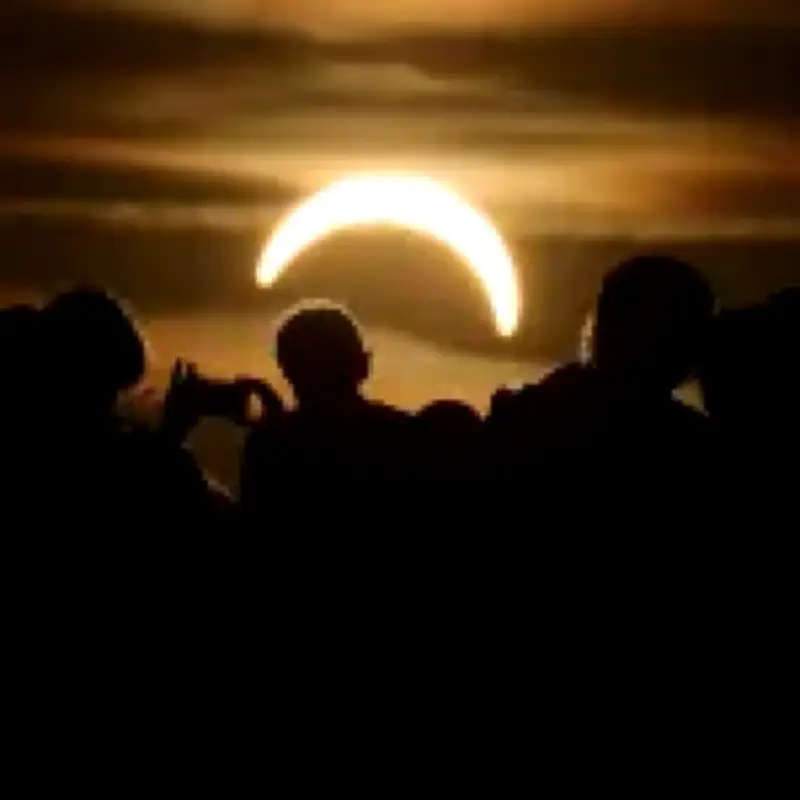
Hundreds of people in the UK have been searching online for 'eye injury' after experts warned against watching the solar eclipse without protective eyewear. Google Trends data shows that searches for the phrase 'eye injury' skyrocketed from 6pm, just as the moon began to slide in front of the sun, with a 5,000% increase compared to the day before.
'Eclipse eye injury' has become a breakout query, and searches for 'eyes hurt' also saw a similar uptick of around 5,000%, peaking at 100 people searching at 7.08pm, around the peak of the partial solar eclipse. The surge comes as skywatchers across the UK turned their gaze upward to witness the moon taking a massive bite of the sun for the first time in three decades.
Eclipse burn: Symptoms and risks
Experts previously warned that symptoms of eclipse burn – when leftover sunlight singes a hole in the cornea, which detangles light into nerve signals – can take hours or even days to appear. Damage can occur in less than a minute, as people see a sunspot carved into their vision in the shape of the sun's crescent-shaped edges.
This burst of intense light, called solar retinopathy, isn't always painful, meaning people may not even realise they have injured themselves at first. Within a few hours, experts say people may see black dots and their eyes becoming watery and sensitive to light. Blind spots may loiter in the centre of their visions, with patients saying they struggle to read and objects appear distorted and blurred.
Long-term effects and treatment
Usually, the symptoms resolve, yet it may take several weeks to a year. Blind spots, however, have lingered for years in some cases. Researchers have found this is because the light injures the macula, a small yellow part of the back of the eye that helps see colours and detail. No treatment can reverse the scarring caused by solar retinopathy.
Eclipse glasses, also called solar viewing glasses, are cardboard frames with a special film in the eyeholes that filters out harmful rays. These rays are ones that are mostly visible to humans, such as ultraviolet or infrared light, which is why sunglasses don't cut it.
Protective measures and guidance
Even though just a sliver of the star was left during the eclipse, looking at it without protective eyewear can still cause injury. Experts had issued urgent warnings ahead of the event, including advice to avoid watching the eclipse through a phone's selfie camera, as this can also pose risks to eye health.
As the UK continues to process the aftermath of the celestial event, health officials and optometrists are urging anyone who experienced symptoms such as blurred vision, blind spots, or eye discomfort to seek medical advice promptly. The surge in online searches highlights the widespread concern among the public about potential eye damage following the rare phenomenon.




